
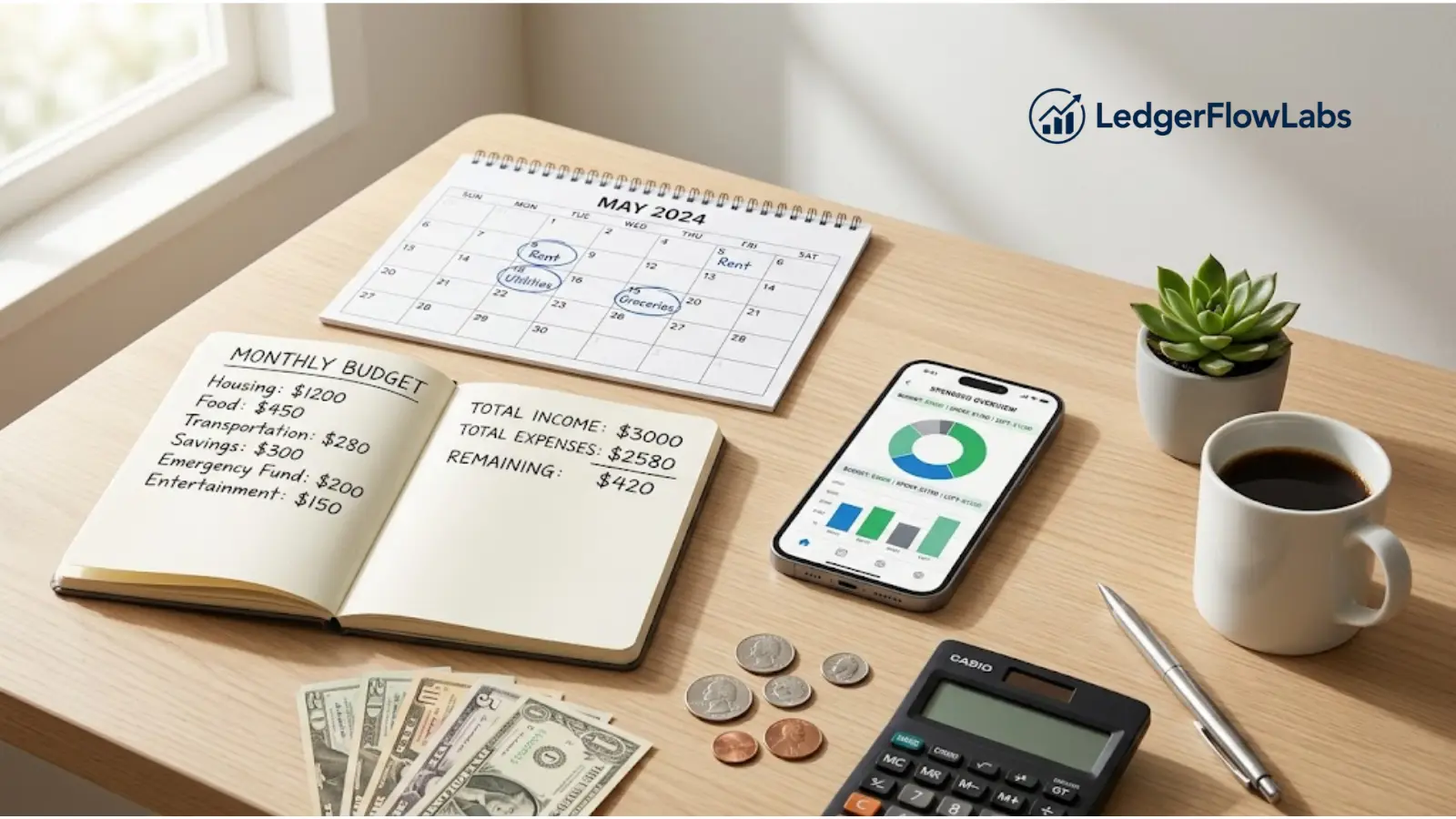
Budgeting for beginners means one simple thing: giving every dollar you earn a plan before you spend it. A budget is just your income, minus your expenses, with the leftover money assigned on purpose instead of by accident. You do not need software, a finance degree, or a high income to start. You need three things: a number for what comes in, a list of what goes out, and a method for handling the gap. This guide explains what budgeting actually is, walks you through the common methods in plain English, and helps you pick the one that fits how you think, so you can stop wondering where your money went.
This is educational information, not financial advice. For decisions about your own situation, consult a licensed financial advisor.
What budgeting actually means (in plain English)
A budget is a plan for your money. That is the whole idea. It is not a punishment, a spreadsheet you have to love, or a promise to never enjoy anything again. It is simply a decision you make in advance about where your money should go, made once so you do not have to make it a hundred small times during the month.
Here is the mechanism. Every month, a certain amount of money comes in. A certain amount goes out. Without a plan, the money that goes out is decided by whatever feels reasonable in the moment: a coffee here, a subscription you forgot about there, a "treat yourself" purchase on a hard day. Each choice feels small. Added up, they decide your whole month for you. A budget takes that decision back. You choose where the money goes first, then spend against that choice.
That is why the same budget can feel freeing to one person and restrictive to another. The rules did not change. The framing did. A budget is permission to spend, not just a rule about not spending.
Why a budget matters more than your income
There is a belief that quietly runs most beginners' money lives: "I would be fine if I just earned more." It feels true. It is usually only half true.
The founder of Ledger Flow Labs started tracking his money for the first time not because he was broke, but because he could not explain where it went. The answer, once the numbers were on paper, was uncomfortable and ordinary: small impulse purchases, repeated often, quietly drained the month. Nothing dramatic. No single villain. Just a pattern that never showed up until it was written down. The lesson generalized into the principle this whole site is built on: financial discipline matters far more than how much you earn.
Here is why that holds. Income raises the ceiling on what you can spend. Habits decide how much of it you keep. Someone who earns more but has no plan simply loses more, at a higher volume, and often feels just as stretched. A budget is how you close the gap between what you make and what you keep, and that gap, not your salary, is what actually builds a cushion.
If you want the wider set of habits a budget sits inside, our overview of 7 simple money-management habits for beginners puts budgeting in context alongside saving, tracking, and avoiding unnecessary debt.
The 3 things every budget needs
Strip away every method and every app, and a budget is only ever three parts. Get these three right and the format barely matters.
- Income. The money you actually take home, after tax, in a normal month. Use your take-home pay (the amount that lands in your account), not your gross salary. Budgeting against gross pay is the single most common beginner error, because you plan to spend money that was never yours to spend.
- Expenses. Everything that leaves your account. This includes the obvious fixed costs (rent, utilities, loan payments) and the slippery variable ones (food, transport, "just this once" purchases). The variable expenses are where budgets are usually won or lost, because they are the ones you can actually influence.
- A plan for the gap. Income minus expenses leaves a number. If it is positive, the plan decides where that surplus goes (savings, debt, goals) instead of letting it evaporate. If it is negative, the plan tells you which expenses to adjust. A budget is not finished until this third part exists. Income and expenses just describe your situation. The plan is the budget.
Notice what is not on this list: a specific app, a specific rule, a specific dollar amount. Those are preferences. These three are the structure.
Common budgeting methods, and who each one suits
Most guides push one method as "the" method, usually the one that suits the person who wrote it. That is the wrong way to choose. A budgeting method is a tool, and the right tool depends on how you think about money and how much effort you want to spend managing it. Here is a fair comparison of the three most common approaches.
| Method | Core idea | Effort | Best for |
|---|---|---|---|
| 50/30/20 | Split take-home pay into needs, wants, savings | Low | People who want a simple, ready-made framework |
| Zero-based | Assign every dollar a job until nothing is left over | High | People who want total, deliberate control |
| Pay-yourself-first | Move savings out first, spend what remains | Low | People whose main goal is building savings |
The 50/30/20 rule (best for: keep it simple)
The 50/30/20 rule splits your after-tax income into three buckets: 50% for needs, 30% for wants, and 20% for savings and debt repayment. It is popular because it is easy to remember and requires almost no tracking to start. The framework was popularized by Elizabeth Warren and her daughter Amelia Warren Tyagi in their 2005 book "All Your Worth: The Ultimate Lifetime Money Plan," as reported by the authors in that book. The percentages are a starting guideline, not a law, and many people adjust them to fit their real costs. If a clean, low-effort structure sounds like you, read our full walkthrough of how the 50/30/20 rule works, with a real example.
Zero-based budgeting (best for: total control)
Zero-based budgeting means giving every single dollar a job until your income minus your assignments equals zero. It does not mean spending everything. Savings and debt payments are "jobs" too. The point is that no dollar is left undirected, so nothing slips through the cracks. It is the most powerful method for people who like control, and the most demanding, because it asks you to plan intentionally each month. If "every dollar has a job" appeals to you, our guide to zero-based budgeting for beginners breaks it down step by step.
Pay-yourself-first (best for: savings-focused)
Pay-yourself-first flips the usual order. Instead of saving whatever is left at the end of the month (which is often nothing), you move your savings amount out the moment income arrives, then live on the rest. It is less a full budgeting system and more a savings-first habit you can bolt onto any method. It suits people whose biggest struggle is that saving keeps losing to spending. Our dedicated guide on pay-yourself-first budgeting separates the ordering rule from the amount question, since the two get confused constantly.
The cash envelope method (best for: hands-on control of specific categories)
Rather than a full system, the envelope method targets your most overspent categories directly: withdraw cash for groceries, dining out, or personal spending, divide it into labeled envelopes, and stop spending in that category once the envelope is empty. It layers on top of any of the methods above rather than replacing them, since fixed bills still get paid the normal way. Our full guide on the envelope method, explained without the apps covers which categories it fits and a tool-free version for anyone who does not want to carry cash.
How to choose the method that fits you
Do not choose the method with the best reviews. Choose the one you will actually keep using. Two honest questions decide it.
First: how much effort are you willing to spend each month? If the answer is "as little as possible," start with 50/30/20 or pay-yourself-first. If the answer is "I want to see and control everything," zero-based budgeting rewards that effort.
Second: what is your main problem right now? If your problem is that you have no structure at all, a percentage rule gives you one instantly. If your problem is that money vanishes with no trace, zero-based makes every dollar visible. If your problem is specifically that you never manage to save, pay-yourself-first attacks that directly.
There is no permanent choice here. Most people start simple, learn what their money actually does, and tighten the method later. Starting with the "wrong" method beats waiting for the perfect one.
Ready to build one?
Understanding budgeting and choosing a method is the thinking part. The doing part is its own task, and it is shorter than you expect. When you are ready to sit down and actually build your first budget in one session, follow our step-by-step guide to building your first monthly budget. It walks through the exact order: calculate income, list expenses, apply your chosen method, and set up tracking, so you finish with a working budget rather than a good intention.
What a budget is NOT
Beginners often quit budgeting because of what they think a budget is, not because of what it actually is. Clearing up three myths removes most of the resistance.
- A budget is not deprivation. Building in money for things you enjoy is not a failure of discipline. It is what makes a budget survivable. A plan with zero room for fun is a plan you will abandon by week two.
- A budget is not perfection. You will overspend a category. You will forget an expense. That is normal and it is not a reason to scrap the whole thing. A budget is a draft you revise, not a test you pass or fail.
- A budget is not forever-rigid. Your numbers should change when your life changes. A raise, a move, a new expense: the budget adjusts to fit reality, not the other way around.
Budgets fail for predictable, fixable reasons, and knowing them in advance is half the battle. Our guide to why budgets fail and the common beginner mistakes covers the traps that quietly sink a first attempt, from budgeting on gross income to forgetting irregular annual costs.
Deep Dives: Every Budgeting Basics Guide
Budgeting for beginners is the overview. Each question below has its own dedicated guide, in the order most beginners actually need them.
- The 50/30/20 rule explained, with a real example
- Zero-based budgeting for beginners
- How to build your first monthly budget, step by step
- Why budgets fail: 8 beginner mistakes and fixes
- Needs vs wants: classifying your own spending honestly
- Gross or net: which income number to budget from
- The envelope method, explained without the apps
- Pay-yourself-first: the ordering rule, not a savings lecture
- Sinking funds vs emergency funds: two different jobs
- How much should an emergency fund be?
- Budgeting as a couple: splitting, pooling, or both
- What to do at the end of month one
FAQ
Do I need a budget if I do not earn much? Yes, and arguably more so. A budget is not about having extra money to manage. It is about directing the money you do have so it lasts and does some of what you want. Lower income leaves less room for waste, which makes a plan more useful, not less. This is a principle, not a judgment on anyone's situation.
How long does making a first budget take? For a first draft, usually under an hour once you have your income figure and a rough list of expenses in front of you. It is not permanent or precise on day one. You are creating a working starting point, then refining it over the next month or two as you see what your real spending looks like.
Which budgeting method is best for beginners? There is no single best one, because it depends on your personality and your main problem. If you want simplicity, the 50/30/20 rule is the easiest to start. If you want control, zero-based budgeting is the most thorough. If saving is your specific struggle, pay-yourself-first targets that. The best method is the one you will keep using.
Should a budget include savings? Yes. Savings is a spending category, not a leftover. Building it into the plan (rather than hoping money survives to the end of the month) is exactly what the pay-yourself-first approach is designed to do, and every method above can include a savings line.
Is a budget the same as tracking my spending? No, they are two halves that work together. A budget is the plan you make in advance. Tracking is checking what actually happened against that plan. The budget sets the target; tracking tells you whether you hit it and where to adjust next month.
Ledger Flow Labs publishes plain-English, noise-free money guidance for beginners. This article explains general principles only and is not financial advice. For decisions about your own money, consult a licensed financial advisor.