
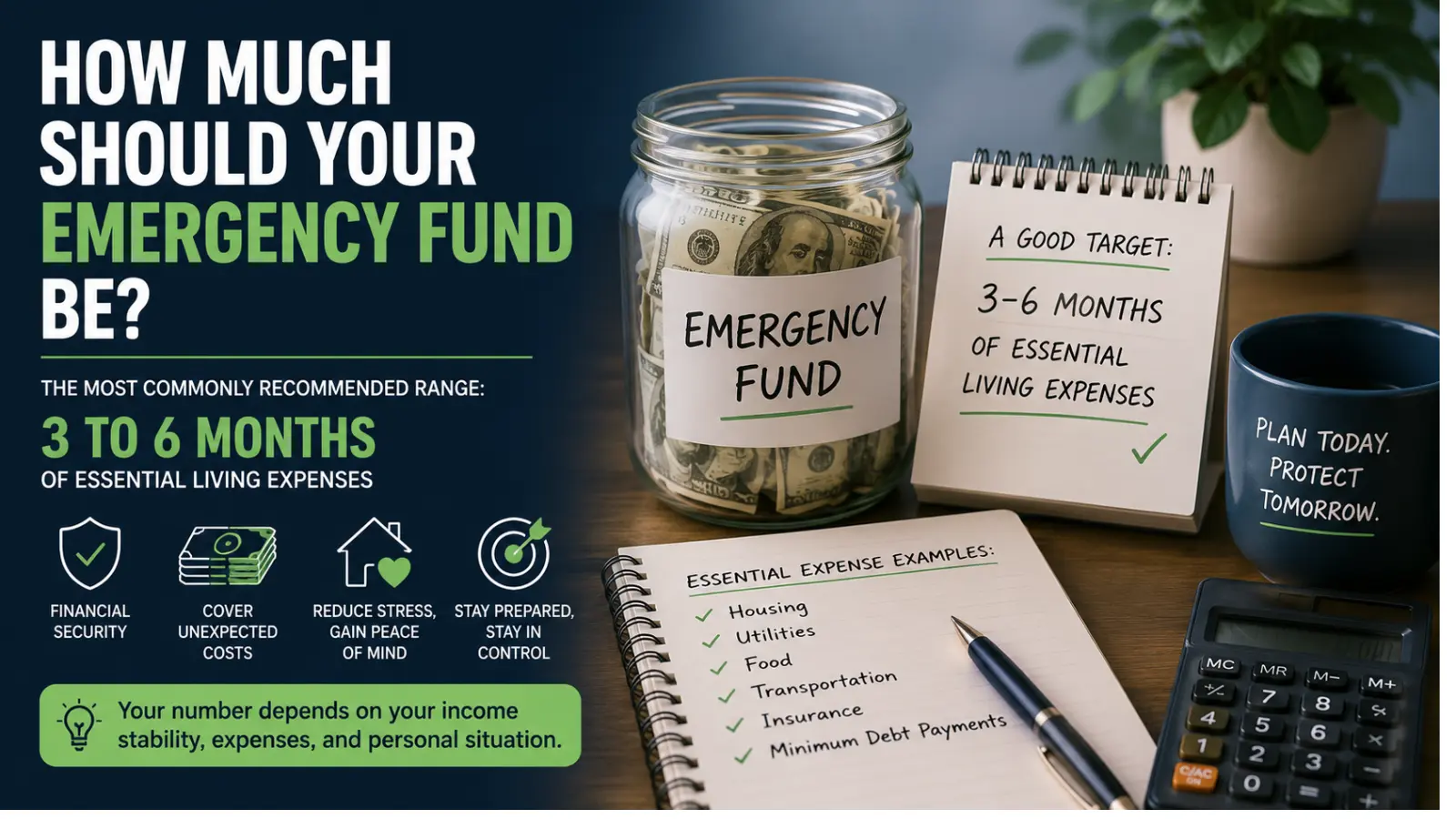
The most commonly cited range for an emergency fund is 3 to 6 months of essential living expenses, with some financial institutions citing up to 9 months for less stable situations. As reported by Chase and NerdWallet, the exact right number for you depends on how stable your income is, whether others depend on your income, and whether you have other assets you could draw on in a pinch. There is no single correct figure, and any source claiming otherwise is oversimplifying a genuinely personal calculation.
This is educational information, not financial advice. For decisions about your own money, consult a licensed financial advisor.
A note on where this applies: this guide is written for US readers, and the ranges cited come from US financial institutions commenting on typical American households. Your own target should come from your actual monthly essential costs, not from a published range.
The commonly cited range: 3 to 6 months of expenses
As reported by Britannica Money and Ally, most financial guidance settles on 3 to 6 months of living expenses as the baseline range for a fully built emergency fund. Wells Fargo and Vanguard note that some situations justify going further, up to 9 months, for households with less stable income or fewer other resources to fall back on.
The range exists because "enough" genuinely depends on circumstances, not because nobody has settled on a number. A person with a stable salaried job, no dependents, and other savings needs less cushion than a freelancer supporting a family with no other assets. Both are following the same principle; they land in different places within it.
Why the range is a range: three questions that move you within it
Rather than picking a number arbitrarily, three questions, drawn from the reasoning several institutions cite, help place you inside the range.
How stable is your income? As reported by Experian, someone with high job security and predictable income can reasonably lean toward the lower end of the range, around 3 months. Someone with variable income, contract work, or a less secure position is generally better served leaning toward 6 months or more, because the fund needs to absorb a longer gap if income stops.
Does anyone else depend on your income? Wells Fargo notes that supporting dependents, whether children or other family members, generally argues for a larger cushion, since the consequences of a gap in income extend beyond one person.
Do you have other assets you could realistically access? As reported by Britannica Money, someone with other liquid assets or resources they could draw on after a short period may reasonably target the lower end of the range, while someone without any other financial cushion should lean toward the higher end.
Answer these honestly and you land somewhere inside 3 to 6 months (or beyond it, per Wells Fargo and Vanguard's guidance for less stable situations) rather than guessing.
The starter-fund idea, for anyone starting from zero
If the full 3-to-6-month target feels miles away, several financial sources, including guidance popularized by Ramsey Solutions, recommend a smaller starter goal first, often cited around $1,000, before working toward the full range. The logic: a small starter fund absorbs the most common minor emergencies (a car repair, an unexpected bill) so you are not immediately forced back into debt while you build toward the larger target over time. This starter figure is a commonly cited example, not a claim about what is sufficient for every household; treat it as a first milestone, not a finish line.
What counts as "expenses" in this calculation
The months-of-expenses calculation is meant to cover essential, needs-level spending if income stopped, not your full current spending including discretionary wants. As reported by NerdWallet, this typically means housing, utilities, groceries, insurance, minimum debt payments, and other genuinely required costs, the same categories our guide to needs versus wants helps you separate out. Multiply your honest monthly needs total by the number of months you land on from the three questions above, and that is your target.
A worked example, to make the math concrete
Numbers help, so here is a fully hypothetical calculation, not a claim about any real person's expenses. Imagine a reader whose genuine monthly needs, the essential categories covered earlier, add up to $2,200: rent, utilities, groceries, insurance, transportation, and minimum debt payments. Running through the three questions above, imagine this reader has a stable job but no other savings to fall back on and no dependents. That combination lands them roughly in the middle of the commonly cited range, around 4 to 5 months.
At 4 months, the target is $2,200 multiplied by 4, or $8,800. At 5 months, it is $11,000. The reader does not need to hit either figure overnight. Using the starter-fund idea covered above, they might work first toward a smaller cushion, then keep contributing through whatever ordering method they use, such as pay-yourself-first, until the fuller target is reached. The $2,200, $8,800, and $11,000 figures here are illustrative only, built to show the calculation, not a recommendation for what anyone's expenses or target should be.
Where this money is different from a sinking fund
It is worth repeating the distinction this cluster covers in more depth elsewhere: an emergency fund is for the expense you could not have predicted, sized in months of essential expenses as covered above. A sinking fund is for the expense you can see coming, sized to that specific known cost. Our guide to sinking funds versus emergency funds covers the full distinction and the gray-area cases where people mix the two up. Once you know roughly what you are building toward, the pay-yourself-first ordering rule is how the money actually gets there: moved out before spending, month after month, until the target is reached.
FAQ
Is 3 months enough, or do I need 6? It depends on your income stability, whether others depend on you, and whether you have other assets to fall back on. More stability and more backup resources generally support the lower end of the commonly cited range; less of either generally supports the higher end.
What is a starter emergency fund? A smaller initial goal, often cited around $1,000 in guidance popularized by Ramsey Solutions, meant to cover the most common minor surprises before you build toward the full 3-to-6-month target. It is a milestone, not a replacement for the larger goal.
Does the emergency fund need to be in a special type of account? It generally works best somewhere separate from your everyday spending account, so it is not accidentally spent, but still reachable within a day or two when you actually need it. A dedicated savings account at an FDIC-insured bank or an NCUA-insured credit union fits both requirements. This guide does not recommend a specific bank or product; the category matters more than the brand.
How is this different from a sinking fund? An emergency fund covers the unpredictable and is sized in months of essential expenses. A sinking fund covers a specific known cost and is sized to that cost, spread across the months until it arrives. They serve different purposes and both are useful.
What if my income is irregular, does the calculation change? Irregular income generally argues for leaning toward the higher end of the range, since a gap in income is harder to predict and can last longer without a fallback plan already in place. Base your monthly-expenses figure on your genuine needs, not on a strong month.
Reminder: this article explains general savings ranges cited by third-party sources, not personalized advice. For decisions about your own money, consult a licensed financial advisor.