
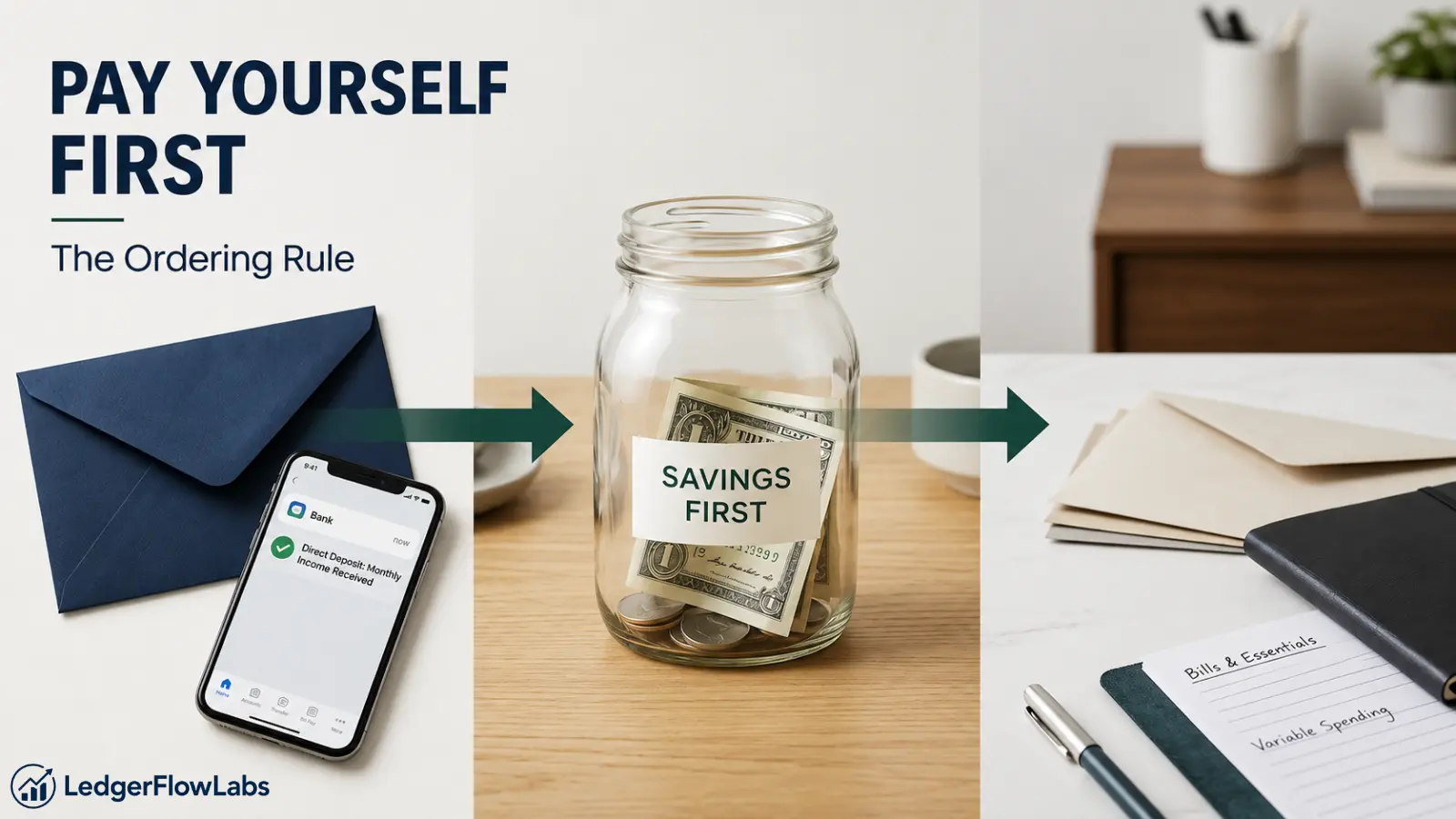
Pay-yourself-first means moving money into savings the moment your income arrives, before you spend on anything else, rather than saving whatever happens to be left at the end of the month. That is the entire rule. It is an ordering decision (savings goes first), completely separate from the amount decision (how much you save), which is where most people get stuck. You can pay yourself first with 2 percent of your income or 20 percent. The order is what makes it work, not the size of the number.
This is educational information, not financial advice. For decisions about your own money, consult a licensed financial advisor.
A note on where this applies: this guide is written for US readers, and the percentage ranges cited below come from US financial institutions. Treat them as general commentary rather than a target, since none of them know your rent, your debts, or your cost of living.
What pay-yourself-first actually means (an ordering rule)
Most people budget in the opposite order without realizing it: pay rent, pay bills, buy groceries, spend on everything else that comes up, and see what, if anything, is left over for savings. As reported by PNC, that leftover approach almost always produces the same result, which is little or nothing saved, because spending naturally expands to use whatever is available.
Pay-yourself-first flips the sequence. As reported by Citizens Bank, you treat your savings contribution like a fixed, non-negotiable bill, the same as rent, and move it out as soon as your paycheck lands, before discretionary spending has a chance to compete for it. Everything else in your budget gets built around what remains after that transfer, not the other way around.
Ordering vs sizing: two different decisions people conflate
This is the part almost every explanation skips past too quickly. "Should I save first?" and "how much should I save?" are two separate questions, and conflating them is what makes the whole idea feel unreachable for anyone on a tight income.
The ordering question has one honest answer: yes, if you can save anything at all, move it first, because money set aside before spending has already competed for is far more likely to survive the month than money you hope is left at the end. The sizing question has no single honest answer, because it depends entirely on your income, your fixed obligations, and your goals. You can apply the ordering rule at almost any size. A person paying themselves first with a small, consistent amount every month is following the same principle as a person doing it with a large one. Only the number differs.
How much is "right" (the range experts cite, and why it is a range)
As reported by Regions Bank and echoed by several other institutions, a commonly cited range is 10 to 20 percent of income, with guidance to start around 5 percent if that range feels out of reach right now and increase it over time as your situation allows. These figures are general commentary from financial institutions, not a universal formula, and none of them account for your specific rent, debts, dependents, or cost of living.
Treat the range as a direction to grow toward, not a bar you must clear on day one. The 50/30/20 rule, for comparison, fixes the savings-and-debt-payoff bucket at 20 percent of take-home pay as part of a full budget structure. Pay-yourself-first is the same underlying idea, an ordering principle, applied at whatever percentage genuinely fits your numbers, whether that happens to land near 20 percent or nowhere close to it yet.
What to do when the honest number is small, or zero, right now
Here is the section most bank pages skip because it does not fit a tidy percentage. If your honest number this month is small, or genuinely zero after real needs are covered, the ordering rule still applies at whatever size is true. Setting aside even a small, consistent amount first, and building the rest of your budget around what remains, is not a lesser version of pay-yourself-first. It is the same rule at a smaller scale, and a small habit that survives is worth more than a large target that gets abandoned in month one, a pattern our guide to why budgets fail covers in more detail.
If the honest number is zero some months, that is worth naming plainly rather than papering over. The fix at that point is usually revisiting the expense side of the budget first, particularly the line between needs and wants, rather than forcing a savings number that is not actually there yet.
Where the money goes once you pay yourself first
Paying yourself first answers when the money moves, not where it goes once it does. That destination matters and is worth deciding on purpose rather than by default: some of it may belong in an emergency fund for the unplannable, some in a separate fund for expenses you can see coming but that do not happen every month (a car repair, an annual bill), and some toward a longer-term goal. Those are genuinely different jobs for money, and worth understanding as separate rather than one undifferentiated "savings" pile.
Once you have the ordering habit in place, the rest of your first budget follows a fairly standard structure. Our step-by-step guide to building your first monthly budget walks through where a savings line fits alongside your other categories, and the budgeting for beginners overview compares pay-yourself-first against other common methods if you are still deciding which structure fits you.
FAQ
How much should I pay myself first?
Financial institutions commonly cite a range of 10 to 20 percent of income, with guidance to start around 5 percent if that feels out of reach and increase it over time. Treat this as a direction, not a fixed requirement, since it does not account for your specific expenses or cost of living.
What if I cannot afford to save anything right now?
The ordering rule still holds at whatever amount is honestly available, even if that is small. A small, consistent amount saved first is more durable than a larger target abandoned after one hard month. If the honest number is currently zero, it is usually worth reviewing your needs-versus-wants split before forcing a savings figure.
Is pay-yourself-first the same as the 20 percent in the 50/30/20 rule?
They share the same underlying idea, that savings should be planned rather than left over. The 50/30/20 rule fixes savings at 20 percent as part of a full budget structure. Pay-yourself-first is the ordering principle on its own, applied at whatever percentage genuinely fits your situation.
Does pay-yourself-first mean I need an automatic transfer set up?
It means the money moves before you spend, which many people accomplish with a transfer they initiate themselves right when they get paid. The mechanism you use to move the money is a separate, personal choice; the rule itself is only about timing.
Should I pay myself first even if I have debt?
Many approaches build a small savings habit alongside minimum debt payments rather than choosing one exclusively, but the right balance for a specific debt situation depends on the details (interest rates, amounts owed) and is worth discussing with a licensed financial advisor rather than following a generic rule.
Reminder: this article explains a general budgeting principle, not personalized advice. For decisions about your own money, consult a licensed financial advisor.