
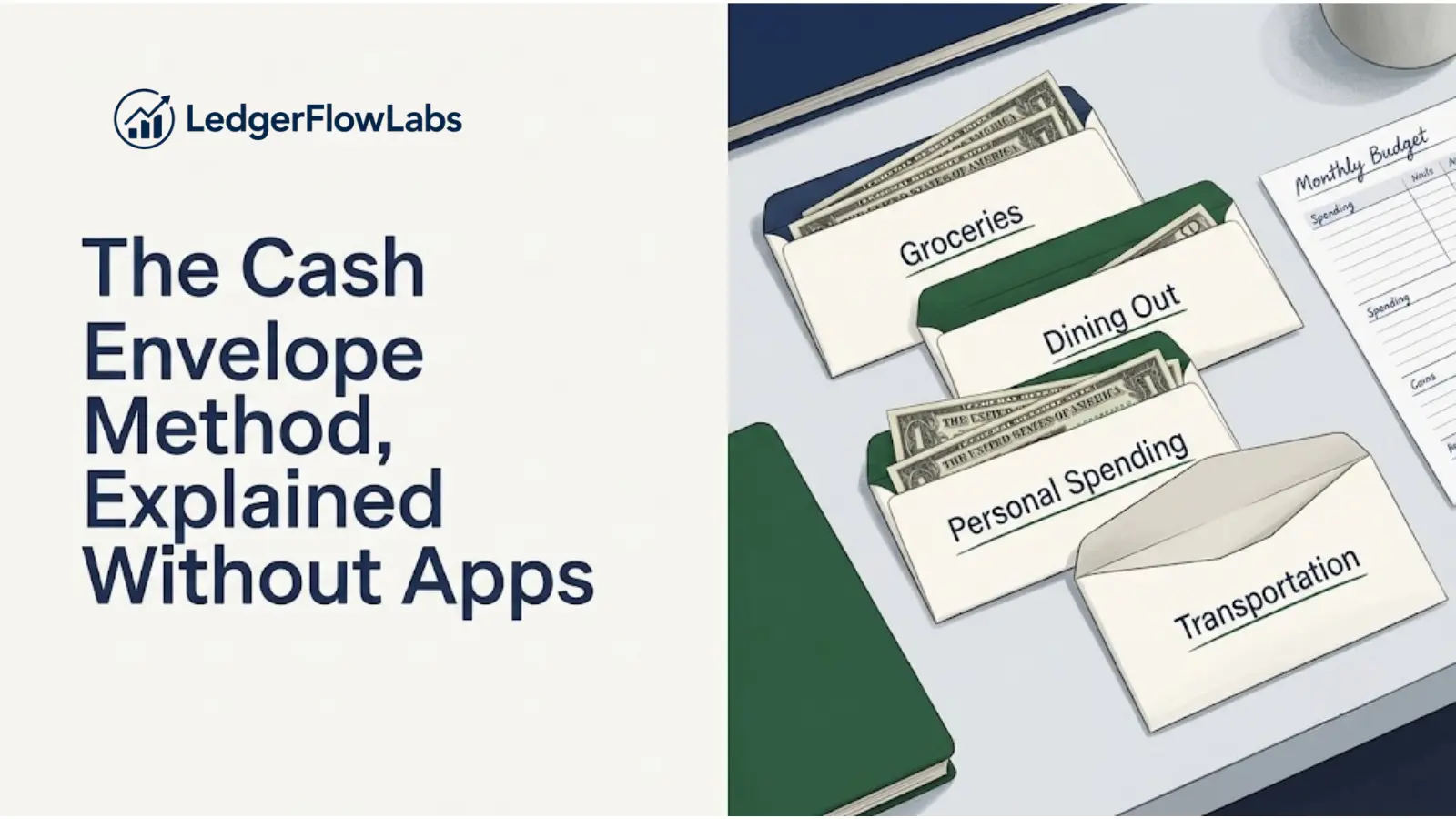
The cash envelope method works by withdrawing cash for your variable, discretionary spending categories (groceries, dining out, personal spending) and physically dividing it into labeled envelopes, one per category, at the start of each month or pay period. When an envelope is empty, spending in that category stops until the next refill. There is no app requirement in the original version at all. It is one of the oldest budgeting methods there is, built on a simple piece of psychology: cash you can see and run out of is far harder to overspend than a number in an account you cannot feel disappearing.
This is educational information, not financial advice. For decisions about your own money, consult a licensed financial advisor.
A note on where this applies: this guide is written for US readers. The one real limitation, covered further down, is that many US landlords, utility companies, and lenders no longer take cash, so envelopes only do useful work in the categories you still spend in person.
What the envelope method actually is
Set a spending limit for a category, take that amount out in cash, and put it in a labeled envelope. As reported by Ramsey Solutions, you spend directly from that envelope for the month, and once it is empty, you either stop spending in that category or, if you allow it, borrow from a different envelope on purpose rather than by accident. Nothing complicated is happening. The system is entirely the physical cash and the labels.
The strength of the method is not clever math. It is friction. A card swipe has almost no felt resistance. Watching physical cash run low, and then run out, is a signal your brain registers in a way a shrinking number on a screen usually does not, according to Capital One’s own explainer on the method.
Why it works (the psychology of physical scarcity)
Spending from a limited, visible pile of cash forces a decision at the moment of purchase: is this worth using up money I can see is running low? Spending from a card or account balance rarely forces that same moment, because the balance feels abstract and the consequence is delayed until you check later, if you check at all.
This is also why the envelope method tends to help most with the categories people already know they overspend in, rather than with every category equally. It is a tool for a specific weakness (impulse and “just this once” spending in flexible categories), not a full replacement for a budget’s structure.
Which categories to put in envelopes (and which never belong there)
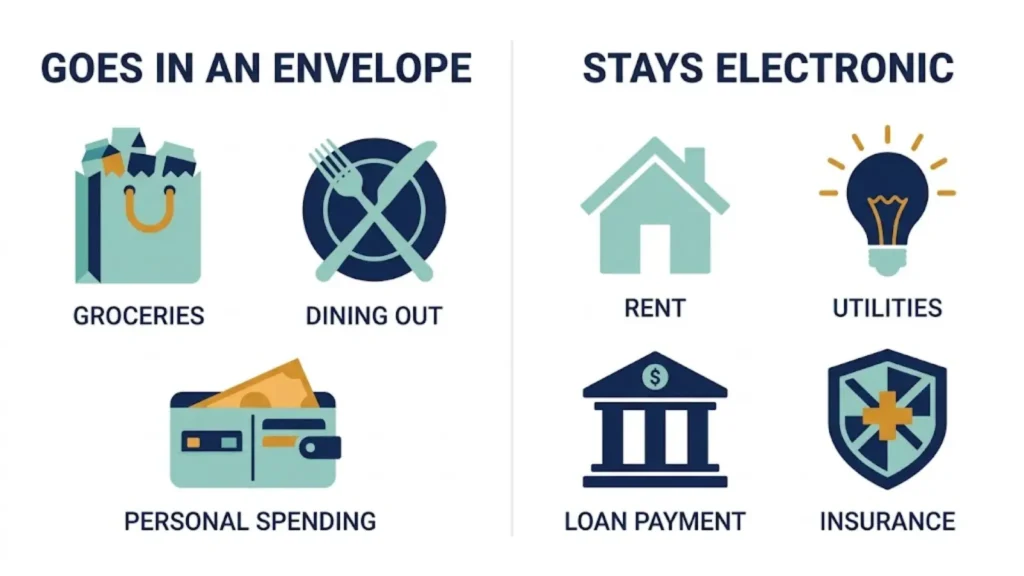
Envelopes work best for variable, discretionary spending: groceries, dining out, entertainment, personal spending, and similar categories where the exact amount is genuinely up to you day to day. These are the categories our guide to needs versus wants helps you separate from your fixed obligations in the first place.
Envelopes do not work for fixed bills paid electronically: rent or a mortgage payment, utilities, a loan payment, insurance, or most subscriptions. Those amounts do not vary by choice in the moment, and many US landlords, utility companies, and lenders do not accept cash for them at all. Trying to force a rent envelope defeats the purpose and adds effort with no payoff.
How many envelopes to start with as a beginner
Most explanations of this method imply you should have an envelope for every line in your budget. That is a fast way to quit in week one. Start smaller: pick the 3 to 5 categories where you already suspect you overspend the most, usually groceries, dining out, and one or two personal or “fun” categories. Run the method on those alone for a full month before adding more. You are testing whether the friction actually changes your behavior, and a handful of categories is enough to find out.
The honest limitation: most bills cannot be paid in cash
Here is the part most explanations skip entirely: a purely cash-based budget cannot cover a full modern household on its own, because most fixed bills are paid electronically by design, not by choice. Rent through a bank transfer, utilities on autopay, a phone bill, most loan payments. None of that fits into an envelope.
The honest way to use this method is as a layer on top of your regular budget, not a replacement for it. Your fixed bills still get paid the normal way, through your bank. The envelope system handles only the flexible slice of spending where a person’s own daily choices are what determine the number, which is exactly where a beginner budget usually leaks the most.
A tool-free way to get the same discipline without carrying cash
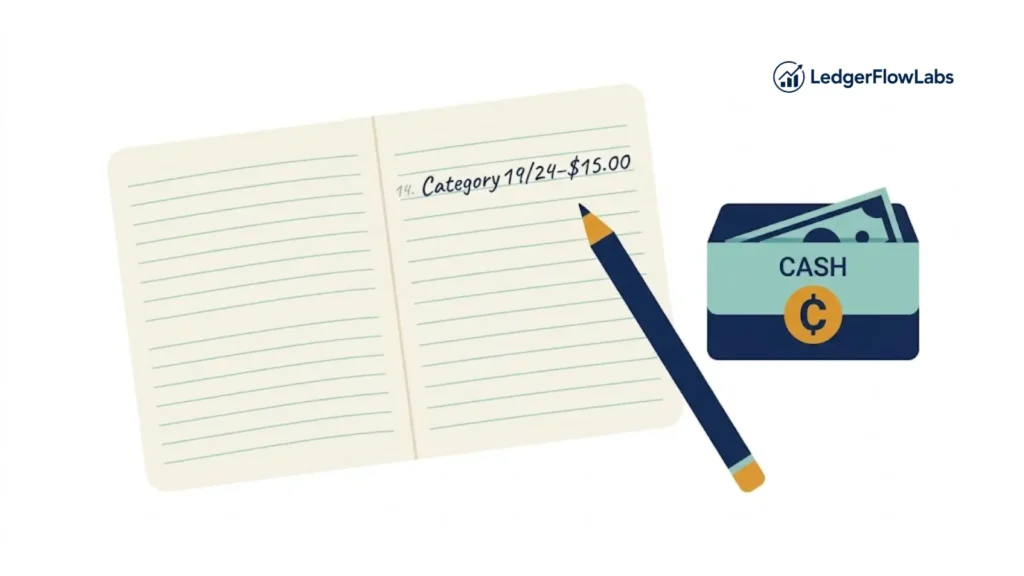
If you dislike carrying cash, or your bank makes it inconvenient to withdraw regularly, you can keep the same discipline without a single app or piece of software. Write your category limits on paper (a small notebook or an index card works), and log each purchase in that category by hand, subtracting as you go, the same way you would watch cash disappear from an envelope. When the paper total hits zero, you have hit the same wall a cash envelope would have created. The tool is irrelevant. The mechanism, a visible, shrinking limit you check before you spend, is what does the work, whether that limit lives in an envelope or on an index card in your wallet.
Once you have picked a handful of categories to try, our overview of budgeting for beginners shows how this method sits alongside others like zero-based budgeting, which gives every dollar a job rather than only the flexible categories. And if a category keeps blowing through its limit no matter how you track it, our guide to why budgets fail covers the setup mistakes that usually explain it.
FAQ
Does the envelope method still work if I hate carrying cash?
Yes. The mechanism that matters is a visible, shrinking limit you check before spending, not the cash itself. A paper tally or notebook per category creates the same friction without carrying physical money.
What categories should never go in an envelope?
Fixed bills paid electronically: rent or mortgage, utilities, loan payments, insurance, and most subscriptions. These are not spent by daily choice, and most US billers will not take cash for them anyway.
Is “cash stuffing” the same as the envelope method?
Yes, at its core. Cash stuffing is the same cash-into-categories mechanism, often presented as a more visual or social hobby around filling envelopes. The underlying discipline is identical to the classic envelope system.
How many envelopes should a beginner start with?
Three to five, focused on the categories you already suspect you overspend in, usually groceries, dining out, and one or two personal categories. Add more only after you have tested the method for a full month.
Can the envelope method replace a full budget?
No. It works best as a layer on top of your budget for flexible, discretionary categories. Your fixed bills still need to be planned and paid through your normal accounts.
Reminder: this article explains a general budgeting method, not personalized advice. For decisions about your own money, consult a licensed financial advisor.