
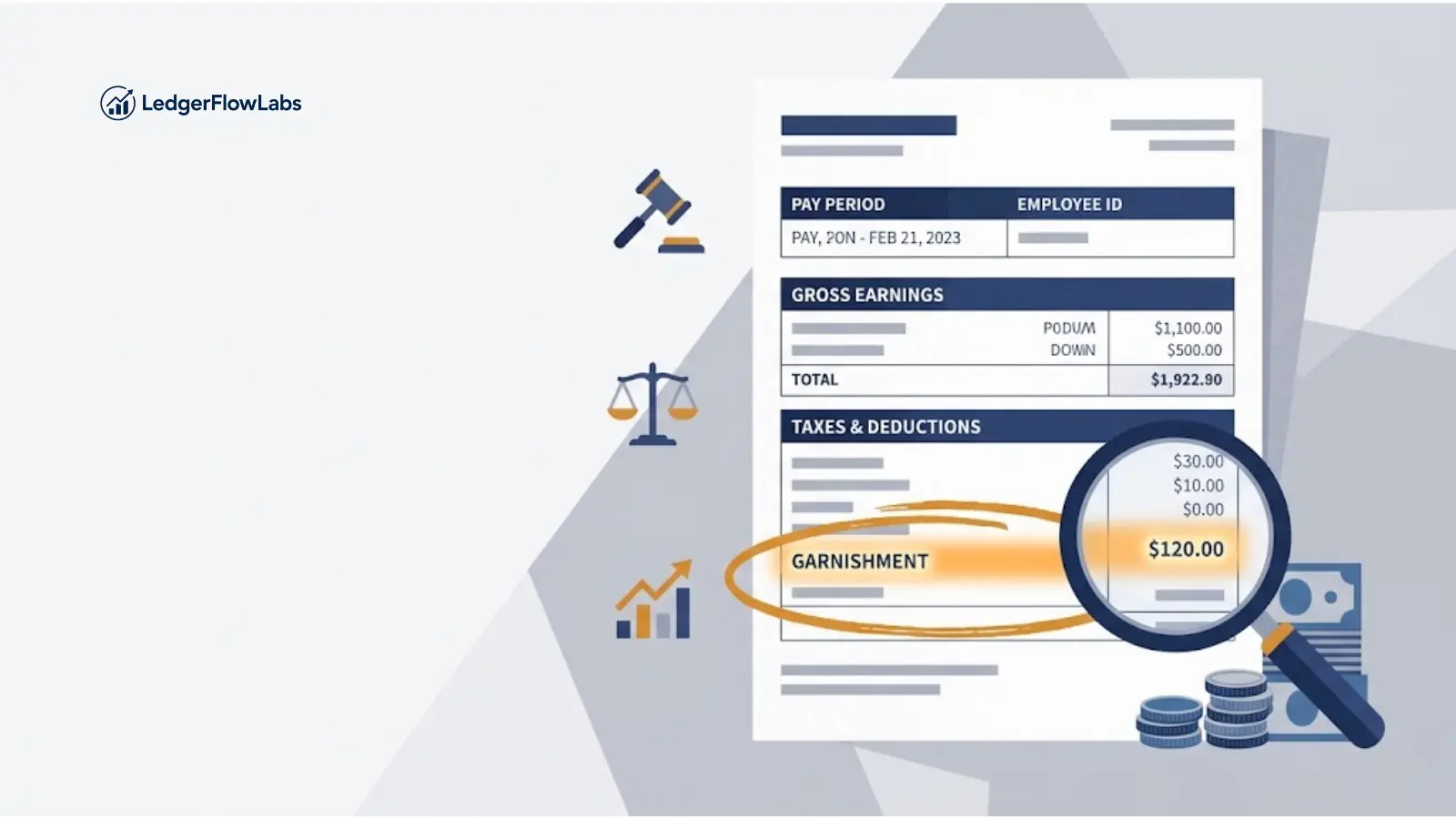
Short answer: a wage garnishment on a pay stub is money your employer is legally required to withhold and send to someone else, such as a creditor with a court judgment, a child support agency, the IRS or the Department of Education. It usually appears in the deductions section, below the taxes, labeled something like GARN, LEVY, CHILD SUPPORT or a creditor name. Federal law limits how much can be taken, and the limit is calculated on disposable earnings rather than net pay. That is why the amount rarely matches a simple percentage of your deposit.
This is educational information, not legal or financial advice. It explains how a garnishment appears and how the federal limits work. It cannot tell you whether a garnishment on your own pay is valid or correctly calculated.
Where this applies: the United States. The federal limits below come from Title III of the Consumer Credit Protection Act. State law can protect more of your pay, and when state and federal rules differ, the rule that takes less applies.
If a garnishment has just appeared
A new line you never agreed to can be alarming. Free, non-commercial help comes first, and it exists.
- The Consumer Financial Protection Bureau explains garnishment and your rights on its page Can a debt collector take or garnish my wages or benefits? (last reviewed August 2, 2023, read 2026-09-11), and points to state legal aid programs for low-income consumers.
- Legal aid in your state can advise on court-ordered garnishments and the exemptions available where you live.
- Non-profit credit counseling agencies, such as members of the National Foundation for Credit Counseling, can help you look at a household budget with a garnishment in it.
- If money pressure is affecting your wellbeing, the 988 Suicide and Crisis Lifeline is free and confidential. Call or text 988.
The rest of this page explains the line itself.
What a garnishment is
The U.S. Department of Labor's wage garnishment page (read 2026-09-11) describes it as a legal process in which an employer is required to withhold part of an employee's earnings to pay a debt. Child support is one of the most common reasons.
The CFPB explains that most creditors, including debt collectors, can garnish wages only after a court issues a judgment saying the debt is owed. Some government debts work differently. Federal agencies such as the IRS and the Department of Education, and state child support agencies, have their own authority to collect.
Your employer does not decide whether you owe the money. It receives an order and is required to follow it. That is why payroll can explain how the amount was calculated, but usually cannot remove it.
How a wage garnishment shows up on a pay stub
A garnishment normally appears as a deduction below the tax lines and above net pay. The labels vary by payroll system. Common versions include:
- GARN or Wage Garnishment, sometimes with a case number
- Child Support, CS or Support Order
- IRS Levy or State Tax Levy
- Student Loan or Dept of Ed for administrative wage garnishment of a defaulted federal student loan
- A creditor or court name
Like other lines, it usually has a this-period amount and a year to date total. Some stubs also show a remaining balance on the order.
The federal limit, and why it is based on disposable earnings
The Department of Labor's Fact Sheet #30 on the federal wage garnishment law (dated December 2024, read 2026-09-11) sets out the limits.
Disposable earnings are "the amount of earnings left after legally required deductions are made." Those required deductions include federal, state and local taxes, Social Security and Medicare, and required retirement contributions. Voluntary deductions, such as health insurance, union dues or charitable donations, are not subtracted.
That is the key to reading the line. Disposable earnings are usually higher than net pay, because your voluntary deductions still count as earnings for this purpose. A garnishment that looks like more than a quarter of your deposit can still be within the federal limit.
For ordinary garnishments, such as a creditor with a court judgment, the fact sheet sets the weekly maximum at the lesser of:
- 25% of disposable earnings, or
- The amount by which disposable earnings exceed 30 times the federal minimum wage, which the fact sheet gives as $217.50 a week at the $7.25 federal minimum wage.
If weekly disposable earnings are $217.50 or less, nothing can be taken for an ordinary garnishment. The fact sheet gives equivalent figures for other pay periods.
An illustration, not anyone's real pay. Suppose weekly disposable earnings are $300. Twenty five percent is $75. The amount above $217.50 is $82.50. The federal maximum for an ordinary garnishment is the lesser of the two, $75. At $250 of weekly disposable earnings, 25% is $62.50 but only $32.50 sits above the floor, so the maximum drops to $32.50. The inputs are chosen for round arithmetic and the method is the one in Fact Sheet #30.
Garnishments that follow different rules
Fact Sheet #30 lists several types with different limits or none:
- Child support and alimony can take up to 50% of disposable earnings if the worker supports another spouse or child, or up to 60% if not, plus an extra 5% for support more than 12 weeks in arrears.
- Federal and state tax debts are not subject to the ordinary limits.
- Bankruptcy court orders are not subject to them either.
- Federal agency collections of non-tax debts, including defaulted federal student loans, can take up to 15% of disposable earnings.
An IRS levy works on its own formula. The IRS page on wage levies (last reviewed March 13, 2026, read 2026-09-11) explains that the levy continues until the tax is paid, other arrangements are made, or the levy is released. The part of your pay that is exempt is based on the standard deduction and the number of dependents, using tables in IRS Publication 1494. Your employer gives you a statement of dependents and filing status, and the IRS page says it must be completed and returned "within three days." If it is not returned, the exempt amount is calculated as married filing separately with no dependents, which leaves the smallest exempt amount.
Other deductions you didn't choose
A garnishment is not the only deduction that arrives without an election. Federal income tax withholding, Social Security and Medicare, state and local taxes where they apply, and any required retirement contribution for certain public jobs are mandatory. They are also the deductions subtracted to reach disposable earnings, which is why they sit above a garnishment on the stub.
A deduction that is neither a tax, an election you made, nor a legal order is worth asking payroll about directly.
Protection from being fired
Title III also protects jobs. The Department of Labor states that an employer may not fire an employee because their wages are garnished for any one debt, "regardless of the number of levies made or proceedings brought." The protection does not extend to garnishments for more than one debt.
Checking the garnishment line
- Confirm what the order is. Payroll can tell you which order it is following and who issued it, and courts or agencies normally send their own notice.
- Work out disposable earnings. From gross pay, subtract only the legally required deductions: taxes, Social Security, Medicare and any required retirement contribution. Leave voluntary deductions in.
- Compare against the limit that applies. For an ordinary garnishment, the lesser of 25% or the amount above 30 times the federal minimum wage. For other types, the limit listed above.
- Check the year to date and any balance. A garnishment that continues after an order should have ended is worth raising.
If something does not add up, the CFPB and legal aid are the free places to start. State law may protect more of your pay than the federal rule, and a legal aid office can tell you what applies where you work.
When a garnishment squeezes the household budget
A garnishment lowers net pay for as long as the order runs, and bills do not shrink with it.
Our guide to what bills to pay first when money is short sets out how essential bills are commonly ordered when the money does not cover everything. When a smaller net pay means the numbers no longer work at all, when a budget says you cannot afford your life looks at that situation directly. And the timing side, a smaller deposit landing before a fixed bill, is covered in why you run out of money before payday.
What this page cannot do
It cannot tell you whether a debt is owed, whether a court order is valid, or whether an exemption applies in your state. Those are legal questions. Legal aid, the CFPB and, for wage calculation questions, the Department of Labor are the places that answer them.
FAQ
What does a garnishment look like on a pay stub? Usually a deduction below the tax lines, labeled GARN, LEVY, Child Support, Student Loan or a creditor name, with a this-period amount and a year to date total. Some stubs also show a remaining balance.
How much of my paycheck can be garnished? For ordinary garnishments, federal law allows the lesser of 25% of disposable earnings or the amount above 30 times the federal minimum wage, which the Department of Labor gives as $217.50 a week. Child support, tax levies, bankruptcy orders and federal agency debts follow different limits, and state law can protect more.
Why is my garnishment more than 25% of my take-home pay? The limit is based on disposable earnings, which subtract only legally required deductions. Voluntary deductions such as health premiums still count as earnings, so disposable earnings are usually higher than net pay.
Can I be fired for having my wages garnished? Federal law bars firing an employee because of garnishment for any one debt. The protection does not cover garnishments for more than one debt.
Sources: U.S. Department of Labor, Wage and Hour Division, Fact Sheet #30, "The Federal Wage Garnishment Law, Consumer Credit Protection Act's Title III" (December 2024), read 2026-09-11, for the definition of disposable earnings, the 25% and $217.50 weekly limits at the $7.25 federal minimum wage, the child support, tax, bankruptcy and 15% federal agency limits, and the state law rule. U.S. Department of Labor, "Wage Garnishment" topic page, read 2026-09-11. Consumer Financial Protection Bureau, "Can a debt collector take or garnish my wages or benefits?" (last reviewed August 2, 2023), read 2026-09-11. Internal Revenue Service, "Information about wage levies" (last reviewed March 13, 2026), read 2026-09-11. The worked illustration uses round inputs with the method from Fact Sheet #30.