
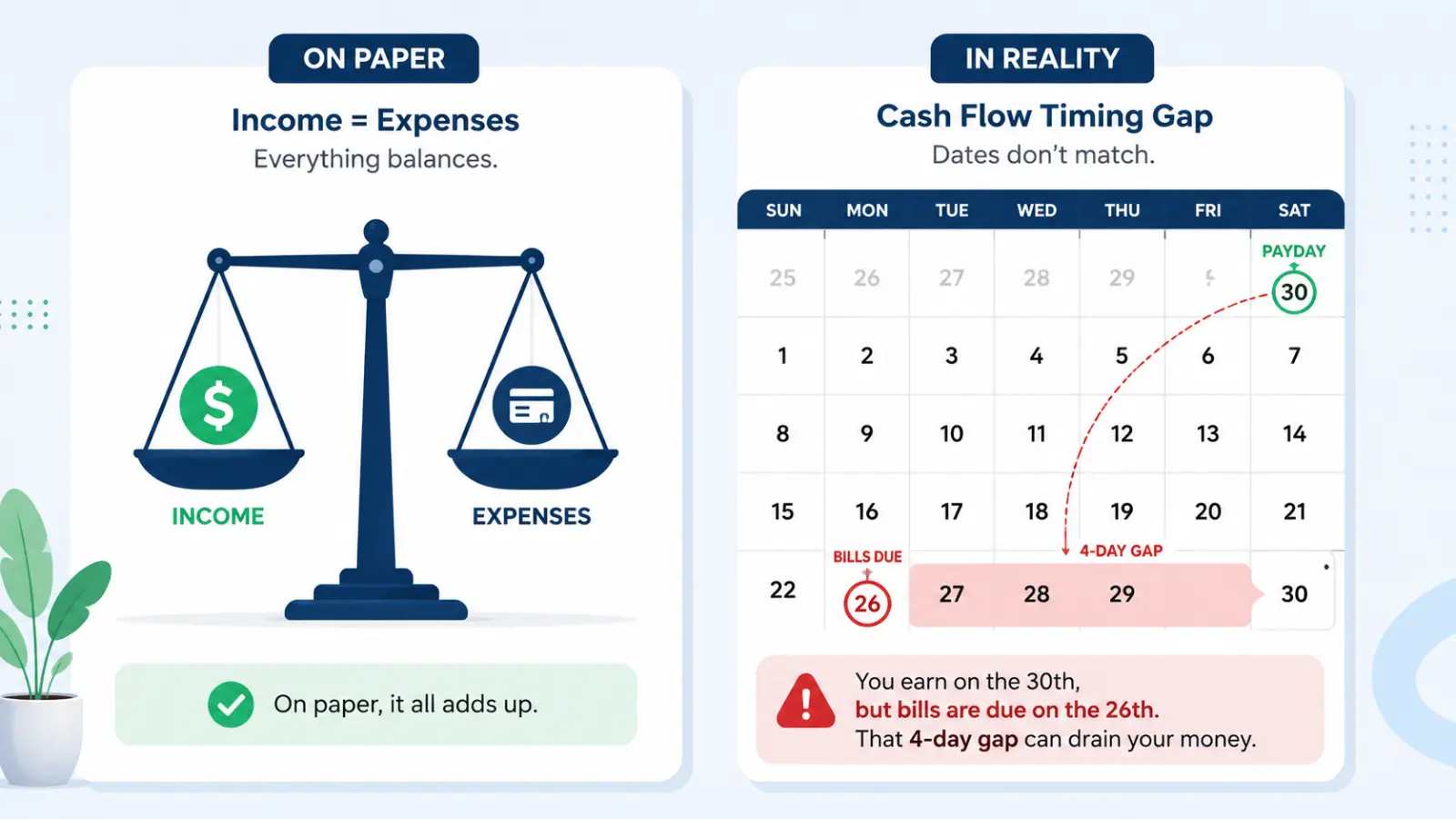
If your annual income covers your annual bills and you still hit zero four days early every month, the problem is probably not what you are buying. It is when the money arrives compared to when it leaves. Bills are scheduled by the companies that send them, on dates that have nothing to do with your pay dates, and a monthly budget cannot see a gap that lasts four days. This guide explains the three timing mechanics that empty an account that should, on paper, balance.
This is educational information, not financial advice. For decisions about your own money, consult a licensed financial advisor.
Where this applies: this guide is written for readers in the United States. The pay schedules, banking practices, and sources named below are US ones. The underlying timing logic travels, but the specific conventions do not.
The question behind the question
Most guides answer a different question than the one people are asking. Search for this and you will be told to make a budget, cut subscriptions, or check whether you qualify for assistance. Those are all reasonable answers to the question “what do I do if I do not have enough money.”
That is not the question. The question is “why does the money I do have keep running out early.” Those are different problems and they have different fixes.
Here is the shape of the situation this guide is for. Your income, over a year, is enough to cover your obligations over that same year. You are not spending wildly. You have probably already tried budgeting and found that it worked for a month and then stopped working. And still, somewhere in the last week before you get paid, the account hits bottom.
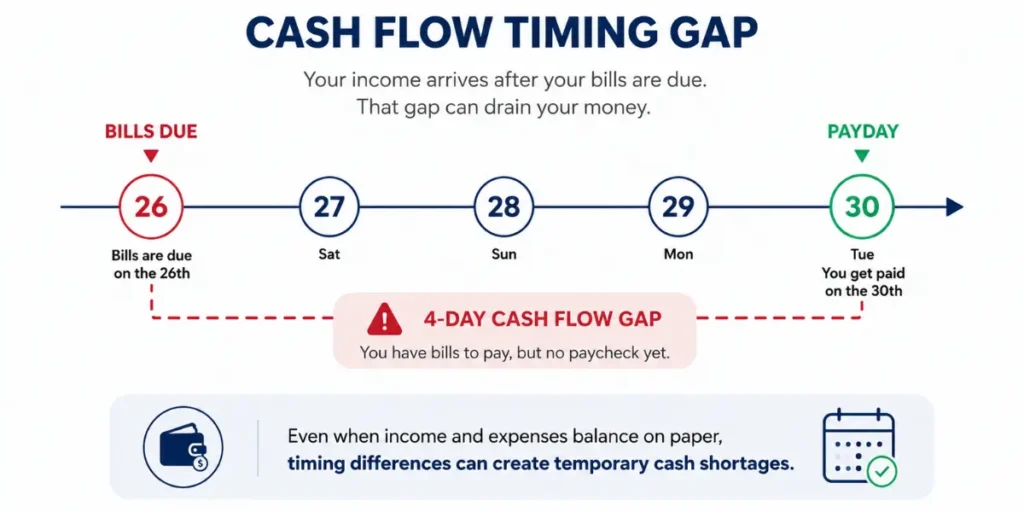
When that pattern repeats, it is usually because a budget is a monthly tool and your money problem is a weekly one. A budget answers whether the total fits. It does not answer whether the money is in the account on the specific Tuesday the withdrawal happens. Those are two different tests, and it is entirely possible to pass the first and fail the second every single month.
Three mechanics produce that failure. Most people have at least two of them running at once.
Reason one: your bills are not synchronized with your pay
You did not choose your due dates. Each one was set by a different company, at a different time, for reasons internal to that company. Your rent is due on the first because that is standard in a lease. Your card statement closes on the fourteenth because that is when your account was opened. Your utility bills follow a meter-reading cycle. Your insurance renews on the anniversary of the policy.
None of those dates knows about the others, and none of them knows when you get paid.
So the outflows arrive in clumps. A stretch of the month where four bills land in six days, and another stretch where almost nothing goes out. If a paycheck falls in the quiet stretch and the clump falls just before the next one, the account is being asked to carry a heavy week on a balance that has already been thinned by the previous heavy week.
This is the most common single cause, and it is also the most fixable, because due dates are more movable than most people realize. The Consumer Financial Protection Bureau, the US federal consumer agency, publishes both a printable bill calendar and a worksheet for requesting a due-date change, which tells you how ordinary a request it is. Our guide to building a bill calendar from your own due dates covers how to see the clumps, and moving a bill due date covers which providers will actually change one and which will not.
Seeing the clumps is the whole first step. Until the dates are written down in date order, next to your pay dates, the pattern is invisible and every month feels like bad luck.
Reason two: your pay schedule is not the same shape every month
The second mechanic is the one almost nobody is told about, and it explains the specific complaint that a budget “works some months and not others.”
If you are paid semimonthly, on two fixed dates such as the fifteenth and the last day, then every month contains exactly two paychecks. Your month has a stable shape.
If you are paid biweekly, every other Friday, your month does not have a stable shape at all. Most months contain two paychecks. Some months contain three. The dates drift forward through the calendar all year, so the gap between your last paycheck and the first of the month is different in January than it is in June.
That drift matters because your bills did not drift with it. A monthly bill is anchored to a calendar date. A biweekly paycheck is anchored to a day of the week. Two schedules that never line up, sliding past each other twelve times a year.
As reported by Indeed and by payroll provider Patriot Software, a biweekly schedule produces 26 paychecks a year while a semimonthly schedule produces 24, for the same annual salary. That is not extra money. It means each biweekly check is slightly smaller than a semimonthly one would be, and twice a year two of them land in the same month to make up the difference. If you plan your month around “two paychecks cover the bills,” you have planned on a number that is deliberately a little too small for eleven months of the year.
Our guide to weekly, biweekly and semimonthly pay works through what each schedule does to a month, and the three-paycheck month covers how to find the months where the correction lands, using your own pay dates rather than a list someone else published.
Reason three: the number in your app is not the money you have
The third mechanic is the one that turns a tight month into an actual shortfall.
Your bank shows you a balance. It is a real number and it is not a lie, but it is a snapshot of a moment, and money moves in stages rather than instantly. A card purchase is authorized today and settles days later. A merchant may hold more than you spent. A deposit may appear in one balance and not yet be spendable. A bill you scheduled has left your plan but not yet left your account.
As reported by Bankrate, the available balance factors in pending transactions and holds while the current balance does not, and the two can differ by a lot. As reported by Capital One and by PNC, a pending amount can change before it posts, which is why the charge you saw on Monday is a different figure by Wednesday.
The practical effect is that a person looks at a number, concludes there is room, spends into the room, and discovers the room was already spoken for. Our guides to the two balances in your account and to pending versus posted transactions cover exactly what sits in that gap.
The deeper point, and the reason this cluster exists, is that neither balance is the right number to plan with. Both are photographs of right now. The number that predicts whether Thursday’s payment will clear is your available balance minus everything already committed between now and Thursday. That is a calendar calculation. No balance screen performs it for you.
How to diagnose your own gap in one sitting
This takes about half an hour and needs nothing but a piece of paper.
Write down your pay dates for the next three months. Actual dates, not “every other Friday.” If you are paid biweekly, count them out and you will see the drift immediately.
Write down every recurring payment with its due date. All of them, including annual ones. If you cannot remember a due date, our bill calendar guide covers how to recover it.
Put both lists on one timeline, in date order. Money in and money out, interleaved.
Walk the timeline and keep a running total. Start from your current available balance. Add each paycheck as it arrives, subtract each bill as it is due, and write the running figure beside each line.
Mark every point where the running total goes negative or gets uncomfortably close. Those points, and their dates, are your actual problem. Most people find two or three, in the same place every month, involving the same two or three bills.
That is a diagnosis rather than a fix, and it is worth more than another month of guessing. Payday versus due date covers what to do with the gaps once you can see them, including why the obvious move of pushing every bill to the day after payday tends to create a new problem instead of solving the old one.
When it is genuinely a timing problem, and when it is not
Honesty matters more than reassurance here.
Rearranging the calendar helps when the money is sufficient over a full cycle and badly distributed inside it. Signs that this is your situation: you cover everything most months, the shortfall is a few days rather than a few hundred dollars, and there are stretches of the month where the balance looks comfortable.
Rearranging the calendar does not help when the total genuinely does not cover the total. If you run the timeline above and the running figure is still negative at the end of three months no matter which dates you move, then the problem is the total, and no scheduling change will fix it. That is a real situation, it is not a character failure, and it deserves a different response than this page can give.
In that case the useful starting point is the whole picture rather than the calendar. Our guide to budgeting for beginners walks through building that picture from scratch, and why budgets fail covers the specific mistakes that make a first attempt collapse. If your obligations genuinely exceed your income, speak with a licensed financial advisor or a nonprofit credit counseling agency about your specific circumstances. This site explains how the mechanics work; it does not tell you what to do with your own money.
Where to go from here
This page is the overview. Each mechanic has its own guide.
Deep dives in this series:
- How to build a bill calendar from your own due dates, the input for everything else
- Payday vs due date: finding the gaps that cause late fees, reading your own timeline
- How to move a bill due date, and what providers will actually change, the mechanism
- Weekly, biweekly, semimonthly: why your pay schedule changes everything, the shape of your month
- The three-paycheck month, where the two extra checks go
- Why the balance in your banking app is not the money you have, the number that misleads
- Pending vs posted: why your balance moves after you spend, what happens in the gap
FAQ
Is running out of money before payday normal?
It is common. Common and fine are different things. What matters is whether it happens because the total is short or because the timing is wrong, since those two situations have completely different fixes.
Will making a budget fix this?
Partly. A budget confirms whether your monthly total works, which is worth knowing. It does not tell you whether the money is in the account on the day each payment leaves, and that is the failure this page describes. Most people need both.
Would getting paid weekly instead of monthly help?
It changes the shape of the problem rather than the size. More frequent pay makes each gap shorter and each paycheck smaller, which suits some bill patterns and not others. The total for the year does not change.
Why does this happen in some months and not others?
Usually because you are paid biweekly. The dates drift through the calendar all year, so the distance between your last check and the first of the month is not the same in every month. See biweekly vs semimonthly pay.
What if my income genuinely does not cover my bills?
Then this is not a timing problem and moving due dates will not solve it. Work from your full picture rather than the calendar, and talk to a licensed financial advisor or a nonprofit credit counseling agency about your specific situation.
Reminder: this article explains general mechanics, not personalized advice. For decisions about your own money, consult a licensed financial advisor.