
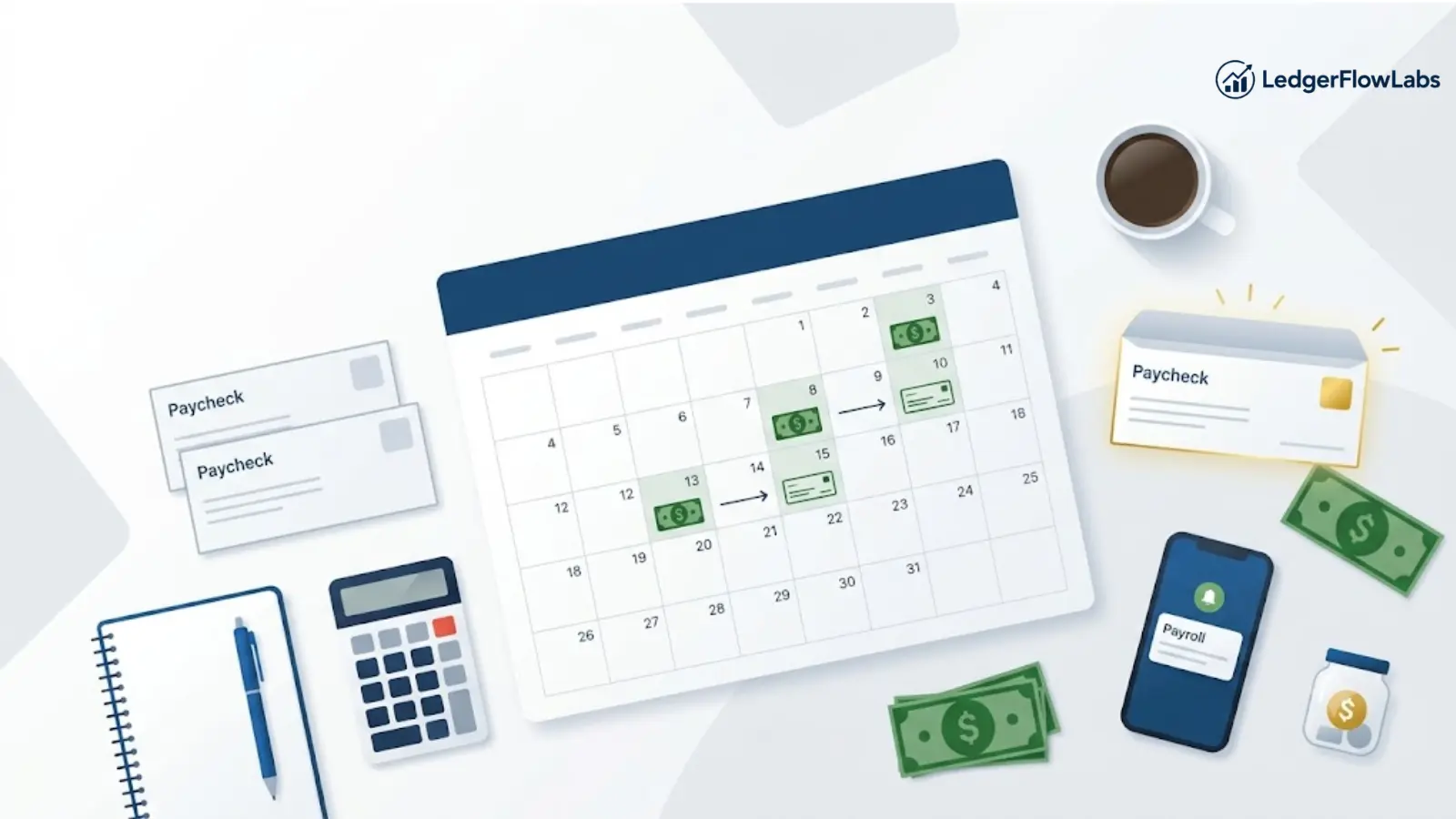
If you are paid every two weeks, two months of the year contain three paychecks instead of two. Most articles about this jump straight to a list of things to do with the money. They skip the two questions people actually have: which months are mine, and why does the extra check never seem to make any difference?
This guide answers both, and then deliberately declines to tell you where to put the money.
This is educational information, not financial advice. For decisions about your own money, consult a licensed financial advisor.
Where this applies: written for readers in the United States. Pay-frequency conventions differ by country.
What a three-paycheck month actually is
It is a calendar artifact, not a payroll policy.
A biweekly schedule pays every fourteen days. Fourteen does not divide evenly into a year, and it certainly does not divide evenly into months of 28, 30 and 31 days. Over a full year you receive 26 paychecks, as reported by Indeed and by payroll provider Patriot Software, spread across twelve months.
Twenty-six checks into twelve months means ten months receive two and two months receive three. That is the whole mechanism. Nobody decided to give you an extra check; the fourteen-day cycle simply lapped the calendar twice.
The same effect occurs on a weekly schedule, where 52 checks across twelve months produces four in most months and five in a few. It does not occur on a semimonthly schedule, because semimonthly is defined by two fixed calendar dates, so it always produces exactly two checks per month. If you are paid on the fifteenth and the last day, there is no extra check to plan for and there never will be. Biweekly vs semimonthly pay covers the difference between the two schedules in full.
How to find yours, using your own pay dates
Here is the part almost every article gets wrong. Several publications name specific months as “the” three-paycheck months of a given year. That cannot be right for everyone, because it depends entirely on which day your own pay cycle falls on.
Two people at different companies, both paid biweekly, can have completely different three-paycheck months. There is no universal answer, only your answer. Work it out like this.
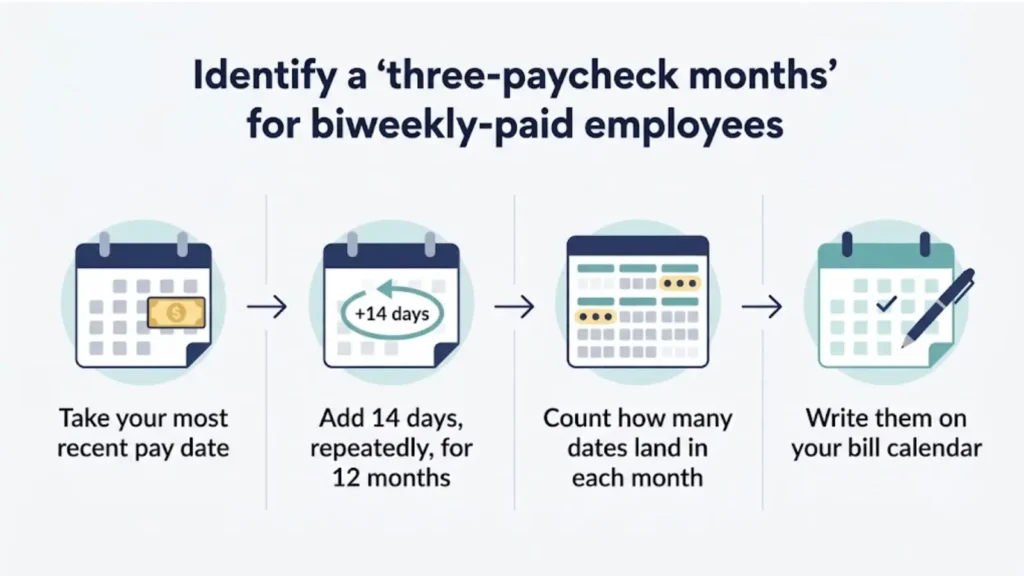
Take your most recent pay date. The actual date the money arrived, not the date it was supposed to.
Add 14 days, repeatedly, for twelve months. That is 26 additions. It takes a few minutes on paper or in any calendar.
Count how many dates land in each month. Two months will have three. Those are yours.
Write them on your bill calendar. Not in your head. On the calendar, months in advance, because the entire value of knowing this is knowing it early. If you have not built one, how to make a bill calendar covers the process.
Do this once a year, in January, and re-check it if your employer ever changes the pay cycle. The dates shift year over year, so last year’s answer is not this year’s.
One caution worth adding: a pay date that falls on a weekend or a holiday is often moved to the preceding business day. That can pull a check from the first of a month back into the last day of the previous one, which changes which month is the three-check month. If your calculation puts a pay date on the first or second of a month, check what your employer actually does in that case.
Why the extra check is a correction, not a bonus
This is the framing that matters, and it is the reason the extra check so often evaporates without a trace.
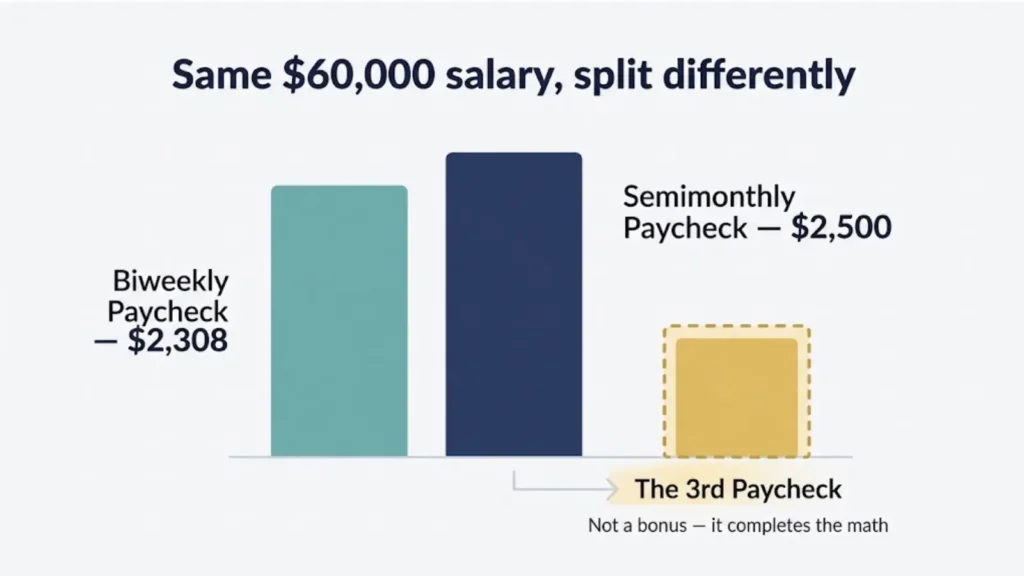
Your annual salary is fixed. Being paid biweekly does not increase it; it divides the same amount into 26 pieces instead of 24 or 12. Each biweekly check is therefore slightly smaller than a semimonthly check on the same salary would be. For a hypothetical 60,000 dollar salary, a biweekly gross check is about 2,308 dollars where a semimonthly one would be 2,500. Those are illustrative figures, not a claim about typical pay.
Now put that against your bills, which are monthly. Ten months of the year you receive two checks totaling about 4,616 gross dollars in that hypothetical, against a month of bills sized for a salary that pays 5,000 a month. Every one of those ten months is slightly short by design.
The two three-paycheck months are where that shortfall is repaid. They are not extra money. They are the correction for the twenty-four checks that were each a little too small.
Treat the third check as a windfall and you will spend it, and then wonder why ten months a year feel tight on a salary that should cover everything. Treat it as the correction it is and the ten tight months stop being a mystery.
The planning question: is this money already spoken for?
Before deciding anything about the third check, answer one question honestly: is this money already committed?
Three ways it can be committed without your having noticed.
It is covering the shortfall described above. If your ordinary two-check months routinely end at zero or slightly below, the third check is already funding that deficit. It is not available; it is the repayment.
An annual bill lands in that month. Check your bill calendar. Three-paycheck months are ordinary months in every other respect, and if your car insurance renews in one of them, the extra check is spoken for.
A larger bill is arriving because of a change you made. If you recently moved a due date, the transition bill can be larger than usual, as covered in how to move a bill due date. Timing that change into a three-paycheck month is sensible, and it also means the extra check is doing that job.
If none of those apply, then the check is genuinely uncommitted, and what happens next is a decision rather than a mechanic.
What people commonly do with it, and why we are not ranking those options
Every article on this topic ends with a ranked list: pay down high-interest debt first, then build an emergency fund, then increase retirement contributions, then move it to a savings account. Those lists are written confidently and they are all slightly different from each other, which should tell you something.
This site is not going to rank them for you, for two honest reasons.
Because the right answer depends on facts about you that a web page does not have. What you owe, at what rate, what your job security looks like, what is already set aside, what is coming up in the next year. A ranking that ignores all of that is not advice; it is a template.
Because it would be outside what this site is qualified to write. Ledger Flow Labs explains how money mechanics work. It is not written by a licensed financial professional, and directing an individual reader’s money is not something an uncredentialed writer should do. Deciding between paying down a balance and adding to savings is exactly that kind of decision.
What this site can honestly tell you is what each option is, mechanically, so you can take an informed question to someone qualified to answer it:
- Money held for the unexpected and money held for a known future cost are doing two different jobs, and mixing them is a common reason both fail. Sinking funds vs emergency funds covers the distinction.
- How large a reserve should be is a question with published ranges rather than a single answer, and the ranges come from named sources with stated reasoning. How much should an emergency fund be covers who says what.
- Reducing a balance you owe reduces future interest, and how much depends on the balance and the rate. The arithmetic of that is a subject this site covers in its own cluster.
For your own situation, a licensed financial advisor or a nonprofit credit counseling agency can look at the actual numbers. That is the honest recommendation and it is the only one this page will make.
How to keep it from disappearing before you decide
The practical problem with the third check is not the decision. It is that the money is in a checking account for the two or three weeks while you are deciding, and money in a checking account looks like spending money.
Two mechanics help, and neither requires any product.
Decide before it arrives, not after. You know the date months in advance, which is the point of the calculation earlier in this guide. A decision made in February about a check arriving in August is a much calmer decision than one made on the day.
Move it out of the account you spend from on the day it lands. Not because a different account earns more, which is a separate question this site does not advise on, but because the balance you see when you decide whether you can afford something should not include money that has a job. That is the same reasoning behind pay yourself first budgeting: the ordering of the outflow matters more than the intention behind it.
The failure mode this avoids is the common one. Nothing dramatic happens to the extra check. It just sits in the balance, the balance looks healthy for three weeks, spending adjusts upward slightly to match, and by the next pay date there is no trace of it and no memory of where it went.
The semimonthly version of the same thing, and why there isn’t one
Worth stating plainly because people on semimonthly schedules go looking for their three-paycheck months and cannot find them.
There aren’t any. Semimonthly means two fixed dates per month, so every month has exactly two checks, 24 a year. There is no drift, no lapping, no extra check. In exchange, each semimonthly check is slightly larger and the shape of every month is identical, which is its own advantage. If a stable month is more useful to you than two windfalls a year, that trade is a good one.
The overall picture of how pay timing interacts with monthly bills is covered in why you run out of money before payday.
FAQ
Which months have three paychecks?
It depends on your own pay dates, not on the year. Two people paid biweekly at different companies can have different three-paycheck months. Work yours out by adding 14 days repeatedly from your most recent pay date.
Do I get paid more in a year with three-paycheck months?
No. Every biweekly year has 26 checks and the same annual salary. The extra checks are how the smaller individual checks add back up to your full pay.
Does this happen with semimonthly pay?
No. Semimonthly is two fixed dates a month, always 24 checks a year.
Should I use it to pay off debt or to save?
That depends on your specific circumstances, and this site does not direct individual money decisions. A licensed financial advisor or a nonprofit credit counseling agency can look at your actual numbers. What this page can tell you is what each option does mechanically.
Why did my extra paycheck not seem to help?
Most often because it was already committed, either to an annual bill landing in the same month or to the small monthly shortfall that biweekly pay creates against monthly bills. Check the timeline before assuming it vanished.
Reminder: this article explains general mechanics, not personalized advice. All salary figures above are hypothetical illustrations. For decisions about your own money, consult a licensed financial advisor.