
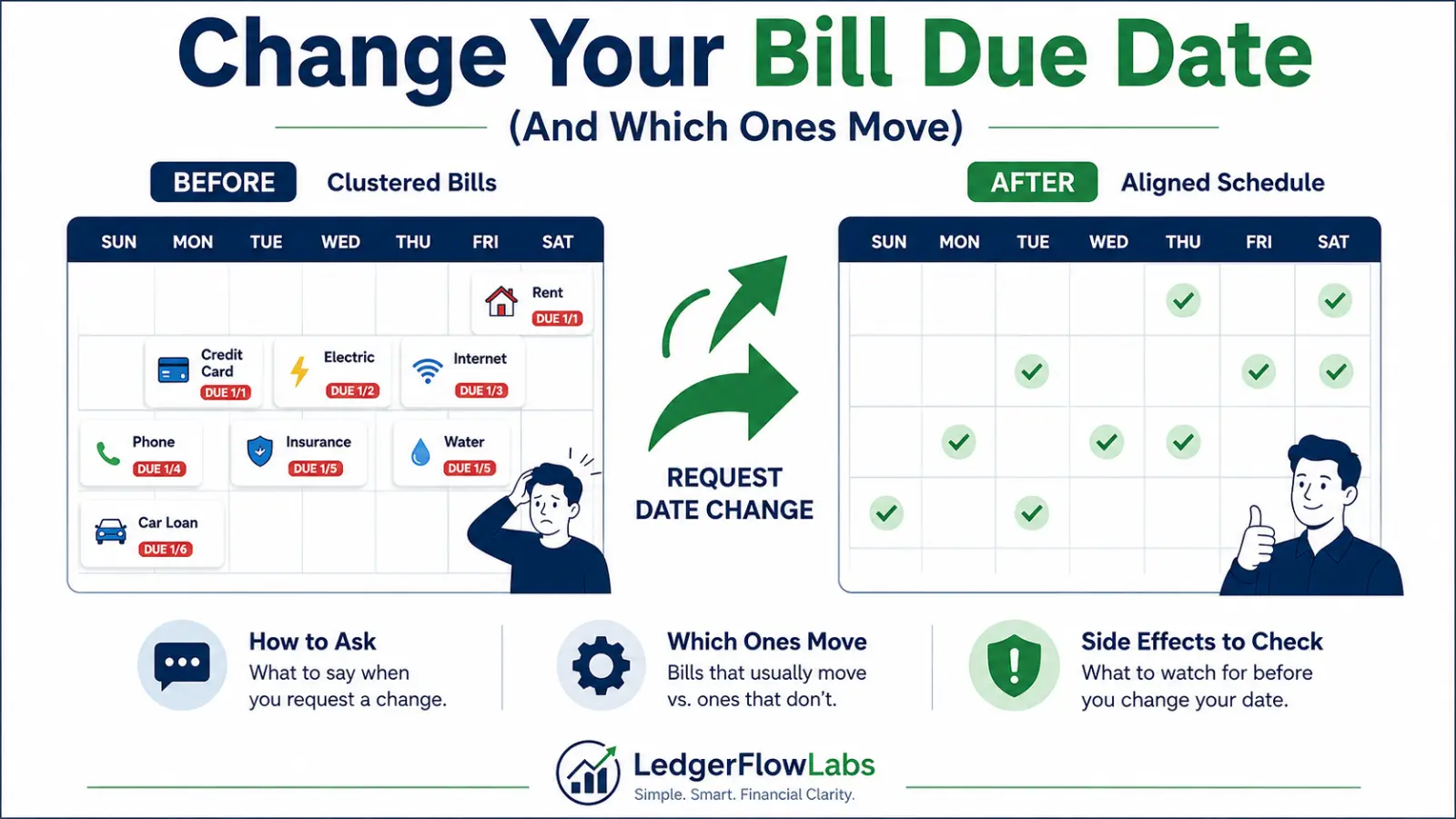
Asking a company to move your due date is an ordinary request that many providers handle in a few minutes. It is also not guaranteed, it works very differently depending on what kind of bill it is, and it has one common side effect that surprises people. This guide covers which bills usually move, how to ask, and what to check before you agree.
This is educational information, not financial advice. For decisions about your own money, consult a licensed financial advisor.
Where this applies: written for readers in the United States. The federal agency and the practices named below are US ones.
Yes, this is a real thing, and no, it is not guaranteed
The Consumer Financial Protection Bureau, the US federal consumer agency, publishes a fill-in worksheet specifically for requesting a change to a bill payment due date, and a blog post recommending the practice as a way to manage cash flow. When a federal agency prints a template for a request, the request is not unusual.
That said, two limits are worth knowing up front, and both are reported consistently by the sources that cover this. As reported by SoFi, not every company allows a due-date change, and where it is offered it is generally offered as a courtesy rather than a right, which means a provider can decline. As reported by Credit Karma, many providers allow the change through their own website or app, and some limit how often you can do it.
So the honest expectation is: often yes, sometimes no, and almost never instant in its full effect.
Which bills usually move, and which almost never do
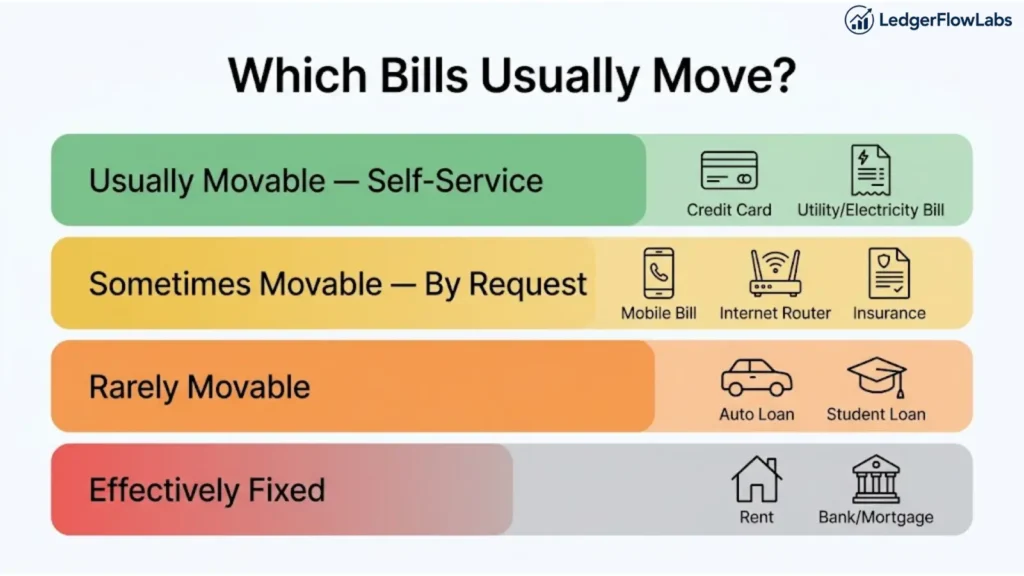
This is the part the general advice skips, and it is the only thing that reliably predicts the answer. Sort your bills into these groups before you spend an afternoon on phone calls.
Usually movable, often self-service. Credit cards and utilities are the two categories most commonly reported as adjustable, frequently through the account settings without speaking to anyone. Utility providers in particular often present it as a standard option, because a utility company would rather move your date than chase a late payment.
Sometimes movable, usually by request. Phone and internet service, insurance premiums, and many subscriptions. These are typically tied to the date the account was opened rather than to anything structural, so there is often no reason the provider cannot change it. Whether they will is a policy question.
Rarely movable. Loan payments, including auto loans and student loans. The due date is written into the loan agreement, and servicers vary widely in whether they will adjust it. Some will; many will only do so as part of a broader change to the account, which is a bigger decision than a scheduling tweak.
Effectively fixed. Rent and mortgage payments. A rent due date is a lease term, so changing it means agreeing a change to the lease with your landlord, not making a customer service request. A mortgage payment date is similarly part of the loan agreement. Neither is impossible, both are a negotiation rather than a setting.
The practical takeaway: if you have one problem week, look first at your cards and utilities. They are the cheapest dates to move and there are usually several of them.
What to say when you ask
Keep it short and specific. The CFPB’s worksheet models the request in almost exactly one sentence: state that you are requesting a change to your bill payment due date, and state the day of the month you would prefer.
Before you contact them, have three things ready.
Your account number. Every source that covers this says the same thing, and it is the difference between a five-minute call and a twenty-minute one.
The date you want. Not “sometime after the fifteenth.” A specific day of the month. If you have not worked out which date to ask for, do that first; payday versus due date covers how to choose, and it is not simply “the day after payday.”
Your reason, in one line. You do not owe anyone an explanation, but “I want my due dates to line up with when I am paid” is a reason companies hear constantly and understand immediately.
Channel matters less than people expect. Many providers now handle this in the account settings on their own site, and where they do, that is faster and leaves a record. Where it needs a person, a phone call is usually quickest.
The three questions to ask before you agree
Do not hang up or click confirm without the answers to these. The CFPB worksheet builds all three into its template, which tells you how often they matter.
When does the new date take effect? Sometimes the next cycle, sometimes the one after. Until it takes effect, your old date still applies, and assuming otherwise is how a due-date change causes a late payment.
What will the next bill be, and when is it due? This is the one that catches people. See the next section.
Is there any cost, and does anything change about the account? Usually there is not. Ask anyway, and ask specifically whether anything other than the date is changing.
Write down the answers and the date of the conversation. If something goes wrong later, the difference between “they said it would start in August” and a note saying so is significant.
The transition bill: the part that surprises people
Here is the mechanic behind it. Most bills cover a period. Move the due date forward and the first cycle after the move covers a longer period than usual, because the billing period stretches to reach the new date. A longer period means a larger bill.
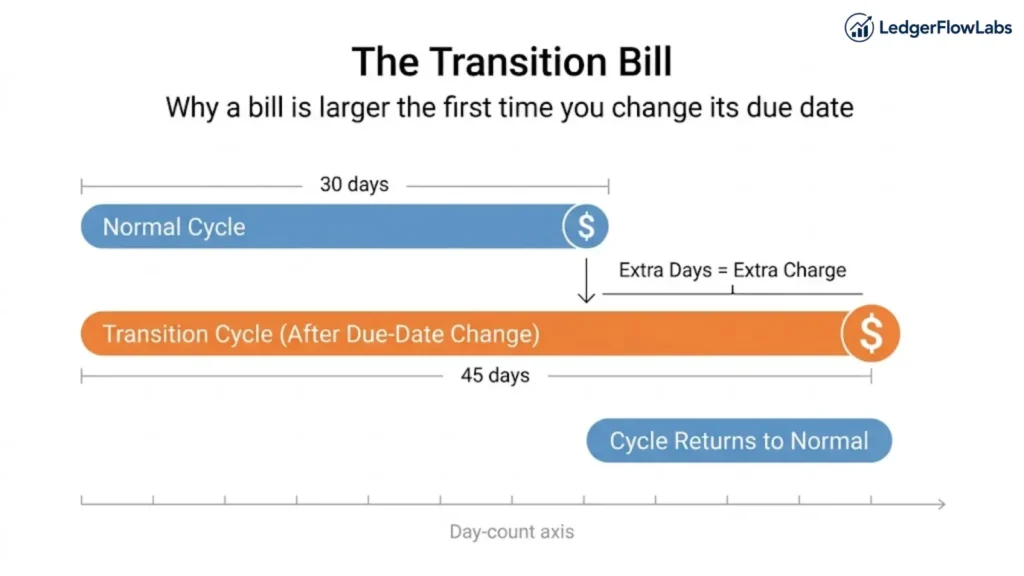
As reported by SoFi, a change to a payment due date may require a higher payment in the first billing cycle after the change. That is not a penalty and it is not a fee. It is arithmetic: you are being billed for more days, once, and then the cycle returns to normal length.
The failure this produces is specific and avoidable. Someone moves a due date to relieve a tight week, and the first bill after the move is larger than any previous bill, landing in the same tight week they were trying to protect. The move was right and the timing of it was wrong.
Two ways to avoid it. Ask what the first bill will be, in dollars, before agreeing, which is why that question is on the list above. Or make the change in a month you already know is a comfortable one, so the larger transition bill lands somewhere with room. If you are paid biweekly, the three-paycheck month is often exactly that month.
What a due-date change does not do
It does not reduce what you owe. Moving a payment from the third to the eighteenth changes when the money leaves and nothing else. Every source on this agrees and it is worth saying plainly, because “fixing” a cash flow problem by rescheduling can feel like the problem is solved when the total has not moved at all.
It does not remove a late payment that already happened. Changing a future due date is not a way to undo a past one.
It does not change the amount of interest on a revolving balance in any way you should count on. Interest on a card balance is driven by the balance and the rate, not by which day of the month the payment is due.
And it does not help if you are moving dates repeatedly. Which brings us to the last section.
When to stop moving dates and change the plan instead
Rescheduling is a genuinely good tool for a genuinely specific problem: money that is sufficient across a full cycle but badly distributed inside it. Our overview of why you run out of money before payday sets out how to tell whether that is your situation.
If you have moved two or three dates and the tight week simply relocated, the calendar was not the problem. If you are considering moving a due date because you cannot pay the bill at all, that is a different situation entirely and this page is the wrong tool for it. A scheduling request buys days. It does not address a shortfall, and treating it as though it does tends to delay the point at which someone gets real help.
In that case, work from the whole picture instead. Budgeting for beginners covers building that picture, and a licensed financial advisor or a nonprofit credit counseling agency can talk through your specific circumstances. This site explains how the mechanics work; it does not tell you what to do with your own money, and it does not recommend any debt product or service.
FAQ
Does changing a due date hurt your credit?
Changing the date itself is a servicing change, not a credit event. What does get reported is whether you pay on time, so the risk is not the change but the confusion around it: paying on the old date when the new one has taken effect, or the reverse. Confirm the effective date and pay to whichever date is currently live.
How often can I change a due date?
It depends on the provider. As reported by Credit Karma, some issuers limit how frequently the change can be made. Ask when you call rather than assuming, and treat it as something to do deliberately rather than repeatedly.
Can I change my rent due date?
Only by agreement with your landlord, because the date is part of the lease rather than a customer setting. Some landlords will agree, particularly if the request is specific and you can explain the reason.
What if they say no?
Move a different bill. The goal is to relieve one crowded week, and it rarely matters which bill moves out of it. If nothing in that week can move, the other approach is to move the money instead of the date, by building enough of a buffer that the week stops being tight.
Should I move all my bills to just after payday?
No, and this is a common mistake. Stacking every outflow into two days creates one enormous withdrawal followed by weeks of a balance that looks healthier than it is. Payday versus due date covers what to aim for instead.
Reminder: this article explains general mechanics, not personalized advice. For decisions about your own money, consult a licensed financial advisor.