
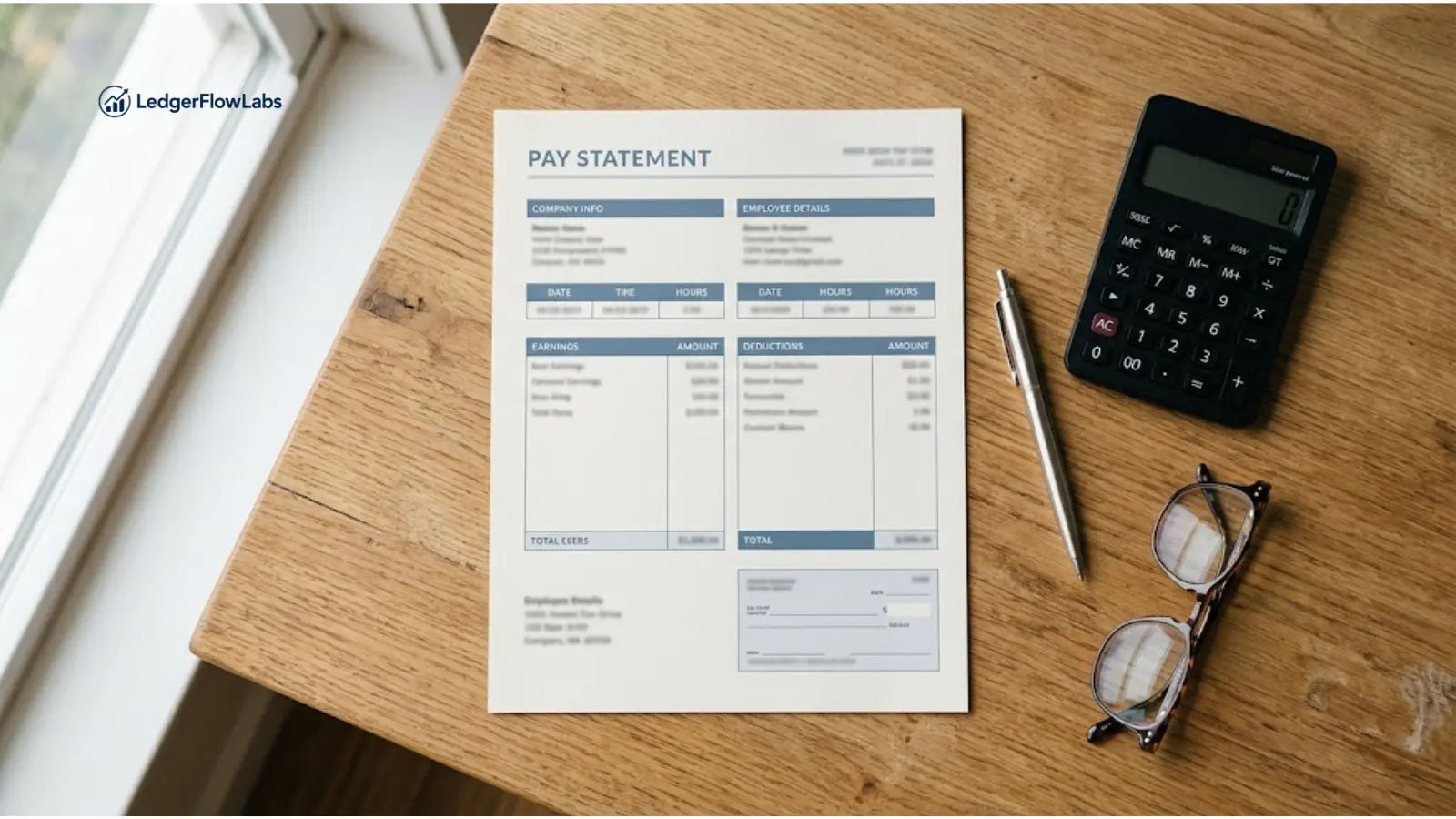
Short answer: a final paycheck should cover every regular wage and overtime hour worked through the last day on the job, plus anything the employer's policy or state law adds on top, such as accrued vacation payout, earned commissions, or a final bonus. Standard deductions still apply, but no new, unexplained deduction should appear. There is no single national deadline for when it arrives; that part is set state by state, so the amount matters more than the calendar date until the state's rule is checked. This guide covers exactly what to check on a final paycheck, line by line, not a state-by-state legal summary.
Most of what gets written about final paychecks is aimed at employers deciding when to cut the check. An employee holding the stub has a narrower, more useful question: does this specific number add up. That is what the checklist below walks through.
What federal law actually guarantees
There is less federal ground here than most people expect, and knowing the floor makes it easier to tell what is a state add-on.
Under the Fair Labor Standards Act, an employer must pay for all hours worked, including overtime earned in the final pay period. What federal law does not do is set a deadline for when that last check has to arrive. The U.S. Department of Labor's own guidance states plainly that employers are not required by federal law to hand over a final paycheck immediately, and that some states require faster payment than the federal baseline, read 2026-09-18.
That single fact reframes the whole topic: the amount is a federal question, and the timing is a state question. Anyone checking a final paycheck needs both answers, and they come from different places.
Final Paycheck: What to Check, Line by Line
Read the stub against this list before assuming the total is right. Skip nothing just because a line looks small.
Regular wages through the last day worked. Every hour on the clock up to and including the final shift belongs in the check, paid at the normal rate. If the pay period cut off mid-cycle, the check should still reflect the actual days worked in that period, not a rounded-down guess.
Overtime earned in the final period. Overtime is a federal requirement, not a policy perk, so it should appear the same way it would on any other paycheck for the same hours.
Accrued PTO or vacation payout. This is the item most likely to be missing and most likely to be owed. Whether unused vacation must be paid out at all is a state-by-state answer. Payroll provider Paycor's 2026 guide to final paycheck rules notes that several states, including California, Colorado and Illinois, treat accrued vacation as earned wages that must be cashed out at separation regardless of the employer's own policy wording, read 2026-09-18. Other states leave it to the employer's written policy. The stub itself, or the pay portal's accrual balance, should show whether a payout was calculated at all.
Earned commissions. A commission already earned under the terms of the compensation agreement is different from one still pending a sale that has not closed. The agreement's own language, not general expectation, decides which bucket a given commission falls into.
A final bonus, if one was promised in writing. A bonus tied to a written plan or agreement is typically owed on the terms of that plan. A purely discretionary bonus, one the employer could choose to grant or not, generally is not.
Reimbursable expenses already submitted. Mileage, travel, or purchases made on the company's behalf that were submitted before the last day should not simply disappear from the process because the employment ended.
Standard deductions, and nothing beyond them. Taxes, retirement contributions already elected, and benefit premiums already owed should look consistent with a normal paycheck. What should not appear is a new deduction invented for the exit, such as an estimated cost for unreturned equipment, unless that arrangement was agreed to in writing and state law allows it.
Reading the stub itself, not just the total
Pulling apart what makes up a normal paycheck is useful groundwork here, because a final paycheck is built from the same parts, just for a shorter and final period. Anyone who has ever looked at a stub and wondered why a raise didn't seem to change the take-home number already has practice separating gross pay, deductions, and net pay, which is exactly the skill a final check requires: compare each line to what a normal period would have shown, then explain every difference instead of accepting the bottom number on faith.
Timing: why there is no single deadline to quote
Because the FLSA sets no delivery deadline, states fill the gap, and they do it very differently. Some states require payment within hours of a firing. Others allow payment on the next regularly scheduled payday regardless of why the job ended. A few states have no specific final-pay statute at all, in which case the federal "next regular payday" practice is what applies in effect.
This is exactly the kind of variation that makes a single quoted deadline unreliable the moment it is copied onto a different state. The only dependable move is to check that state's own labor department page for its current final-pay rule, since these rules are updated and occasionally litigated. Treat any number quoted here as an example, not a promise: Paycor's guide describes some states requiring immediate or same-day payment after a termination, while others follow the standard payday schedule. Which category a given state falls into is a lookup, not a guess.
What a short or late paycheck actually means for the budget behind it
A final paycheck that is smaller than expected, or arrives later than the next payday, is not just a paperwork problem. It is a cash-flow problem for whatever bills were counted on that income. If the number does not match what was expected, it is worth working through what to do when a budget does not balance before assuming the shortfall will sort itself out. The same logic applies to the gap between a last paycheck from one job and a first paycheck from the next: splitting bills across the paychecks that actually land in that window is a more reliable plan than assuming the calendar will cooperate.
If a line item looks wrong
Start with payroll or HR, in writing, and ask specifically which line is disputed and why, referencing the pay period dates. Keep a copy of every pay stub from the final months of employment; those are the records that show whether a discrepancy is new or has been there for months.
If that does not resolve it, the next step is the state labor department responsible for wage claims, since most final-pay disputes are governed by state, not federal, law. The U.S. Department of Labor's Wage and Hour Division is the federal contact for FLSA-covered issues like unpaid overtime, and its guidance points toward the relevant state agency for state-specific final-pay questions.
The one thing most checklists skip
Most final-paycheck guides are written for the employer processing the check, so they explain deadlines and penalties from that side. What they rarely mention is that the final stub is often the last full record an employee will have of that employer's pay practices, including year-to-date totals needed for tax filing and any benefit contributions that were still being deducted. It is worth saving that final stub permanently, not just checking it once and discarding it, because it is the reconciling document if a W-2 or year-end tax form ever looks off later.
FAQ
Does an employer have to pay out unused vacation in the final paycheck? It depends on the state. Some states, including California, Colorado and Illinois, treat accrued vacation as earned wages that must be paid at separation. Others leave it to the employer's written policy, so the policy itself is the document to check.
Can a final paycheck legally be smaller than a normal paycheck? Yes, if the final pay period covered fewer days, or if it excluded a bonus or commission that had not yet been earned under the compensation agreement. A smaller check is not automatically wrong; it should still equal wages actually earned for the period, plus whatever the policy or state law adds.
What happens if the final paycheck is late? There is no single federal deadline, so "late" is measured against the relevant state's rule, not a fixed number of days everywhere. If the regular payday has passed with no payment, the U.S. Department of Labor recommends contacting its Wage and Hour Division or the state labor department.
Is unused sick time paid out the same way as vacation? Not necessarily. States that require vacation payout do not automatically treat sick time the same way, and some distinguish between the two explicitly. The written policy and the state's specific rule both need checking rather than assuming they match.
Can an employer deduct the cost of unreturned equipment from a final paycheck? Whether that deduction is allowed at all, and how much can be withheld, varies by state, and several states restrict or forbid it even with a signed agreement. This is a case where the state labor department's rule matters more than what a company handbook states.
This is general information about how final paychecks work, not a substitute for advice from a state labor agency about a specific situation. Sources: U.S. Department of Labor, "Last Paycheck," dol.gov, read 2026-09-18, for the federal timing baseline and the guidance to contact the Wage and Hour Division or a state labor department. Paycor, "Final Paycheck Laws by State," paycor.com, read 2026-09-18, for the state variation in vacation payout treatment and in post-termination payment timing. Rules cited for individual states are examples from these sources, not a complete state-by-state summary; check the relevant state labor department for the current rule before relying on any single figure.