
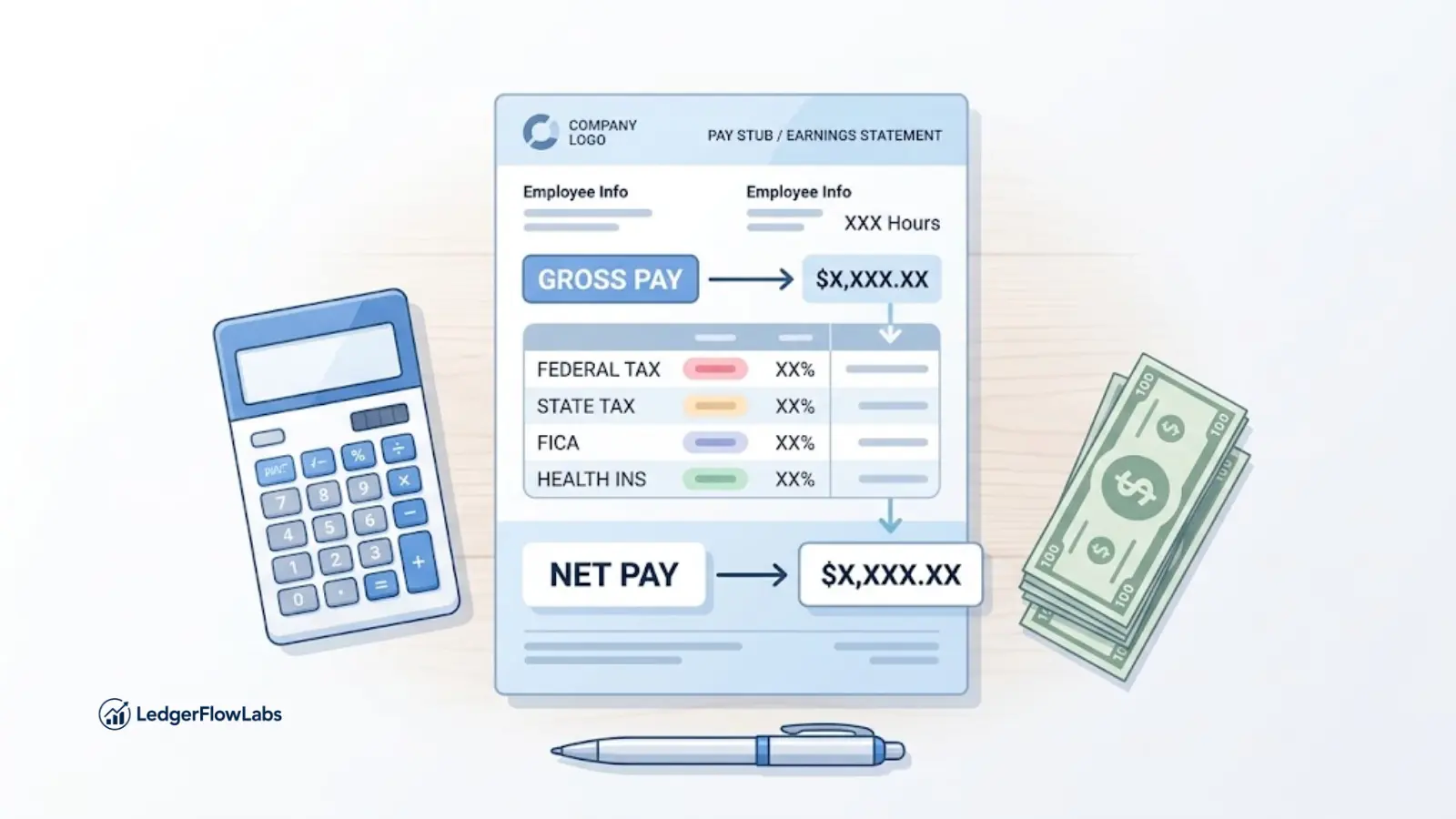
First paycheck explained in plain terms: the gross pay on your stub is the amount your offer letter promised, and net pay, the amount that actually lands in your bank account, is smaller because federal income tax, state income tax where it applies, and FICA (Social Security and Medicare) come out automatically. Reading the stub line by line is what turns that gap from a mystery into arithmetic.
Gross Pay vs. Net Pay: The Two Numbers That Matter
Every pay stub leads with two totals, and confusing them is where the surprise starts. Gross pay is what you earned before anything is taken out: hours worked times your rate, or your annual salary divided by the number of pay periods in the year. Net pay, sometimes labeled "take-home pay," is what is left after every mandatory and voluntary deduction. The offer letter quotes gross pay because that is the contract; the direct deposit reflects net pay because that is what actually moves. Between those two numbers sits a list of withholdings, and each one is required by a specific law or a form the employee filled out, not a guess by the payroll department.
The Taxes That Come Out of a First Paycheck
Three tax lines show up on nearly every US pay stub, and none of them are optional.
Federal income tax is calculated from the Form W-4 filled out on the first day of the job. The employer uses the filing status, dependents and any extra withholding listed on that form to estimate the year's tax bill and collect it in pieces. A W-4 filled out differently changes the withholding on the very next check, which is why two people earning the same salary can see different federal tax lines.
State income tax depends entirely on where the work is performed. A handful of states charge none; most charge a rate that rises with income, similar to the federal system. This is a state-level rule, not a federal one, so the amount and even the existence of this line varies by employer location.
FICA funds Social Security and Medicare and is the one line that does not change based on any form. As of the 2026 Social Security Cost-of-Living Adjustment fact sheet, published by the Social Security Administration (read 2026-09-18), the employee share is 6.2 percent of wages for Social Security, up to the year's taxable maximum, plus 1.45 percent of all wages for Medicare, with no cap on the Medicare portion. Employers pay a matching share on top; it just never shows up on the employee's stub.
Other Deductions You Might See
Beyond the three tax lines, a stub can carry deductions the employee chose rather than ones the law requires. Health, dental or vision insurance premiums are common from the first paycheck if coverage starts immediately, and they are often deducted before taxes are calculated, which lowers the taxable income slightly. A 401(k) or similar retirement contribution, if enrollment happened right away, is another common line, again often pre-tax. None of these lines mean something is wrong; they mean a benefit election is active. It is also worth understanding why a raise sometimes does not increase your paycheck by the amount expected, since a raise can push more income into a benefit-eligible bracket or reset an annual deduction cap at the same time it increases the tax withheld.
How to Read the Layout of a Pay Stub
Most stubs share a common structure, even though the exact design differs by employer and payroll provider. Near the top: the pay period, meaning the range of dates the paycheck covers, and the pay date, which is when the money actually arrives. In the middle: earnings, listing regular hours, overtime and any bonus separately, followed by the deductions column with each tax and benefit itemized. At the bottom: year-to-date (YTD) totals, a running sum of everything earned and withheld since January 1, which becomes useful when checking that a benefit deduction stopped at the right point in the year or that withholding is on pace with the annual estimate.
Pay Stub Rules Are Set State by State
There is no federal law requiring an employer to hand over a pay stub at all. According to Fact Sheet #21 from the US Department of Labor's Wage and Hour Division (read 2026-09-18), the Fair Labor Standards Act requires employers to keep accurate payroll records, including hours worked and wages paid, but it does not require an employer to give those records to the employee as a stub. Whether a pay stub is provided automatically, provided on request, or not required at all is decided state by state, and the rules on what a stub must contain also differ by state. If a first paycheck arrives without a pay stub, or the stub looks unusually sparse, check that state's labor department for what it actually requires rather than assuming a national standard.
Your First Paycheck Explained in Dollars: A Simple Illustration
To make the arithmetic concrete, here is an illustration using round numbers and the sourced FICA rates above; it is not a prediction of any specific paycheck, because federal and state income tax depend on the individual's W-4, location and benefit elections. On a hypothetical $1,000 of gross pay for a single pay period, Social Security withholding at 6.2 percent is $62, and Medicare withholding at 1.45 percent is $14.50, for $76.50 in FICA alone before any income tax is calculated. Federal and, where applicable, state income tax are layered on top of that using the W-4 and the state's own tax tables, which is why two coworkers earning the identical gross pay can still see different net pay.
What To Do If Your First Paycheck Looks Wrong
A first paycheck that looks smaller than expected is usually explained by the lines above, but a few things are worth checking rather than assuming. Confirm the pay period matches a full cycle; a first check sometimes covers a partial period if the start date fell mid-cycle. Confirm the hourly rate or salary on the stub matches the offer letter. If federal income tax shows as zero, that can mean the W-4 was filled out claiming exempt status, which is only valid in specific circumstances and is worth revisiting with HR before it becomes a large tax bill later. If the numbers still do not add up after checking each line, payroll or HR can walk through the calculation directly. Once the numbers make sense, the next step is usually figuring out what to do when a budget does not balance around the real number rather than the offer-letter number.
Building a Budget Around Your Real Take-Home Pay
Net pay, not gross pay, is the number a budget should be built around, since it is the only number that actually reaches the bank account. New employees paid every two weeks sometimes plan bills as if every month has two paychecks, when two months a year have three; splitting fixed bills across paychecks deliberately, rather than paying whatever is due whenever a check lands, avoids that gap. It also helps to build irregular costs into the plan early rather than reacting to them later, since planning ahead for seasonal expenses is far easier from the first paycheck than after a surprise bill has already landed.
Frequently Asked Questions
Why is your first paycheck smaller than the salary you were offered? The offer letter states gross pay, before anything is withheld. Federal income tax, FICA, and state income tax where it applies, plus any benefit elections, are subtracted to produce net pay, which is the number that actually deposits.
What is FICA, and can you opt out of it? FICA funds Social Security and Medicare. It is withheld at 6.2 percent and 1.45 percent of wages respectively, per the Social Security Administration, and it is mandatory for nearly all employees; it is not a benefit election that can be turned off.
Why is there no federal income tax listed on your first pay stub? This usually means the W-4 on file claims exempt status or very high withholding allowances, resulting in little or no federal tax being taken out. It is worth confirming with HR that this was intentional, since it affects the tax bill filed the following year.
When should you expect your first paycheck at a new job? Timing depends on the employer's pay schedule and payroll cutoff dates, and can also depend on whether the start date fell in the middle of a pay period. HR or payroll can confirm the exact first pay date during onboarding.
Where can you find the pay stub rules for your specific state? Pay stub requirements, what a stub must include, and how it must be delivered, are set at the state level, not federally. Searching for that state's department of labor site is the reliable way to find the current rule rather than relying on a national assumption.
Understanding a first pay stub is mostly a matter of matching each line to a reason: a tax required by law, a benefit chosen during onboarding, or a pay period that does not match assumptions. Once each line has a name, the paycheck stops being a surprise and starts being a tool for the budget built around it.