
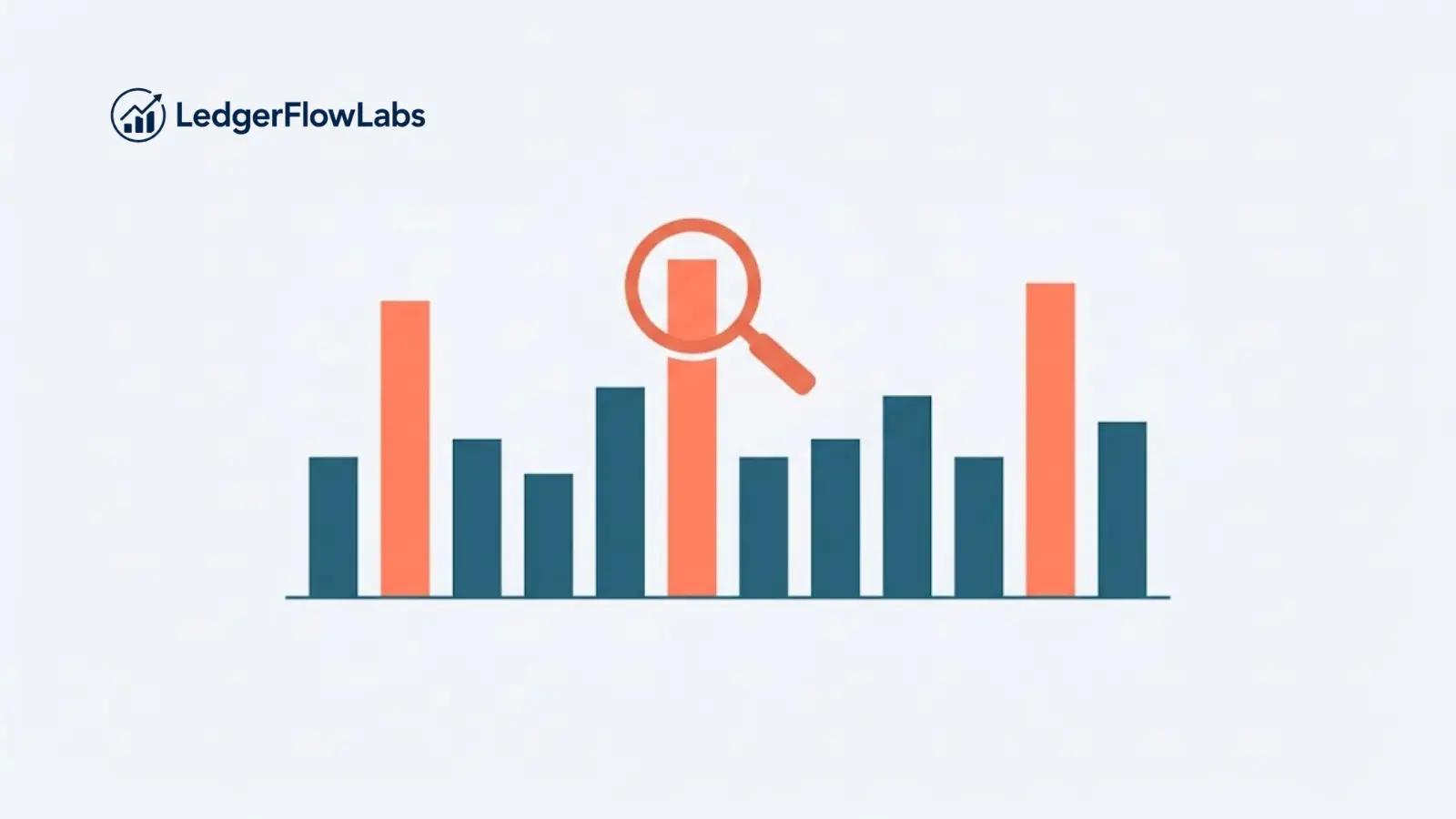
Short answer: pull twelve months of your own records, total each month, and mark every month that sits above your own median. Those are your spike months, and they are usually the same ones every year. Then find the categories that actually caused each spike, because a seasonal spike is rarely one purchase. It is ordinary spending that gets bigger for several weeks. Fund the total across the months in between, and start funding earlier than the month you blame, because most spikes begin before the month you noticed them.
This is educational information, not financial advice. For decisions about your own money, consult a licensed financial advisor.
Where this applies: the method here is arithmetic on your own bank and card records, so it works anywhere. The examples of what tends to cluster in a given month reflect a United States calendar, and your own records are the authority on your own year.
A seasonal spike is not the same thing as an annual bill
This distinction is the whole reason a seasonal month keeps catching people who already plan ahead.
An annual bill has a name, an amount and a date. Insurance renews. Registration comes due. You can look it up, write it down and divide it across the months before it lands, which is exactly the approach in our guide to annual and irregular bills.
A seasonal spike has none of those three. It has no single name, because it is spread across groceries, gas, gifts, eating out, clothing and travel at once. It has no exact amount, because nobody sends you a total in advance. And it has no date, because it is a stretch of weeks rather than a day.
So the standard advice, list the bill and divide by the months remaining, does not reach it. The bill method needs a bill. A spike month has to be found before it can be planned for, and finding it is the part almost every guide skips.
Step one: find your own spike months, from your own records
You do not need a national average for this and you should not use one. Somebody else's holiday season is not yours. Twelve months of your own statements will tell you more than any survey.
Pull twelve months of checking and card statements. For each month, write down one number: total money out. Ignore categories for now.
Then find your median month, which is the middle value when you line the twelve totals up in order. The median is more useful here than the average, because one extreme month drags an average upward and makes every other month look artificially fine.
Now mark every month that sits meaningfully above that median. Two or three usually stand out, and most people can name the reason as soon as they see the shape. Common clusters in a US calendar include the November and December holiday stretch, an August back-to-school and back-to-work stretch, a summer travel and cooling stretch, and a winter heating stretch. Yours may be none of these. A wedding season, a birthday cluster, a religious calendar, a sports season or a self-employed slow quarter all produce the same pattern.
Step two: find what actually caused each spike
A month total tells you which month. It does not tell you what happened, and the answer is usually not what people assume.
Take one spike month and your median month, and compare them category by category. What you are looking for is the difference in each category, not the size of each category. Gifts may be the obvious line and still not be the biggest one. Food, fuel, shipping, parking, alcohol, clothing and the small unplanned purchases around an event routinely add up to more than the thing everyone was budgeting for.
| Column | What goes in it |
|---|---|
| Category | Groceries, fuel, gifts, dining, travel, utilities, clothing, other |
| Median month | What that category costs in an ordinary month |
| Spike month | What the same category cost in the spike month |
| Difference | Spike minus median, which is the part that is actually seasonal |
The bottom of that difference column is your real spike size. It is the number to fund, and it is almost always different from the number people would have guessed, in both directions. Doing this with your own figures rather than a published average is the same discipline as reading your own cash flow across three months instead of judging your year by one bad month.
Step three: the spike starts before the month you blame
Here is the part that changes the plan.
Most people label December as the expensive month because that is when the statement arrives. Look at the dates on the transactions and the spending usually begins weeks earlier, in October or early November. The same is true of an August school spike that really started in July, and of a summer travel spike that was paid for in the spring when the trip was booked.
This matters for two reasons. The money has to be present earlier than you thought, so a plan that funds a December spike by the end of November is already late. And the spike is often split across two statement periods, which is why the total feels smaller than it was: you saw it in two pieces. If your card period does not line up with the calendar month, our explainer on the statement cycle versus the calendar month covers why the split happens.
The practical adjustment is to date the spike from the first transaction rather than from the month it hurt, then count the months you have from today until that first date.
Step four: fund it, and keep it separate from everything else
Once you have a size and a start date, the arithmetic is ordinary: the spike total divided by the number of months between now and the month it begins. That is a monthly set-aside, and it belongs somewhere it will not be spent by accident.
Money named for a spike is not emergency money. It is already spoken for, it has a date, and mixing the two makes both numbers meaningless, which is the distinction drawn in sinking funds versus emergency funds.
Two traps are worth naming before they cost you a month.
Double counting. If you already listed holiday spending as a line in your annual bill plan, do not fund it again here. Pick one place for it and delete the other. Funding the same spike twice is a common reason the monthly total looks impossible.
Confusing a spike with a variable expense. Groceries change every month for everyone, and that ordinary variation is handled by averaging variable expenses rather than by a seasonal fund. What belongs here is only the part above your normal range, for a limited stretch, that repeats at the same time each year.
When the spike genuinely does not fit
Sometimes the honest answer is that the months between now and the spike cannot produce the total. That is a real result, not a failure of the method, and it is better to know in September than in December.
What the arithmetic gives you at that point is a choice rather than a surprise. You can fund part of it and know exactly how much of it is unfunded. You can start with next year's cycle, since a spike you cannot fund this year has a full twelve months in front of it after it passes. You can move some of the spending outside the spike window, which works for anything that is not date locked, such as clothing or a gift bought in advance. Or you can reduce the spike, which is a personal decision this page will not make for you.
None of those options is available to somebody who finds out in the last week. The value of the method is the notice it buys, and the notice is what turns a spike month into a planned one. A spike that arrives unfunded also tends to arrive at the wrong moment inside the month, which is the timing problem behind running out of money before payday.
What this method cannot do
It cannot make a seasonal month cheaper. Spreading a spike across the months before it costs exactly the same total, and anyone promising otherwise is selling something. What changes is when the money is set aside and whether the other months are quietly borrowed from.
It also assumes next year resembles last year. A new child, a move, a new job or a changed household will move your spike months, and one year of records will not show that. Rerun the twelve-month totals once a year rather than trusting a chart you built once.
FAQ
How do I know which months are my seasonal months? Total twelve months of your own outgoing money, find the middle value, and mark the months that sit above it. Two or three usually stand out, and they tend to repeat each year.
Why not just use an average for holiday or back-to-school spending? Because a published average describes a population, not your household. Your own statements give you a number you can act on, and they cost nothing to read.
Is a seasonal spike the same as an annual bill? No. An annual bill has a name, an amount and a due date. A spike is spread across several ordinary categories over several weeks, with no invoice and no fixed total, so it has to be measured before it can be funded.
When should the money be ready? Earlier than the month that hurts. Look at the transaction dates in last year's spike and you will usually find the spending started several weeks before the month you remember.
What if I cannot save the full amount in time? Then you know the size of the gap in advance, which is the point of measuring it. Partial funding, starting on next year's cycle, or shifting some spending outside the window are all options, and which one fits is your call.
Sources: no statistic, average or national figure is cited on this page. Every number in this method comes from the reader's own bank and card records, which is deliberate. Category clusters named in the text are examples of what the exercise commonly finds, not measured claims.