
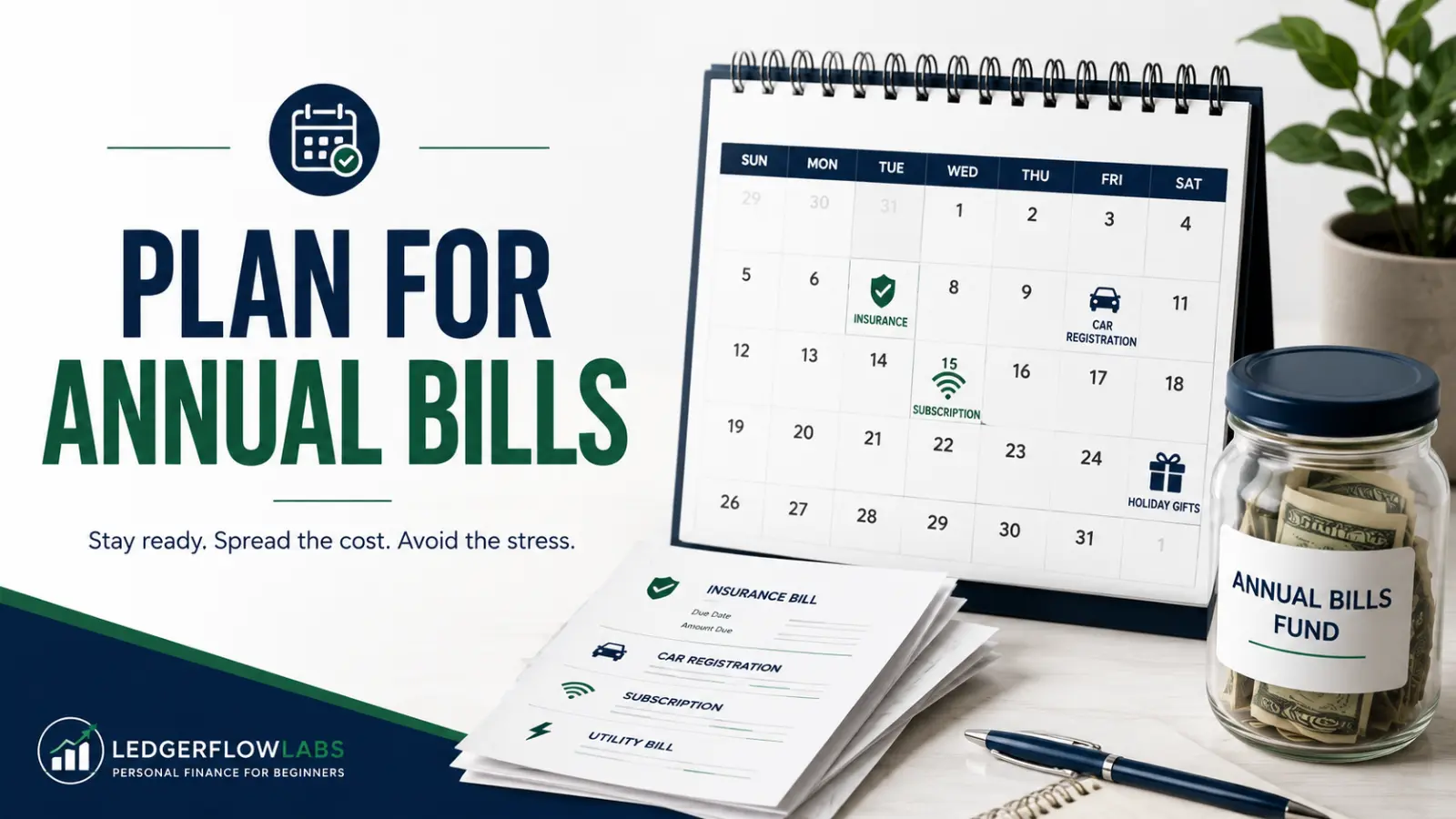
Short answer: list every bill that arrives less often than monthly, find each one's due date, and divide what you owe by the number of months remaining until that date rather than by twelve. Hold the money in a separate account so it is not spendable by accident. The step almost every guide skips is the first year, where several bills are due sooner than twelve months away and the arithmetic is genuinely heavier than the version you were promised.
This is educational information, not financial advice. For decisions about your own money, consult a licensed financial advisor.
Where this applies: written for readers in the United States. Billing options, renewal practice and installment terms are set by each individual provider, and yours is the authority on what it offers you.
Why an annual bill feels like an emergency when it is not
Nothing about an annual bill is a surprise. You know the amount within a small margin and you know the month. It still lands like a shock, because a monthly budget has no place to put it.
Your budget describes a month. An annual bill belongs to a year. So it arrives inside a month that was never built to hold it, and the month absorbs it by taking money from everything else, or by not absorbing it at all. That is a structural mismatch, not a discipline failure, and structural problems have structural fixes.
Step one: build the list, with dates
Pull twelve months of statements and write down everything that is not monthly. Typical entries:
- Insurance premiums paid annually or every six months
- Vehicle registration, inspection, licensing
- Property tax or any bill collected once or twice a year
- Annual subscriptions and memberships
- Professional fees, dues, renewals
- Predictable seasonal spending such as holidays, school costs or a birthday cluster
- Regular maintenance you know is coming, such as a service interval
For each, record three things: the amount, the month it is due, and how confident you are in the amount. The third column matters, because "insurance renewal, roughly, may change at renewal" behaves differently from "registration, exact, same every year."
Amounts you are unsure about: use last year's figure and note that it may move. Do not invent an inflation adjustment you cannot source.
Step two: divide by months remaining, not by twelve
Here is the arithmetic error the standard advice bakes in.
"Divide by twelve" is correct only for a bill twelve months away. Most of your bills are not. If your registration is due in four months, you need a quarter of it each month, not a twelfth.
Monthly amount = amount due, divided by the number of months between now and its due date.
A worked example, with hypothetical figures:
| Bill | Amount | Due in | Monthly set-aside |
|---|---|---|---|
| Car insurance | $960 | 6 months | $160 |
| Registration | $180 | 4 months | $45 |
| Annual subscription | $120 | 10 months | $12 |
| Holiday spending | $500 | 5 months | $100 |
| Total | $317 |
Divide-by-twelve would have produced $147 a month and a very unpleasant fourth month. The real first-year number is more than double it.
The first-year problem, which nobody warns you about
This is the information the sinking-fund guides leave out, and it is why people start this system and stop.
Year one is not the steady state. In year one you are funding bills that are only a few months away, so the monthly total is high. In year two, every one of those bills is a full twelve months out and the number drops to the comfortable divide-by-twelve figure you were originally promised.
Knowing that in advance changes the decision, because the honest question is not "can I afford this forever," it is "can I get through the next several months." If the year-one total does not fit, you have four legitimate options, and none of them is failure:
- Partially fund the near bills. Cover what you can and accept that the first cycle of one or two bills will be tight. Then that bill is fully funded from its next cycle onward.
- Start with the bills furthest away. Counterintuitive, but the far bills are the cheapest to fund per month, so starting there gets the most bills onto the system for the least money. The near ones join as they reset.
- Ask the provider about monthly billing. Many annual bills can be paid in installments. This removes the saving problem completely by converting the bill to a monthly one.
- Move a renewal date. Not always possible, but some renewals can be shifted, which lets you pull a bill out of an already crowded month.
On option three, one honest caution: installment billing is sometimes more expensive than paying in full. Some providers add a service or finance charge for splitting a payment, and some do not. This site will not publish a figure for it, because it is set by each provider. Ask yours what the annual cost is each way and compare the two totals before deciding. If the difference is small, the certainty may be worth it. If it is large, funding it yourself keeps that difference.
Step three: check your peak month, not just your monthly total
Dividing by months remaining tells you what to set aside. It hides something else: whether your bills are evenly spread across the year. They rarely are.
Put the due dates on the same view as everything else, which is exactly the job of a bill calendar, and count what lands in each month. Most people find one or two months carrying several renewals at once, often because everything was set up in the same week when they moved or bought a car.
That clustering is worth fixing separately, because a fully funded peak month still drains the account it is funded from all at once. The options are the same as above: move a renewal, convert one bill to monthly, or simply know it is coming. Some of these dates can be changed by asking, as covered in how to change a bill due date.
Step four: where the money sits
The money must be somewhere it will not be spent by accident, and somewhere you can reach without a delay when the bill lands.
A separate savings account, or a named savings bucket at the same institution, is the usual answer. Many banks and credit unions allow multiple savings accounts or sub-accounts, so ask yours what it supports.
One thing to keep straight: this money is not your emergency fund and it is not your paycheck buffer. It is spoken for. Every dollar in it has a name and a date. Mixing it with emergency savings makes both numbers meaningless, which is the distinction drawn in sinking funds versus emergency funds.
Automate the transfer for the day after your income lands, not the day of, so a late deposit does not turn a good habit into an overdraft. That timing risk is covered in autopay and overdraft risk.
Step five: true up once a year
Once a year, compare what you set aside against what each bill actually cost. Adjust the ones that moved. Add anything you missed, and something is always missed the first time.
Two habits that make this hold:
- Recalculate an amount when a renewal notice arrives, not at the end of the year, so you have months of notice rather than weeks.
- Leave the surplus in place when a bill comes in under the funded amount, and reduce next year's contribution instead of withdrawing it. It is the cheapest cushion you will ever build.
What this does not do
It does not reduce what you owe. Spreading an annual bill across twelve months costs exactly the same as paying it in one month, and anyone claiming otherwise is selling something. What changes is that the money is present on the day it is needed, and that the other eleven months stop being borrowed from.
It also does not cover genuine surprises. A funded sinking fund and an emergency fund are different accounts because they answer different questions, and using one for the other quietly disarms both.
FAQ
Should I divide my annual bills by 12? Only for bills that are twelve months away. Divide each bill by the number of months until its own due date, which in the first year is usually fewer than twelve.
Where should I keep money for annual bills? In a separate savings account or a named bucket, away from everyday spending, and reachable in time for the due date. It should not be mixed with emergency savings.
Is it cheaper to pay annually or monthly? It depends entirely on the provider. Some add a charge for installments and some do not. Ask for the total annual cost both ways and compare, rather than assuming either is cheaper.
What if I cannot afford the first-year amount? Fund the bills that are furthest away first, since they cost the least per month, and add the near ones as they reset. Partial funding of a near bill is still better than none.
What counts as an irregular bill rather than a variable expense? An irregular bill has a known amount and an unpredictable or infrequent date. A variable expense happens every month at a different amount and is handled by averaging instead.