
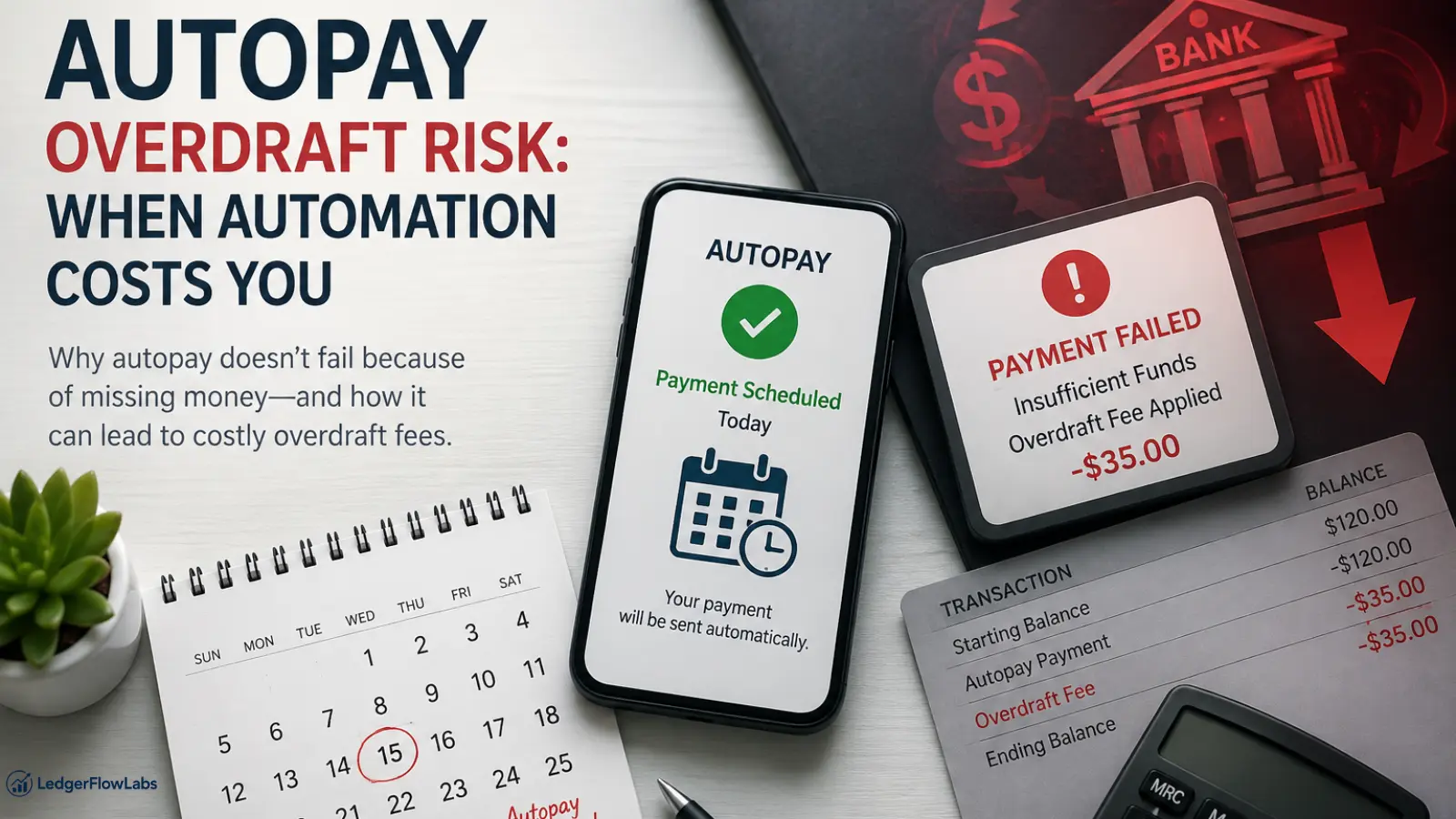
Short answer: autopay does not fail because the money was missing. It usually fails because the payment and the deposit landed on the same day and the payment posted first. A bank does not process your account in real time as a continuous stream; it posts in cycles, and a payment scheduled for your payday is scheduled against yesterday's balance. The fix is to set every automatic payment for a date after your deposit reliably becomes available, not on your payday and not on the due date.
This is educational information, not financial advice. For decisions about your own money, consult a licensed financial advisor.
Where this applies: written for readers in the United States. Posting order, cut-off times and fees are set by each bank and disclosed in your account agreement, which is the authority for your account.
The mechanism, stated plainly
Two events on the same calendar date are not simultaneous.
Your employer's deposit arrives through a batch process with its own timing, described in how long a direct deposit takes to clear. Your biller's automatic payment arrives through a separate process with its own timing. Your bank then applies both according to its own posting order and cut-off hour.
If the payment is applied before the credit, your balance dips, and it does not matter that the money arrived four hours later. The decision was made at the moment of posting.
This is why the advice "make sure the money is there" is not enough. The money was there, on the correct date. It was not there at the correct moment, and the moment is what the bank acts on.
The three kinds of autopay, and why the risk is different
Almost nobody distinguishes these, and they behave differently.
| Type | Who initiates it | Timing risk |
|---|---|---|
| Biller pull (you give a company your account number) | The company | Highest. The date is theirs, it can drift within a window, and you cannot see it coming in your own scheduled payments |
| Bank push (you set it up in your bank's bill pay) | You | Lower. You control the date, and the payment appears in your own bank's schedule |
| Card on file (the bill charges a credit card) | The company | The overdraft risk moves to your card statement due date instead of the bill date, which is a different problem, not a smaller one |
If a bill has repeatedly caught you out, moving it from biller pull to bank push gives you back control of the date. That is often a bigger fix than adjusting the amount you keep in the account.
What it actually costs when it fails
Two charges, sometimes three, and they are separate.
The bank's charge. If the bank pays the item anyway, that is an overdraft fee. If it declines the item, that may be a nonsufficient funds charge instead. Amounts are set by each institution. As reported by the National Consumer Law Center, per-item overdraft fees at many institutions are commonly cited in the range of roughly $25 to $35 at the time of writing, though the actual figure is whatever your own account disclosure states. Note also that the CFPB's 2024 rule limiting overdraft fees at very large institutions was repealed by Congress in 2025, as recorded by the Congressional Research Service, so there is no single national cap to rely on. Read your own fee schedule rather than any figure on any blog, including this one.
The biller's charge. A returned payment usually carries its own charge from the company, plus a possible late fee if the payment does not go through in time.
The retry, which is the part nobody explains. Many billers automatically attempt the payment again after a failure. If your balance is still low, that second attempt can produce a second fee from the bank. This is how one failed payment turns into a multiple-fee week, and it is why calling the biller to pause the retry can matter as much as depositing money.
This concentration is not evenly spread across the population. As reported by the CFPB in its Data Spotlight on consumer experiences with overdraft programs, 79 percent of overdraft and nonsufficient funds fees were borne by 9 percent of accounts, and that group's median account balance was under $350. In other words, these fees fall hardest on accounts running closest to zero, which is exactly the situation autopay timing creates.
The information gain: pick the date backward from your deposit
Most guidance says to align autopay with payday. That is half a rule and the missing half is where people get hurt.
Do not schedule payments on your payday. Schedule them for one to three business days after the day your deposit reliably becomes available.
Work it out in this order:
- Observe your own deposit timing over two or three cycles. Not what your employer says, and not what the internet says. Note the day and rough hour it becomes spendable.
- Add a business day. This absorbs a batch delay, a weekend, or a federal holiday.
- Check the payment date is still inside the grace period, if there is one. A payment made after the due date but inside a grace period is generally treated differently from a genuinely late one, and grace periods vary by product and provider. Ask yours, in writing if you can.
- Then set the autopay to that date.
The reason people resist this is fear of being late, so they set the payment on the due date, which is the single riskiest date available: it maximizes the time between the deposit and the payment being needed, and it leaves no room at all if anything slips.
If the due date genuinely cannot accommodate a delay, move the due date instead of the payment. Many providers will change one, as covered in how to change a bill due date, and matching due dates to your pay cycle is the whole subject of payday versus due date.
Why the balance on your screen will not warn you
The number you check before letting an autopay run is not a forecast. It is a photograph of a moment that already contains authorizations you have forgotten and excludes payments you have scheduled. The gap between the two figures your bank shows is explained in available balance versus actual balance, and the delay between spending and settlement is in pending versus posted transactions.
The number that would actually tell you whether Thursday's autopay will clear is not on the screen at all. It is your available balance, minus everything already committed before Thursday, plus anything definitely arriving before Thursday. Working that out by hand every month is unpleasant, which is why a paycheck buffer is the durable version of this fix: with a buffer, the posting order stops mattering, because the payment is never drawn against money that has not arrived.
A short autopay audit worth doing once
Once a year, or the next time a payment fails, list every automatic payment you have and record four things for each: the amount, the date it actually hits, whether it is a pull or a push, and whether the amount is fixed or variable.
Two findings are common and both are fixable:
- Variable-amount autopays are the ones that overdraw accounts, because the number you planned around was last month's. Utilities and card minimums are the usual culprits.
- You have autopays you forgot about entirely, which is not a moral failing; it is the predictable result of setting up a payment and never seeing it again. Putting them all on a bill calendar is what makes them visible.
What autopay is still good for
Being fair to it: autopay prevents the most common cause of a late payment, which is forgetting. That is a real benefit and this article is not an argument against automation.
The honest position is narrower. Autopay removes the memory problem and adds a timing problem. Automating a fixed payment on a well-chosen date is close to free. Automating a variable payment on the due date, from an account that runs near zero, converts a problem you could have seen coming into one that resolves itself at your expense.
FAQ
Can autopay cause an overdraft even when I get paid that day? Yes. A deposit and a payment on the same date are not simultaneous, and a bank applies transactions according to its own posting order and cut-off times. A payment can post before a deposit that arrives later the same day.
What is the safest date to schedule an automatic payment? One to three business days after your deposit reliably becomes available, provided that date still satisfies the biller. Scheduling on payday or on the due date leaves no room for a delay.
What happens if an automatic payment fails? You may face a fee from your bank and a returned-payment charge from the biller, and many billers retry automatically, which can trigger a second bank fee. Contacting the biller to stop the retry can prevent the second one.
Should I turn off overdraft coverage? That is a personal decision with real trade-offs: coverage means the payment goes through and a fee may apply, while declining means no overdraft fee but a failed payment and possible charges from the biller. Ask your bank what options your account has and what each one costs.
Is it better to use a credit card for autopay? It moves the timing risk rather than removing it, from the bill date to the card's due date. That can help if your card date suits your pay cycle better, and it makes things worse if the balance is not cleared each month.