
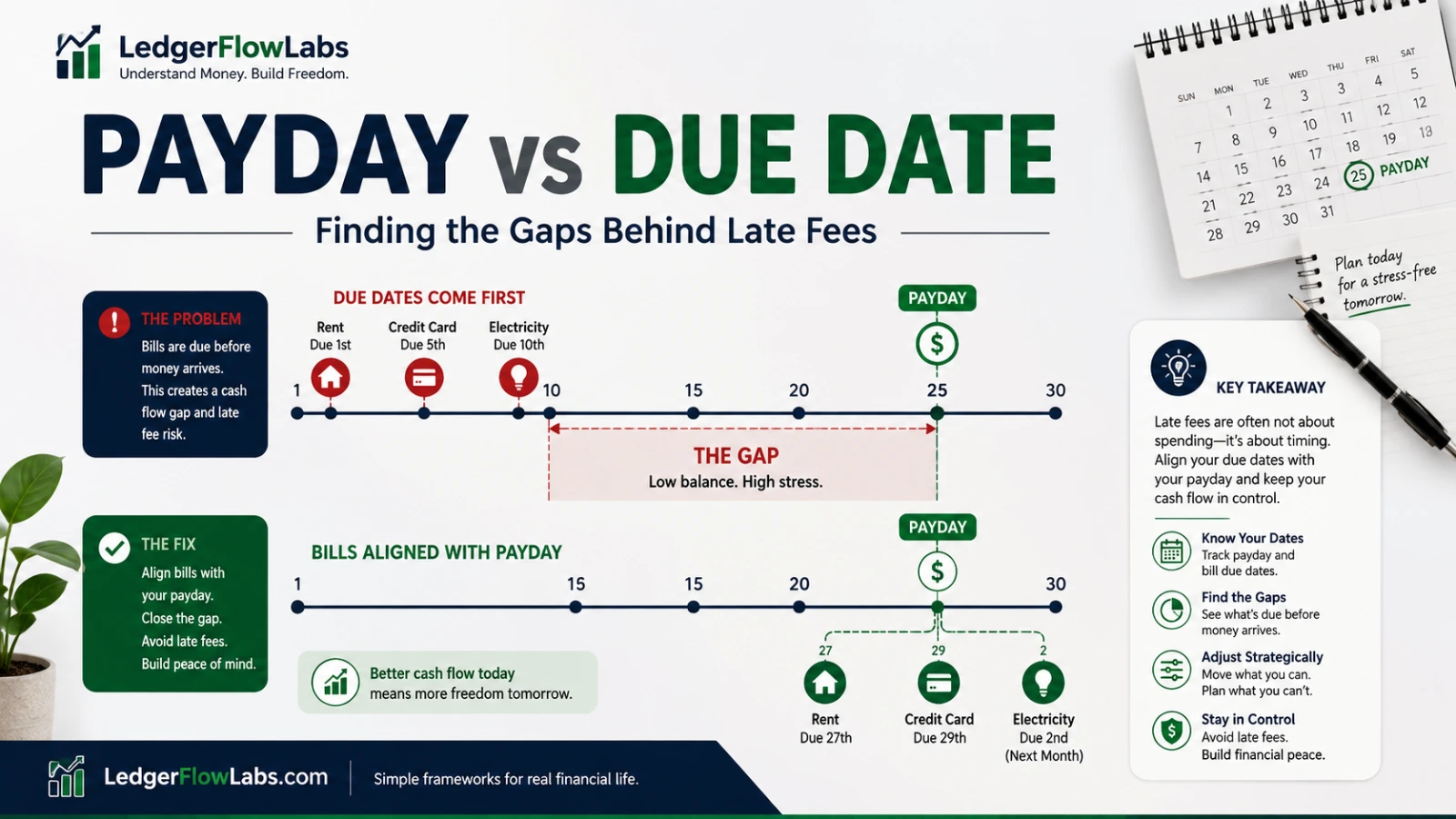
A late fee is usually not a memory failure. It is a scheduling failure: a payment fell due at a point in the cycle when the account was at its thinnest, and it did so for the same reason it did last month. This guide covers how to lay your pay dates and due dates on one timeline, how to read the negative stretches, and why the obvious fix of pushing every bill to just after payday tends to create a new problem.
This is educational information, not financial advice. For decisions about your own money, consult a licensed financial advisor.
Where this applies: written for readers in the United States. The federal source named below is a US agency.
The gap, defined precisely
The Consumer Financial Protection Bureau, the US federal consumer agency, puts the underlying issue plainly: one reason people fall behind on bills is that their bill due dates and their income are not aligned. That is correct, and it is also general enough that it is hard to act on. Here is the precise version.
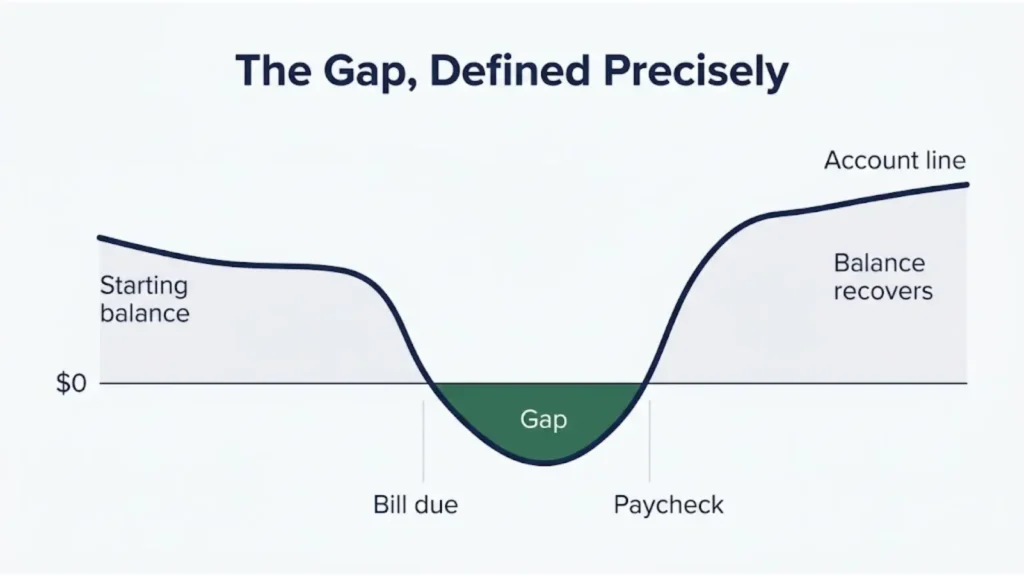
A gap is any stretch of days where scheduled outflows exceed the money on hand plus any income arriving inside that stretch. It has three properties, and all three matter.
It has a start date and an end date. It is not a month, it is a window, often three to six days long.
It has a depth. How far below zero, or below your comfortable floor, the running total goes.
It has a cause you can name. A specific bill, or a specific pair of bills, landing before a specific paycheck.
A gap is not the same thing as being short of money. It is entirely possible to have a comfortable month overall and a serious gap inside it, which is exactly why a monthly budget can pass while the account still goes negative. The rest of this guide is about finding yours.
Step 1: put pay dates and due dates on one timeline
You need two lists, on one page, in one date order.
If you have already built a bill calendar, you have the first list. If not, our guide to building a bill calendar from your own due dates covers how to find dates you do not currently know, and why the date you write down should be the date the money must leave rather than the date printed on the bill.
For the second list, write out your actual pay dates for the next three months. Real dates, not the rule that generates them. Three months rather than one, because a single month of a biweekly schedule tells you almost nothing: the dates drift, and the shape of the problem changes as they do. Weekly, biweekly and semimonthly pay explains why that drift happens.
Now interleave them. One column of dates from today forward, with every paycheck and every payment on its own line, in the order they occur.
Step 2: find the negative stretches
Start with your available balance today, and only your available balance. Not the larger number your bank may also show you, and not the amount you think of as being in the account. The reason for that specific choice is covered in why the balance in your banking app is not the money you have, and it matters here because starting from the wrong figure makes the whole timeline optimistic by exactly the amount you are most likely to trip over.
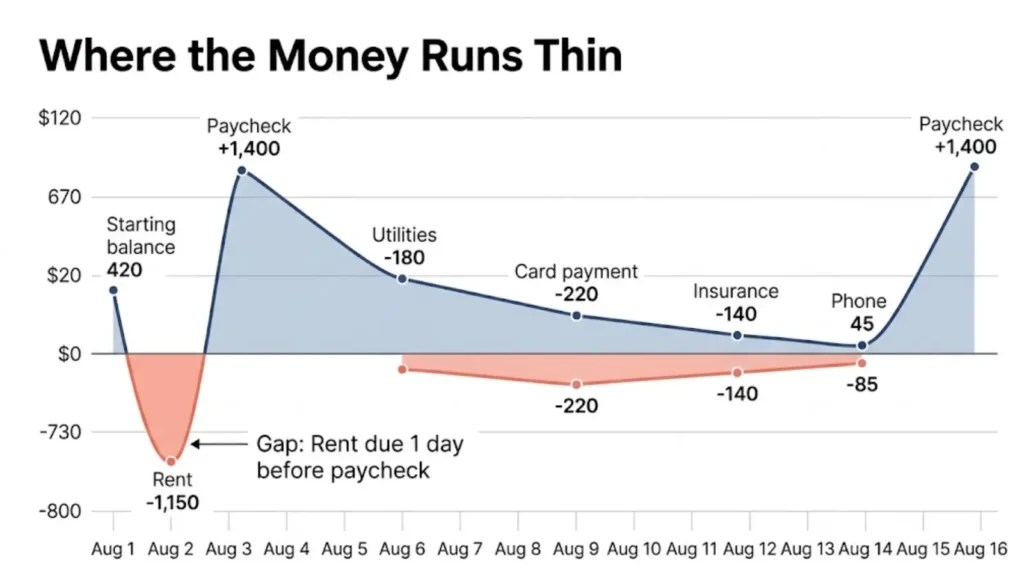
Then walk the list from top to bottom, adding paychecks and subtracting payments, writing the running total beside each line.
Here is a hypothetical illustration of what the output looks like. These figures are invented for the example and are not typical of anything.
| Date | Item | Amount | Running total |
|---|---|---|---|
| Aug 1 | Starting available balance | 420 | |
| Aug 1 | Rent | -1,150 | -730 |
| Aug 2 | Paycheck | +1,400 | 670 |
| Aug 5 | Utilities | -180 | 490 |
| Aug 9 | Card payment | -220 | 270 |
| Aug 12 | Insurance | -140 | 130 |
| Aug 14 | Phone | -85 | 45 |
| Aug 16 | Paycheck | +1,400 | 1,445 |
Read that and the problem is not vague at all. It is August 1, and it is caused by rent falling one day before a paycheck. Everything after August 2 is fine. The month as a whole is fine. A single day is not.
Most people find one or two of these, and find that they are the same one or two every month, involving the same bills. That is the entire diagnosis, and it is worth more than another month of guessing which purchase was the mistake.
Step 3: decide what to move, and where to move it to
Once you can see the gap, the question is what to move. Three options, in rough order of how easy they are.
Move the bill that causes the gap. In the example above, that is rent, which is one of the hardest bills to move because the date is a lease term. So look at the next lever.
Move a different bill out of the same stretch. You do not have to move the biggest bill. Relieving the pressure around it can be enough, and cards and utilities are usually the most movable. How to move a bill due date covers which providers will actually change one, what to ask, and the larger transition bill that arrives after the change.
Move the money instead of the date. Covered at the end of this guide.
As for where to move it to, that is where most advice goes wrong.
Why stacking everything right after payday backfires
The standard recommendation is to arrange your bills so they fall as soon as possible after you are paid. The logic is intuitive: pay everything while the money is there, so it cannot be spent on anything else.
It has a real failure mode, and it is worth being specific about it.
It creates one enormous withdrawal. If every bill lands in the two days after a paycheck, those two days remove most of the paycheck at once. Anything that goes wrong in that window, a hold that lands earlier than expected or a payment that posts sooner than you thought, hits all of them together rather than one of them.
It makes the rest of the cycle read as surplus. This is the bigger problem. After the stack clears, the balance sits at a number that looks like spare money for the next two or three weeks. It is not spare money; it is next cycle’s money, arriving early in appearance only. A balance that looks comfortable for eighteen days is a much more reliable way to overspend than a balance that never looks comfortable at all.
It concentrates the risk of a single mistimed deposit. If a paycheck is delayed by even a day, a stacked schedule turns one late deposit into several late payments rather than one.
The better target is a deliberate split. If you are paid twice a month, aim for roughly half your outflows shortly after each paycheck, sized so that each half fits the check that precedes it. The point is not symmetry for its own sake. It is that each paycheck should visibly cover the obligations that follow it, so the balance in between never pretends to be something it is not.
Our guide to pay yourself first budgeting covers the related ordering question of what comes out before anything else, which is a different decision from this one and often gets confused with it.
The bills you cannot move
Some dates are genuinely fixed. Rent and mortgage payments are contract terms. Many loan servicers will not adjust. Some employers will not change a pay date under any circumstances.
When the immovable bill is the one causing the gap, you have two remaining moves and neither is a scheduling change.
Move everything else away from it. If rent on the first is the problem, the goal is to have as little else as possible due between the twenty-fifth and the third. You are not fixing the rent date; you are giving it room.
Change the amount of money in the account when it arrives. Which is the next section.
The other fix: move the money, not the date
Every gap in the timeline exists because the account is being asked to fund an outflow before the matching inflow arrives. There are exactly two ways to close that: bring the outflow later, or bring money earlier.
The second is a buffer. Enough money sitting in the account permanently that the timing of any single bill stops mattering, because there is always a cushion underneath the balance. A person with a full cycle of expenses sitting in their account does not have a gap problem at all; every bill is being paid out of money that arrived a cycle ago, and due dates become an administrative detail rather than a monthly stress.
Building one is slower than moving a date, which is why this cluster covers due dates first. But it is the only version of the fix that is permanent, and the mechanics of it are worth understanding early. Money set aside for a known, dated purpose is doing a different job from money set aside for the unexpected, and our guide to sinking funds versus emergency funds covers why keeping those two jobs separate matters.
If the timeline you built in step 2 is negative at the end of three months no matter which dates you move, then the issue is not distribution, and neither rescheduling nor a buffer will fix it. That situation is covered honestly in why you run out of money before payday, and it is a conversation to have with a licensed financial advisor or a nonprofit credit counseling agency rather than a scheduling exercise.
FAQ
Should all my bills be due right after payday?
No. Stacking everything into two days creates one large outflow and then weeks of a balance that reads as surplus. Aim for a deliberate split across the cycle, sized so each paycheck visibly covers what follows it.
What if I get paid every two weeks and my bills are monthly?
Then the two schedules never line up, and the mismatch rotates through the year rather than staying still. That is normal and it is the single most common cause of “it works some months and not others.” See biweekly vs semimonthly pay.
How many bills should I move at once?
One cycle’s worth, then look at the timeline again. Move several at once and you cannot tell which change helped, and you also collide several transition bills into the same month.
Can a late fee be removed?
Fees are set by the agreement you have with the provider. Some companies will consider a request, particularly on a first occurrence, and none of them is obliged to. This site cannot tell you what any specific provider will do, and it would be dishonest to imply an outcome.
How long does it take to see whether this worked?
Two full cycles. One cycle is often distorted by the transition bill that follows a due-date change, so the second is the first clean read.
Reminder: this article explains general mechanics, not personalized advice. All figures used above are hypothetical illustrations. For decisions about your own money, consult a licensed financial advisor.