
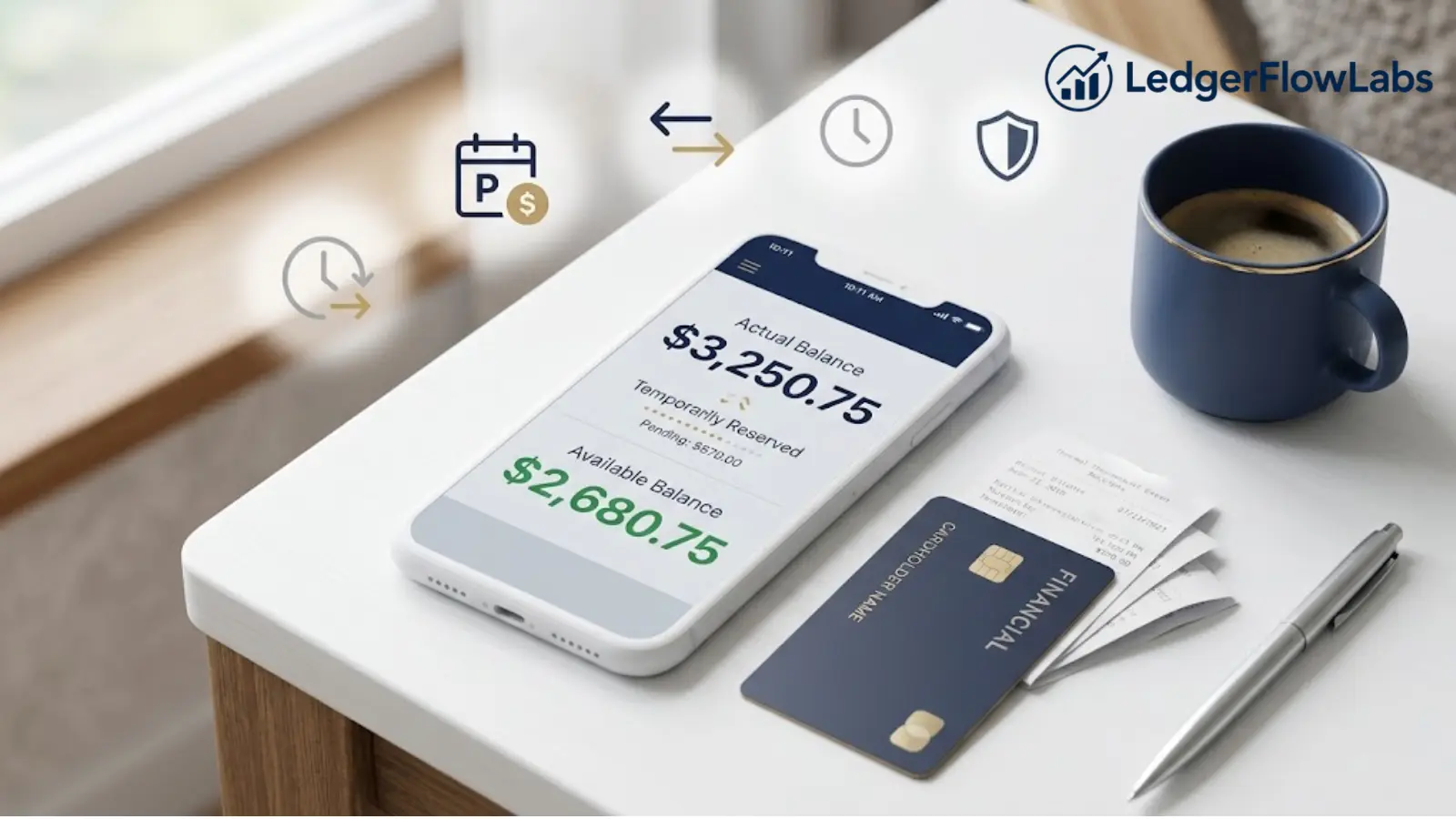
Open your banking app and there is a number at the top of the screen. Depending on where you look, there may be two numbers, and they may not agree. Neither of them is a lie, and neither of them is the amount you can safely spend. This guide explains what sits between the two figures, why they sometimes cross over in the direction nobody expects, and why the number that actually predicts whether Thursday's payment will clear is not on the screen at all.
This is educational information, not financial advice. For decisions about your own money, consult a licensed financial advisor.
Where this applies: written for readers in the United States. Banking practice differs by country, and the sources named below are US ones.
Two numbers, one account
Banks generally show a current balance and an available balance. The names vary a little between institutions, and some apps show only one of them by default, which is part of the problem.
As reported by Bankrate, the current balance reflects the money in the account without subtracting pending payments or withdrawals, while the available balance is what you can actually spend right now, after pending transactions, holds and any restrictions on recently deposited funds are taken into account. As reported by American Express, the current balance can include transactions that have not yet cleared.
Put simply: the current balance is a bookkeeping figure and the available balance is a spending figure. Most people look at whichever is larger, which is usually the current balance, and treat it as their money.
The gap between them can be small enough to ignore for weeks and then large enough to matter on exactly the wrong day.
What sits between them, itemized
Sources tend to summarize the gap as "pending transactions and holds," which is accurate and not very useful. Here is what that actually consists of.
Card authorizations you have already made. You tapped a card, the merchant checked that the funds existed, and the money is spoken for but has not moved. This is usually the largest component and it is invisible unless you go looking for a pending list.
Merchant holds larger than what you spent. Some businesses authorize an amount higher than the purchase to cover an unknown final total. As reported by Capital One and by PNC, this is standard practice at gas stations, hotels and rental companies, where the eventual charge is not known at the moment the card is presented. The excess is released later, but until it is, it is subtracted from what you can spend.
Restaurant tips. A related case. The bill is authorized when the card is run and the tip is added afterward, so the pending amount and the final amount differ almost every time.
Deposits that have not fully cleared. Money that has arrived on paper but is not yet released for spending. Deposit availability depends on the type of deposit and the bank's own policy, so there is no single figure that applies everywhere, and this site will not invent one.
Transfers in flight. Money you have sent, or that is arriving, which has left one side and not yet landed on the other.
Any hold placed by the bank itself. Less common, but it exists, and it is the category most likely to require a phone call to understand.
Nothing on that list is unusual or a sign of a problem. All of it is the ordinary machinery of an account, and it is covered stage by stage in pending versus posted transactions.
The direction people expect, and the direction that surprises them
Most of the time, available is lower than current. Pending spending has been subtracted from one figure and not the other. This is the case everybody eventually learns about, usually the expensive way.
The classic version, as illustrated by Bankrate and by SmartAsset in their own examples: a person sees the higher number, concludes there is room for a payment, makes it, and discovers that a purchase from two days earlier had not yet posted. The money was never there. It was already committed to something that had not finished happening.
What surprises people is the other direction, where available is higher than current. That happens when money has been credited and made available before it is fully reflected in the other figure, for example with certain deposits. It looks like a gift and it is not one. Both numbers will converge, and building a decision on the temporarily higher one is the same mistake in reverse.
The useful rule is not "trust the lower one." It is understand why they differ before you act on either, because the reason tells you whether the gap is about to close in your favor or against you.
Why the safe number is neither of them
Here is the point this cluster exists to make.
Both balances are photographs of right now. Neither of them knows what is scheduled. Your rent, your card payment, the autopay you set up eight months ago and have not thought about since, are all completely invisible to both figures until the moment they hit.
The number that determines whether Thursday's payment clears is not a balance at all. It is:
Your available balance, minus everything already committed between now and Thursday, plus anything definitely arriving in that window.
That is a calendar calculation. No balance screen performs it, because your bank does not know what you owe to companies you have not scheduled a payment with yet, and it certainly does not know your pay dates in advance.
This is exactly the arithmetic that our guides to building a bill calendar and payday versus due date set up. The bill calendar produces the list of commitments; the timeline walks the running total forward. The balance on the screen is only the starting figure for that walk, and starting from the larger of the two numbers makes every subsequent line optimistic by exactly the amount most likely to catch you out.
How to read your own account in the right order
A short sequence that takes under a minute and avoids most of the trouble.
Find the available balance, not the headline figure. In some apps it is the number shown; in others it is one tap deeper. Find out which yours is, once, and remember it.
Open the pending list. Every institution has one. Read it. If a pending amount looks larger than what you remember spending, it is probably a merchant hold, and it will resolve.
Ask what is scheduled before the next money arrives. This is the step that requires your bill calendar rather than your bank.
Only then decide whether there is room.
The order matters because most overspending is not a decision to overspend. It is a correct decision made on the wrong input.
What the balance cannot tell you at all
Worth naming the limits plainly.
It cannot tell you whether a pending charge is correct. It only tells you that something is pending. If you see a pending item you cannot place, the balance screen is not where that gets resolved; contact your bank and ask about the specific transaction.
It cannot tell you when a hold will be released. Release timing depends on the merchant and the institution. Attributed ranges exist for common cases, and any single number presented as universal should be treated with suspicion.
It cannot tell you whether you can afford something. Affordability is a question about your commitments over a period, not about a figure at an instant. That is the whole subject of why you run out of money before payday, and it is why a person can have a comfortable balance today and a genuine problem on the ninth.
It cannot substitute for a record of your own. Keeping your own list of what you have spent, and checking it against the account, is a separate skill and one this site takes seriously. It is covered later in the statements series.
FAQ
Which balance should I spend against?
The available balance, which is the figure that accounts for pending items and holds. Even then, treat it as a ceiling rather than a target, because it does not include anything scheduled between now and your next deposit.
Why is my available balance higher than my current balance?
Usually because a credit has been made available before the other figure caught up. It is temporary in either direction. The two figures converge once everything settles.
How long do holds last?
It varies by the type of transaction, the merchant, and the institution's own policy. Gas station and hotel holds are the ones people ask about most, and the release time is set by the merchant and the bank rather than by any universal rule. Ask your bank about a specific hold rather than relying on a number from an article.
Does my banking app update in real time?
Not entirely. Card activity often appears quickly as pending, but the settlement behind it takes longer, and some items appear only once they post. The screen is close to live for some things and a day or more behind on others.
I went negative even though the app said I had money. What happened?
Almost always a pending item that had not been subtracted from the figure being looked at, or a scheduled payment the app had no way to know about. Working through pending versus posted transactions will usually identify which of the two it was.
What if I see a pending charge I do not recognize at all?
Contact your bank and ask about that specific transaction. Do not rely on a website, including this one, to tell you what a charge on your account is.
Reminder: this article explains general mechanics, not personalized advice. For decisions about your own money, consult a licensed financial advisor.