
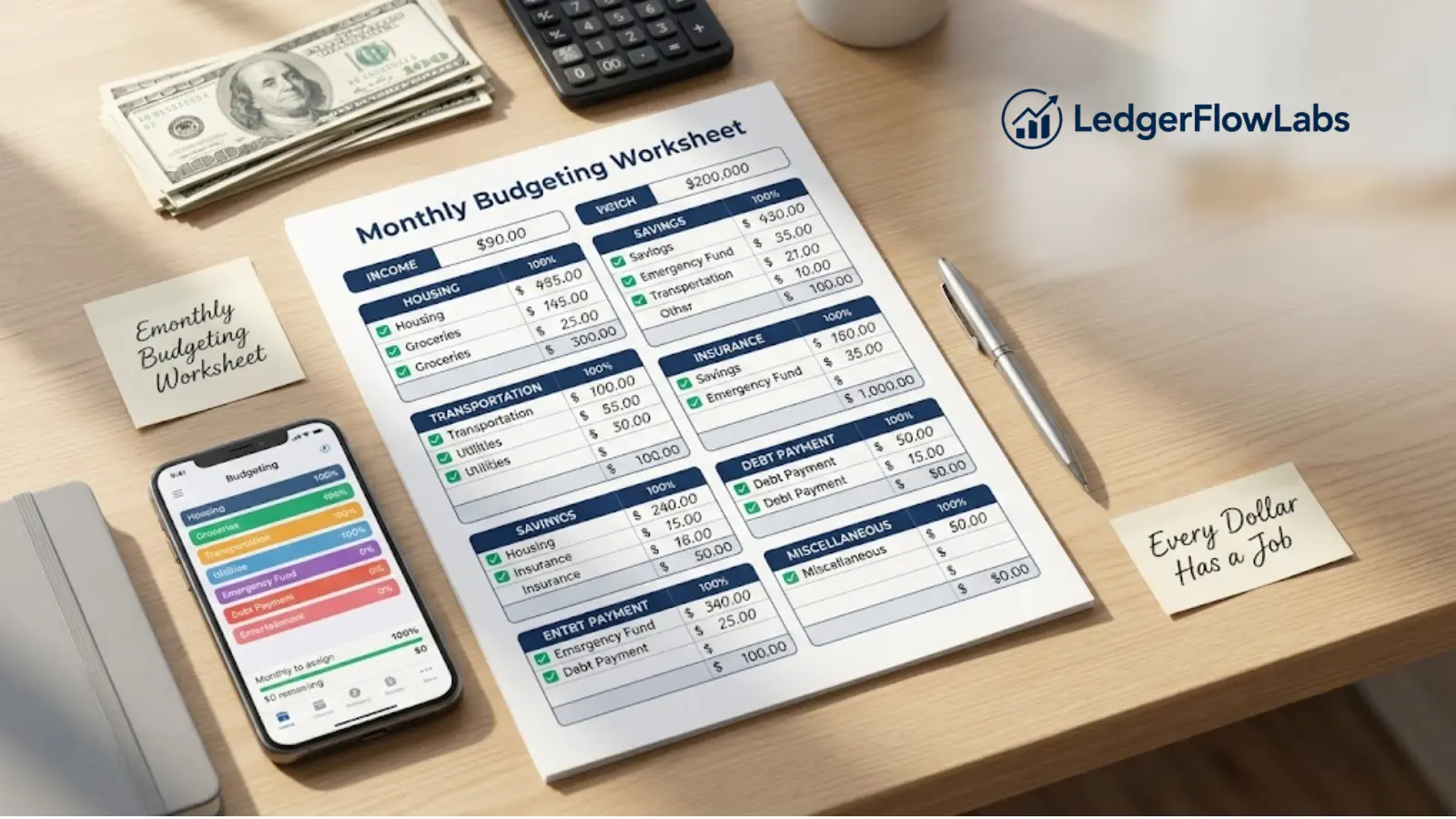
Zero-based budgeting is a method where you assign every dollar of your take-home pay a specific job (spending, saving, or paying off debt) before the month begins, until the money you have left to assign reaches zero. The simple formula is income minus everything you assign equals zero. It does not mean you spend all your money. It means no dollar sits around unassigned. As reported by Fidelity and Ramsey, both of whom teach this method, the core idea is to “give every dollar a job.” For beginners who want tight control and want to know exactly where their money goes, it is one of the most powerful budgeting systems there is. It is also the most work, especially in month one. This guide walks you through how it works and whether the effort is worth it for you.
Quick note before we start: this is educational information, not financial advice. For decisions about your own money, consult a licensed financial advisor.
What zero-based budgeting actually means
Most budgets tell you roughly how much to spend in a few big categories and leave the rest fuzzy. Zero-based budgeting removes the fuzz. You start with the money that actually lands in your account (your take-home pay, after taxes and deductions), and you keep assigning it to categories until there is nothing left to assign.
Say a hypothetical reader brings home $3,000 in a month. Under this method, all $3,000 gets a label: rent, groceries, transportation, minimum debt payments, savings, a little for fun, and so on. When the last dollar has a home, the plan is done. Income ($3,000) minus everything assigned ($3,000) equals zero. That is where the name comes from. The $3,000 here is a made-up figure to show the math, not a suggested amount for anyone.
The point is intention. Instead of spending first and wondering where the money went, you decide in advance where it should go.
“Zero” does not mean “spend it all”
This is the single most common misunderstanding, so it is worth stating plainly. Reaching zero does not mean your bank account hits zero. It means every dollar has been given a job, and saving and investing are jobs.
As reported by Fidelity, a zero-based budget does not mean your goal is to spend everything you earn. If you decide $400 of a hypothetical paycheck goes into savings, that $400 is “assigned.” It counts toward reaching zero even though you never spent it. The same is true for money you put toward an emergency fund, retirement, or an extra debt payment. Those are not leftovers. In this system, savings is a planned line, not whatever happens to survive to the end of the month.
If that idea appeals to you, it is also the core strength of the percentage-based 50/30/20 budgeting rule, which forces savings to be a fixed slice rather than an afterthought. It is the same underlying discipline our guide to pay-yourself-first budgeting covers on its own: move the money before you spend, regardless of which method organizes the rest of your budget.
How to build a zero-based budget, step by step
You build the whole plan before the month starts. Here is the sequence.
- Start with your take-home pay. Use the amount that actually reaches your account, not your salary before deductions. Budgeting off gross pay is a classic beginner mistake.
- List your fixed costs. Rent or mortgage, utilities, insurance, minimum loan and debt payments. These barely move month to month, so assign them first.
- Assign your variable costs. Groceries, gas, phone, anything that changes. Look at the last month or two to estimate honestly.
- Fund your goals. Savings, emergency fund, and any extra debt payoff each get their own line. Treat them like bills you owe your future self. If you are not sure how much your emergency fund line should target, our guide on sizing an emergency fund covers the commonly cited ranges and who says so.
- Give the rest a job too. Fun money, dining out, hobbies. This is not the enemy. A budget with zero room for enjoyment is a budget you will quit.
- Adjust until you hit zero. If you have money left unassigned, assign it (usually to savings or debt). If you have gone over, trim a flexible category until the math balances.
Then you track spending against those categories through the month. When a category runs empty, it is empty, unless you make a conscious decision to move money from another job.
Doing this the first time is where a lot of beginners stall. If you want a slower, screen-by-screen walkthrough of setting up that first plan, the companion guide on how to make your first budget covers it start to finish.
What to do if your income is irregular
Zero-based budgeting seems to assume a steady paycheck, which leaves out freelancers, gig workers, tipped workers, and anyone on commission. It still works. You just change what you plug in at the top.
A simple, conservative approach: take your lowest income month from the last three and use that as your baseline. Build your entire budget on that lower number. Because you assumed less, a normal or good month leaves you with extra income that arrives unassigned. That surplus then gets a job of its own, and the highest-value jobs are usually building a buffer, funding next month in advance, or attacking debt.
This does two things. It keeps you from overcommitting during a strong month, and it protects you during a lean one, because your essential categories were already covered by your worst recent month. It is a small mindset shift that makes the whole method survivable on variable pay, and it is the part most thin beginner guides skip.
The honest timeline: why month 3 is when it clicks
Here is what the pages selling you this method tend to leave out: the first month is genuinely a lot of work, and it usually feels clumsy.
You will underestimate a category. You will forget an annual or irregular expense (car registration, a subscription that renews yearly, a birthday). You will have to move money between jobs mid-month and feel like you are doing it wrong. That is normal, and it is not a sign the method is failing. It is a sign you are still gathering real data about how you actually spend.
A pattern people who use this method describe again and again, and it is a commonly reported experience rather than a measured statistic, goes roughly like this: month one is rough, month two is noticeably smoother because you have corrected your first guesses, and month three is when it clicks and starts to feel automatic. Knowing that curve exists is half the battle. Most people who quit budgeting quit in month one, right before it gets easier. If you understand why budgets stall out, the guide on why budgets fail breaks down the specific mistakes that trip beginners up.
Zero-based vs 50/30/20: which one fits you
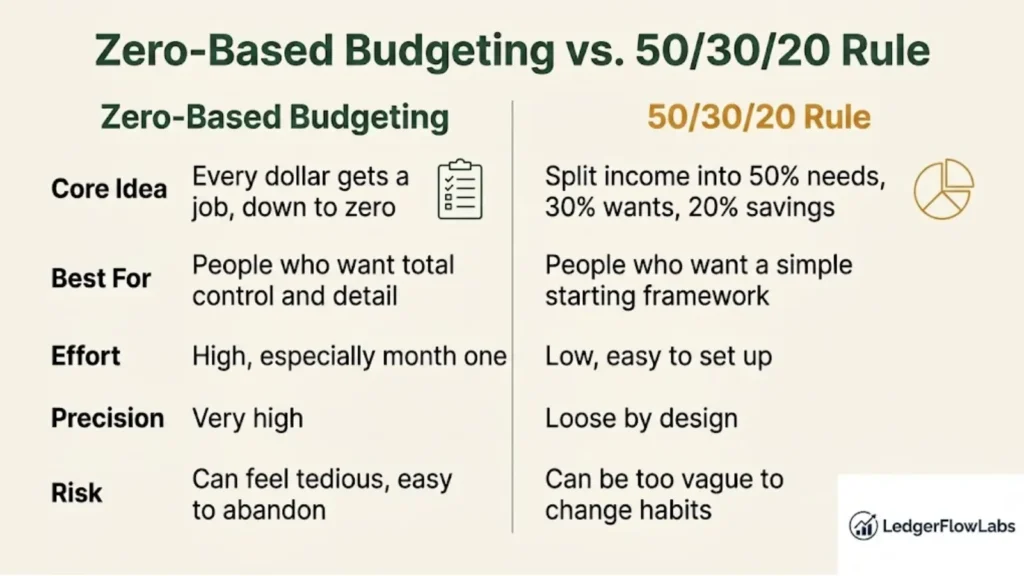
There is no universally “best” budget. There is the one you will actually stick with. Here is a fair comparison so you can self-select.
| Zero-based budgeting | 50/30/20 rule | |
|---|---|---|
| Core idea | Every dollar gets a specific job to zero | Split take-home pay into 50% needs, 30% wants, 20% savings |
| Best for | People who want total control and detail | People who want a simple starting framework |
| Effort | High, especially the first month | Low, easy to set up |
| Precision | Very high | Loose by design |
| Risk | Can feel tedious and easy to abandon early | Can be too vague to change real habits |
If you found percentage buckets too loose and want to control every dollar, zero-based budgeting is likely your match. If tracking every category sounds exhausting and you just want a sane structure to start today, the 50/30/20 rule may suit you better. Both are legitimate. For the wider picture and other methods, the pillar guide on budgeting for beginners lays them side by side.
Tools you can use
You do not need any special app to do this. Zero-based budgeting works with:
- Pen and paper, or a simple notebook, if you like a physical record.
- A spreadsheet, which is free and flexible, and lets your categories add up to zero automatically.
- A budgeting app in the category of tools designed for assigning every dollar. Apps can automate the tracking part, though they are not required.
Start with whatever you will actually open every few days. The tool matters far less than the habit of checking in. If assigning every single dollar sounds like more than you want to take on, our guide to the cash envelope method covers a lighter, targeted version that applies the same “runs out, stop spending” discipline to just your most overspent categories.
FAQ
Is zero-based budgeting good for beginners?
Yes, if you want control and detail. It teaches you exactly where your money goes, which builds strong habits fast. The trade-off is effort: the first month takes real work, so go in expecting a learning curve rather than instant ease.
Does zero-based budgeting mean I cannot save?
No, the opposite. Saving and investing are jobs you assign dollars to, so they are built into the plan from the start. “Reaching zero” means every dollar is assigned, including the dollars you move into savings, not that your account is emptied.
How is zero-based budgeting different from 50/30/20?
Zero-based budgeting assigns every dollar to a specific category for maximum control. The 50/30/20 rule splits your take-home pay into three broad buckets (needs, wants, savings) for simplicity. Zero-based is more precise and more work; 50/30/20 is looser and easier to start.
What if I overspend a category mid-month?
Move dollars from another job to cover it. The plan is meant to flex, not break. If dining out ran over, you might pull from your fun or grocery category to rebalance. The rule is that the move is a conscious decision, not an accident.
How do I use zero-based budgeting with irregular income?
Baseline your budget on your lowest income month from the last three, and build the whole plan on that lower number. When you earn more than that baseline, treat the extra as unassigned income and give it a job, usually savings, a buffer, or debt.
This article is educational information, not financial advice. Everyone’s situation is different. For guidance on your own money, consult a licensed financial advisor.