

Short answer: in the United States, a direct deposit does not “clear” the way a check does. Once your bank receives the electronic payment, Regulation CC (12 CFR Part 229) requires the funds to be available for withdrawal no later than the business day after the banking day the bank received them, and many banks release them the same morning. The waiting you are doing is almost never your bank holding your money. It is the gap between the day your employer says the payroll was sent and the day the payment was actually scheduled to settle.
This is educational information, not financial advice. For decisions about your own money, consult a licensed financial advisor.
Where this applies: written for readers in the United States. Funds availability rules and payment networks differ by country, and every source named below is a US one. Your own bank’s funds availability disclosure, which it is required to give you, is the authority for your account.
“Cleared” is the wrong word, and that is part of the confusion
Clearing is a check concept. A paper check has to be presented, collected from the paying bank, and settled, and your bank may hold part of it while that happens. A direct deposit is not a check. It is an electronic credit that arrives through the Automated Clearing House network, already funded by the sender.
So the honest version of the question is two questions:
- When does the payment arrive at my bank? That is controlled by your employer’s payroll timing and the ACH network.
- When can I spend it? That is controlled by federal law and your bank’s own policy, and it is usually the shorter of the two.
Almost everyone assumes the delay is in question two. It is nearly always in question one.
The three clocks, in order
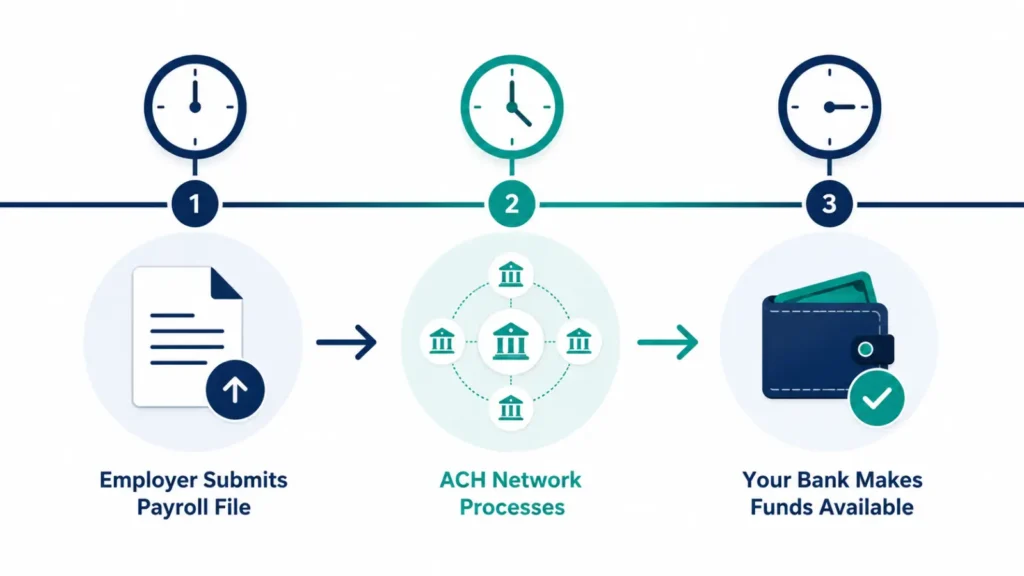
This is the part that page-one search results tend to compress into a single “one to three business days,” which is true on average and useless when you are staring at an empty balance.
Clock 1: your employer submits the payroll file
Payroll is not sent at the moment you are paid. Your employer, or their payroll provider, submits a file in advance and names an effective entry date, which is the date the money is supposed to land. Submission commonly happens a day or more before that date because standard ACH is a batch system, not an instant transfer.
When an employer says “it was sent,” they usually mean the file was submitted. That is not the same as the money being due today.
Clock 2: the ACH network moves and settles the payment
The ACH network processes in batches on business days. Weekends and federal holidays are not business days, which is why a Friday payday behaves nothing like a Saturday one, and why a Monday holiday quietly pushes a whole week’s timing.
Same-day ACH exists and some employers pay for it, but it is an option the sender chooses, not the default.
Clock 3: your bank makes the money available
Here the rule is unusually clear. Regulation CC, the rule implementing the Expedited Funds Availability Act, sets the maximum a bank may hold consumer deposits and requires banks to disclose their availability policy to customers. As summarized by the American Bankers Association, electronic payments including direct deposits fall under next-business-day availability, and the full text sits in 12 CFR Part 229 on eCFR.
Two things follow that are worth stating plainly:
- A bank cannot lawfully sit on a received direct deposit for three days. If it genuinely arrived, availability is measured in hours or one business day, not days.
- Some banks release deposits earlier than required. Institutions that market “early” direct deposit are choosing to post the payment when the payment instruction arrives rather than on the settlement date. That is a bank policy, not a legal entitlement, and it can change.
Why yours is late when your coworker’s is not
Same employer, same payday, different bank, different morning. All of the following are ordinary:
| What happened | Why it delays you |
|---|---|
| Payday falls on a weekend or federal holiday | ACH does not settle on non-business days |
| Your employer submitted late or missed a cut-off | The effective date shifts to the next processing window |
| Your bank posts on a nightly cycle | The credit is applied in an overnight batch rather than on arrival |
| Your account is new, or the deposit is your first from this employer | Some banks apply extra review to first-time credits |
| The account or routing number changed recently | The payment can be returned to the originator and reissued |
| Your bank offers early availability and your coworker’s does not | Nothing is late. Theirs is early |
Notice that only one row on that list is your bank holding money, and even that one is a posting cycle rather than a hold.
The information most guides skip: what to actually ask, and who to ask
The advice everywhere is “contact your bank or your employer.” That sends you into a phone queue with nothing to say. Ask for specifics instead.
Ask your payroll department or provider for two things:
- The effective entry date on the payroll file. This is the date the payment was scheduled to land. If it is tomorrow, nothing is wrong and nobody needs to escalate.
- The ACH trace number. Every ACH entry carries one. It is the reference your bank can use to look up an individual payment rather than telling you what usually happens.
Then ask your bank one question: has a credit with that trace number been received, and if so, when will it be available? A bank can answer that. It cannot usefully answer “where is my paycheck.”
And read one document once: your bank’s funds availability disclosure. It is required, it is usually in the account agreement or on the bank’s website, and it states that bank’s own posting times and cut-off hour. That document, not a blog and not a search result, is the authority for your account.
The reason this matters is that the two most common outcomes are opposite. Either the payment has not been sent yet, in which case the bank can do nothing at all, or it has been received and the question is a posting time. Guessing between those two wastes the afternoon.
What this does not fix
Being honest about the limits: knowing the mechanics does not make the money arrive sooner. If the effective date is tomorrow, it is tomorrow. If your rent autopay is scheduled for the morning of payday, understanding ACH batching will not stop the payment attempt.
What it does change is your planning. If your deposit reliably posts late in the day, then a payment scheduled for that same morning is being drawn against yesterday’s balance, which is exactly the collision described in autopay timing and overdraft risk. Moving the payment by one day is a permanent fix. Refreshing the app is not.
It is also why the balance on your screen is not the deciding number. A posted deposit, a pending credit and available funds are three different states, covered in available balance versus actual balance and pending versus posted transactions.
The practical version
Treat payday as a window, not a moment. Write down, over two or three pay cycles, the day and rough time your deposit actually became spendable. That observed pattern is more useful than any published average, because it reflects your employer, your bank and your pay schedule together.
Then build the rest of your month behind that observed time rather than in front of it. That is what a bill calendar is for, and it is why a one-paycheck buffer removes the question entirely: when you are not spending this deposit the day it lands, the exact hour stops mattering.
FAQ
Does a direct deposit clear instantly?
It does not clear in the check sense at all. Once received, availability is governed by Regulation CC and your bank’s own disclosed policy, which for electronic deposits generally means no later than the next business day, and often sooner.
Can my bank hold my paycheck for several days?
For a received electronic direct deposit, an extended hold is not the normal outcome under the funds availability rules described in 12 CFR Part 229. If your money is days late, the more likely explanation is when it was sent. Ask payroll for the effective entry date before assuming a hold.
Why did my deposit arrive at a different time than last month?
Because the arrival time depends on your employer’s submission, the ACH processing window, weekends and holidays, and your bank’s posting cycle. Any one of those shifting moves the time.
What is early direct deposit?
It is a bank choosing to post the credit when the payment instruction is received rather than on the settlement date. It is a feature offered by the institution, not a legal requirement, and the terms are set by that bank.
Payday is a Saturday. When do I get paid?
ACH does not settle on non-business days, so employers typically schedule the effective date for a surrounding business day. Whether that is Friday or Monday is your employer’s choice, and it is worth asking once rather than rediscovering it every month.