
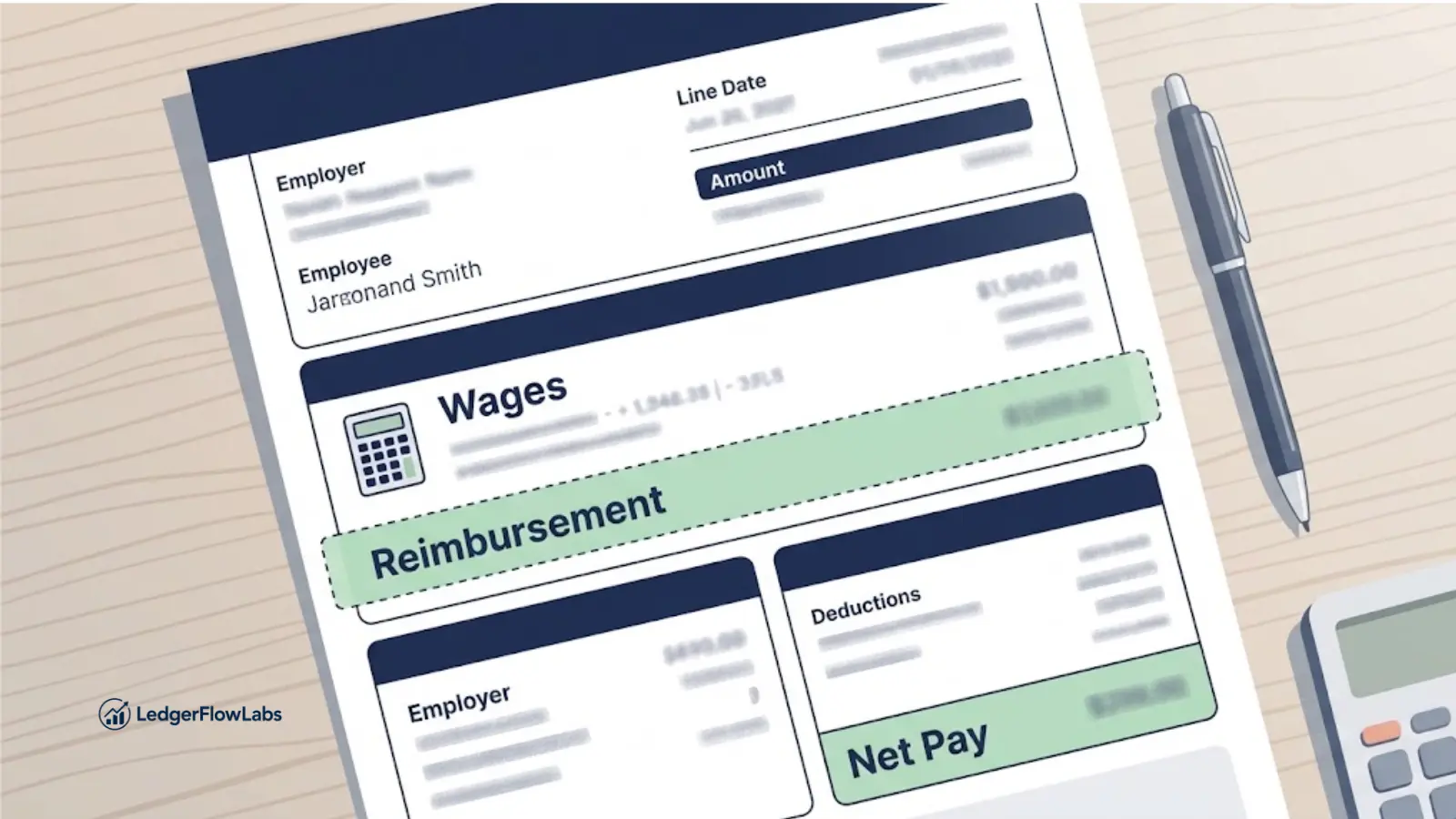
Short answer: an expense reimbursement on a paycheck is your employer paying you back for money you spent on its behalf, such as mileage, travel or supplies. Under IRS rules, a reimbursement paid under an "accountable plan" is not wages. It is not subject to income tax withholding or payroll taxes, and it usually appears on the stub as a separate, non-taxable line added after the tax calculation. A reimbursement that fails those rules, or is paid under a "non-accountable plan," is treated as wages and taxed like the rest of your pay. The stub usually shows which kind it is.
This is educational information, not tax, legal or financial advice. It explains how reimbursements appear and how the federal tax rules sort them. It cannot tell you how your own employer's plan is set up or how a payment will be treated on your return.
Where this applies: the United States. The tax treatment below comes from IRS Publication 15 (2026), Employer's Tax Guide. Whether an employer has to reimburse expenses at all is set largely by state law and employer policy.
Why a reimbursement is not income
A reimbursement repays you. You spent money on something the job needed, and the employer returns it. Your financial position is back where it started. Nothing was earned.
The IRS agrees, with conditions. Those conditions determine whether the reimbursement goes around the tax calculation or through it.
The accountable plan: three conditions
IRS Publication 15 (2026), Employer's Tax Guide (read 2026-09-11) describes reimbursement arrangements in its section on wages and other compensation. A plan is an accountable plan when it meets three requirements:
- Business connection. The expense was incurred while performing services for the employer.
- Substantiation. The employee accounts for the expense to the employer with receipts, logs or other records, within a reasonable time.
- Return of excess. The employee returns any amount received beyond the substantiated expenses, within a reasonable time.
When all three are met, the reimbursement is not treated as wages. It is not subject to federal income tax withholding or to Social Security and Medicare tax.
When they are not met, or the arrangement is a non-accountable plan, such as a flat monthly allowance with no receipts required, Publication 15 treats the payments as wages. They are subject to income tax withholding and employment taxes like any other pay.
Publication 15 also addresses per diem and fixed allowances, such as a set rate per mile or per day of travel. Amounts up to the federal rates the IRS publishes can be treated as reimbursement if the other conditions are met. Amounts above those rates are treated as wages. The federal mileage and per diem rates change and are published each year, so they are not reprinted here.
How an expense reimbursement shows up on a paycheck
Payroll systems label reimbursements in several ways. Common versions include:
- Reimbursement, Expense Reimb or Exp Reimb
- Mileage or Travel
- A non-taxable or after-tax earnings line
- A section called Other Pay or Non-Taxable Pay below the deductions
The placement is what matters. An accountable plan reimbursement is usually added after taxes and deductions, so it raises net pay without appearing in taxable wages. You can confirm this on the stub: gross pay or taxable wages should not include it, and the tax lines should not change because of it.
A reimbursement under a non-accountable plan, or a taxable allowance, usually appears in the earnings section alongside regular pay. It raises gross pay, and taxes are calculated on it. Some stubs label it "taxable reimbursement" or "allowance."
Some employers pay reimbursements separately from payroll entirely, by direct deposit or check. In that case the stub shows nothing at all.
A quick way to read the reimbursement line
| What you see | What it usually means |
|---|---|
| Reimbursement added below net pay or in a non-taxable section | Treated as an accountable plan reimbursement, not wages |
| Reimbursement listed in earnings, included in gross pay | Treated as taxable wages, often a non-accountable plan or allowance |
| A flat monthly allowance with tax taken | Commonly a non-accountable arrangement |
| Nothing on the stub, separate deposit | Reimbursed outside payroll |
If the treatment does not match what you expected, payroll or HR can tell you which plan the payment was made under. A tax professional can explain what it means for your return.
Why reimbursements do not count toward overtime
Reimbursements have one more effect on the stub that is easy to miss. Under the Fair Labor Standards Act, overtime is paid at one and a half times the regular rate. The Department of Labor's Fact Sheet #23 on overtime pay (revised October 2019, read 2026-09-11) lists expense reimbursements among the payments excluded from the regular rate.
So a large mileage reimbursement in a week with overtime does not raise the overtime rate. That is correct, because the reimbursement is not pay for work.
Must an employer reimburse expenses?
This is where federal tax rules end and the question moves elsewhere.
Publication 15 explains how reimbursements are taxed. It does not require employers to reimburse anything. Whether an employer must pay back work expenses is set by state law, the employment agreement and the employer's own policy, and it varies. Some states require employers to reimburse necessary work expenses. Others leave it to policy.
Your state labor office (read 2026-09-11) is the authority on what your state requires, and the employer's written expense policy sets out what it has agreed to pay.
Reimbursements and your budget
This is the part that trips households up, because the deposit looks like income.
A reimbursement makes a deposit larger without making you any richer. If a month includes a large reimbursement, that month's net pay overstates your income. A budget built from it assumes money that was already spent. Reading several months side by side, as in our guide to reading three months of cash flow, makes these one-off amounts easy to separate from regular pay.
The timing can also run against you. An expense paid on a personal credit card may post on this month's statement while the reimbursement arrives on a later paycheck. Whether the statement is due before or after that paycheck depends on the card's cycle, which is covered in statement cycle vs calendar month. When a reimbursement arrives in a separate deposit, the usual clearing questions apply as well, covered in how long a direct deposit takes to clear.
It follows that a budget usually runs on net pay excluding reimbursements. The reimbursement matches an expense already paid, and the two cancel out.
Keeping the paper trail
Because an accountable plan depends on substantiation, receipts matter twice. The employer needs them to treat the payment as a reimbursement rather than wages. And they are your record that the money was paid back, if a question comes up later.
Keeping each receipt with the stub or deposit that repaid it makes it easy to confirm every expense was reimbursed once, and in full.
What the stub cannot tell you
A stub shows how payroll classified a payment. It cannot tell you whether your employer's plan is set up correctly, whether your state requires reimbursement, or how a taxable allowance affects your own return. Those questions belong with payroll, your state labor office and a tax professional or the IRS.
FAQ
Is an expense reimbursement on my paycheck taxed? Not if it is paid under an accountable plan, which under IRS Publication 15 requires a business connection, substantiation and return of any excess. Reimbursements paid under a non-accountable plan, or allowances above federal rates, are treated as wages and taxed.
Where does a reimbursement appear on a pay stub? An accountable plan reimbursement usually appears as a separate non-taxable line added after taxes, raising net pay but not gross or taxable wages. A taxable one appears in the earnings section and is included in gross pay.
Does a reimbursement count as income for my budget? It repays money already spent, so it is not new income. Many people leave it out of their budgeted income and match it against the expense it covered.
Does mileage reimbursement affect my overtime rate? No. The Department of Labor's Fact Sheet #23 lists expense reimbursements among the payments excluded from the regular rate used to calculate overtime.
Sources: Internal Revenue Service, Publication 15 (2026), "Employer's Tax Guide", section on wages and other compensation, accountable and non-accountable plans, and per diem and other allowances, read 2026-09-11. U.S. Department of Labor, Wage and Hour Division, Fact Sheet #23, "Overtime Pay Requirements of the FLSA" (revised October 2019), read 2026-09-11. U.S. Department of Labor, "State Labor Offices" directory, read 2026-09-11. Federal mileage and per diem rates change each year and are not reprinted here.