
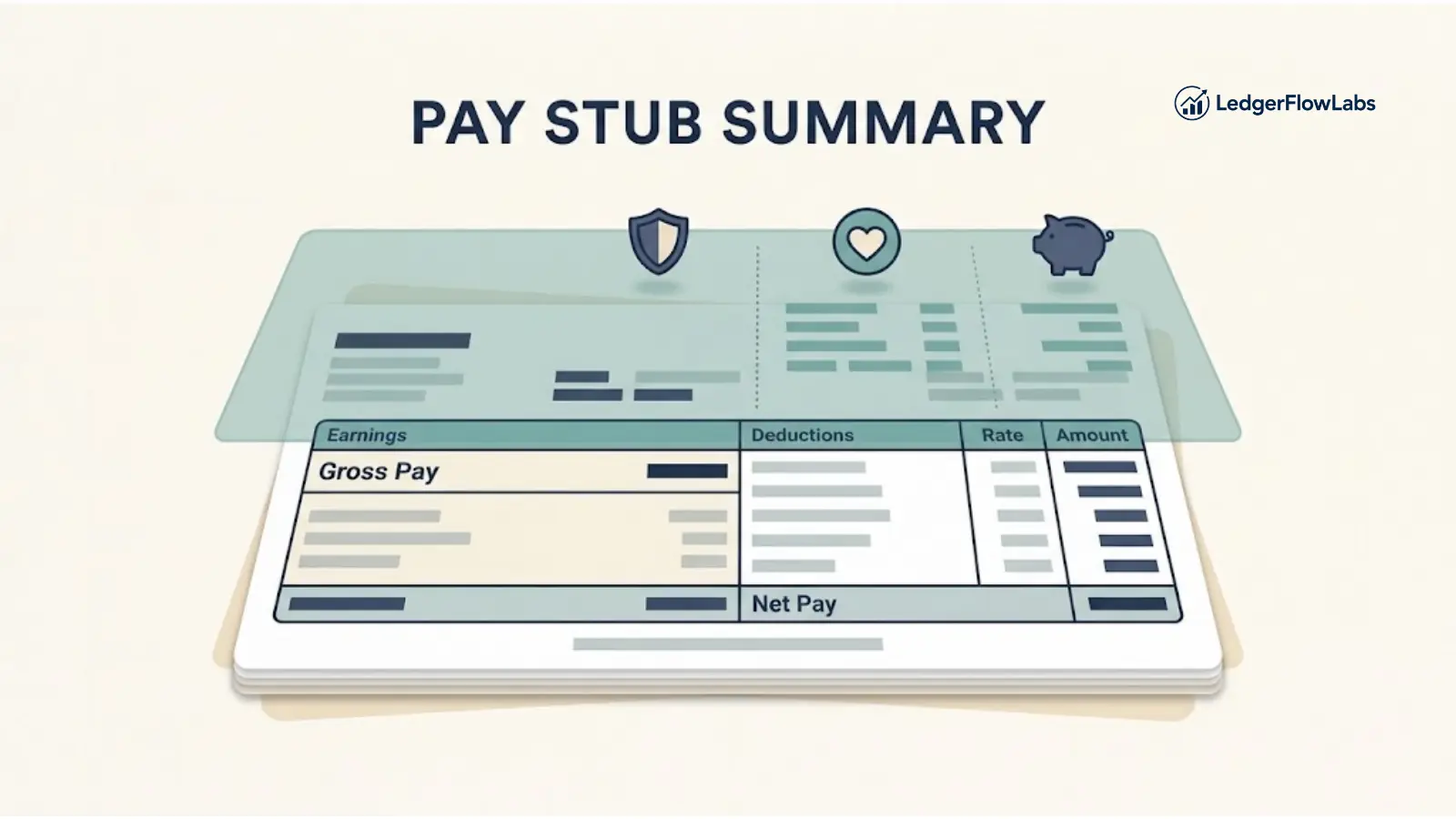
Short answer: employer contributions on a pay stub are amounts your employer pays toward your benefits and payroll taxes, printed for information and not taken out of your pay. Common examples are the employer's share of Social Security and Medicare, its share of your health premium, and a retirement plan match. Some stubs show them in a separate section, often marked "ER" or "Employer," and many leave some or all of them off. They never reduce net pay. That is why a benefits package described as worth a large sum can be almost invisible on the stub itself.
This is educational information, not tax, legal or financial advice. It explains what these lines mean. It does not assess any benefit plan or recommend any election.
Where this applies: the United States, and the stub of an employee who receives a Form W-2. Tax figures quoted here are for 2026, as published by the IRS.
Two kinds of money on the same stub
A pay stub can hold two very different kinds of number.
Your deductions come out of your gross pay. Your share of the health premium, your retirement contribution, your Social Security and Medicare, your income tax withholding. They are why net pay is smaller than gross pay.
Employer contributions are paid by the employer on top of your gross pay. They are costs of employing you, not money taken from you. When a stub prints them, it is showing you what your employment costs beyond the wage.
Stubs mark the difference in different ways: an "Employer" or "ER" heading, a separate column, a "Company Contributions" box, or a benefits summary at the bottom. The test is the same on every layout. If a number is not part of the calculation that runs from gross pay down to net pay, it did not change your deposit.
The common employer contributions, and where to find each
| Employer contribution | Does it come from your pay? | Might it appear on your stub? | Where else it is recorded |
|---|---|---|---|
| Employer share of Social Security and Medicare | No | Sometimes, in an employer section | Your own share appears on your Form W-2 |
| Employer share of health premiums | No | Sometimes | Form W-2, Box 12, code DD, together with your share |
| Retirement plan match or employer contribution | No | Often, as a match line | Your retirement plan statement |
| Employer-paid life or disability insurance | No | Sometimes, and it can create imputed income | Benefits summary; taxable portions on your W-2 |
| Health savings account contribution by the employer | No | Sometimes | Form W-2 and the account statement |
| Unemployment insurance and workers' compensation | Generally no | Rarely | Employer's own filings |
The rest of this page takes the biggest ones in turn.
The employer's share of Social Security and Medicare
Your stub shows the Social Security and Medicare tax taken from your pay, often labeled FICA, OASDI and Med. Your employer pays a matching amount on the same wages.
The IRS's Topic 751 on Social Security and Medicare withholding rates (last reviewed January 20, 2026, read 2026-09-11) states the current rates: "6.2% for the employer and 6.2% for the employee" for Social Security, and "1.45% for the employer and 1.45% for the employee" for Medicare. It also notes that "There's no employer match for Additional Medicare tax," which applies to higher earners. Social Security tax applies only up to an annual wage base limit that the IRS sets each year.
Some stubs print the employer's share in an employer column. It is a cost of employing you, and it is not deducted from your pay.
The employer's share of health coverage
When an employer pays part of a health insurance premium, the stub typically shows only your share as a deduction. Some stubs also print the employer's share, marked "ER."
The fuller picture shows up at year end. The IRS page on Form W-2 reporting of employer-sponsored health coverage (last reviewed September 19, 2025, read 2026-09-11) explains that many employers report the cost of coverage in Box 12 with code DD, and that "the amount reported should include both the portion paid by the employer and the portion paid by the employee."
The same page is clear that this is information, not a tax: "Reporting the cost of health care coverage on the Form W-2 does not mean that the coverage is taxable." It describes the purpose as giving employees "useful and comparable consumer information on the cost of their health care coverage."
That Box 12 figure is often the first time an employee sees what their coverage actually costs in total.
Retirement plan matches
If your employer matches retirement contributions, a stub may show your contribution as a deduction and the match on a separate line. The match is paid into the plan, not to you, so it appears neither in gross pay nor in net pay.
Two things about a match are easy to miss on a stub. First, the plan's own rules set how the match is calculated and when it is deposited, which may not be every payday. Second, many plans have a vesting schedule, which sets when employer contributions become fully yours. The stub will not show vesting. The plan's summary plan description and account statements do, and the plan administrator can explain them. Whether and how much to contribute is a personal decision, and not one this page addresses.
Lines that look like employer contributions but affect your tax
Some employer-paid benefits are partly taxable to you. When that happens, the stub may show imputed income: a value added to your taxable wages without being paid to you in cash. Group term life insurance above a certain coverage level is a common example. The IRS sets the rules for which fringe benefits are taxable.
On a stub, imputed income can raise the figure your taxes are calculated on while adding nothing to your deposit. It usually appears in the earnings section with a matching offset, or as a memo line. If you see one, payroll can tell you which benefit produced it.
Why a benefits package "worth thousands" is hard to find on paper
Employers sometimes describe total compensation as salary plus the value of benefits. Employees then look at their stub and see almost none of it.
That gap has three causes. Many employer contributions are never printed on the stub at all. The ones that are printed often sit in a separate, easily skipped box. And some, such as a retirement match, go straight into an account the stub does not track.
To see the whole picture, people usually combine three documents: the stub for what came out of pay, Form W-2 for the annual totals including Box 12, and the retirement plan and benefits statements for what the employer paid in. Some employers also issue an annual total compensation statement.
None of this changes what arrives in your account. A budget still runs on net pay, which is the case made in our guide to budgeting from gross or net income. And when a raise and a benefit change land together, the benefit side is one of the reasons a raise sometimes does not show up in your bank account the way people expect.
Using the stub to check your arithmetic
The most common error people make with employer contributions is adding them in when checking a stub.
Add up your taxes and deductions for the period, subtract them from gross pay, and compare the result with net pay. Leave every employer line out. If the numbers only work with an employer line included, or never work at all, that is worth asking payroll about.
Looking at several months together helps here too, the same way that reading three months of cash flow shows more than one month does. A match that appears on some stubs and not others, or an employer premium that changed mid year, is easier to spot across a run of stubs than on one.
What a stub cannot tell you
A stub cannot tell you whether a benefits package is good value, whether a plan suits your household, or how much to contribute. It records what happened this period. For the plan rules, the plan administrator and the plan documents are the source. For the tax treatment of a benefit, the IRS and a tax professional are.
FAQ
What are employer contributions on a pay stub? Amounts your employer pays toward your benefits and payroll taxes, such as its share of Social Security and Medicare, part of your health premium, or a retirement match. When printed, they are for information and do not reduce your net pay.
Why doesn't my pay stub show my employer's contributions? Employers choose what their stubs display, and many leave employer contributions off. Form W-2, especially Box 12, and your retirement and benefits statements usually give a fuller picture.
Is the code DD amount on my W-2 taxable? According to the IRS, no. Reporting the cost of employer-sponsored health coverage with code DD is informational, and the amount includes both your share and your employer's.
Does my employer pay Social Security tax too? Yes. IRS Topic 751 lists the 2026 rates as 6.2% each for employer and employee for Social Security and 1.45% each for Medicare, with no employer match for the Additional Medicare Tax.
Sources: Internal Revenue Service, Topic No. 751, "Social Security and Medicare withholding rates" (2026 rates, last reviewed January 20, 2026), read 2026-09-11. Internal Revenue Service, "Form W-2 reporting of employer-sponsored health coverage" (last reviewed September 19, 2025), read 2026-09-11. The Social Security wage base limit and the life insurance coverage level for imputed income change and are set by the IRS each year, so they are not reprinted here.