
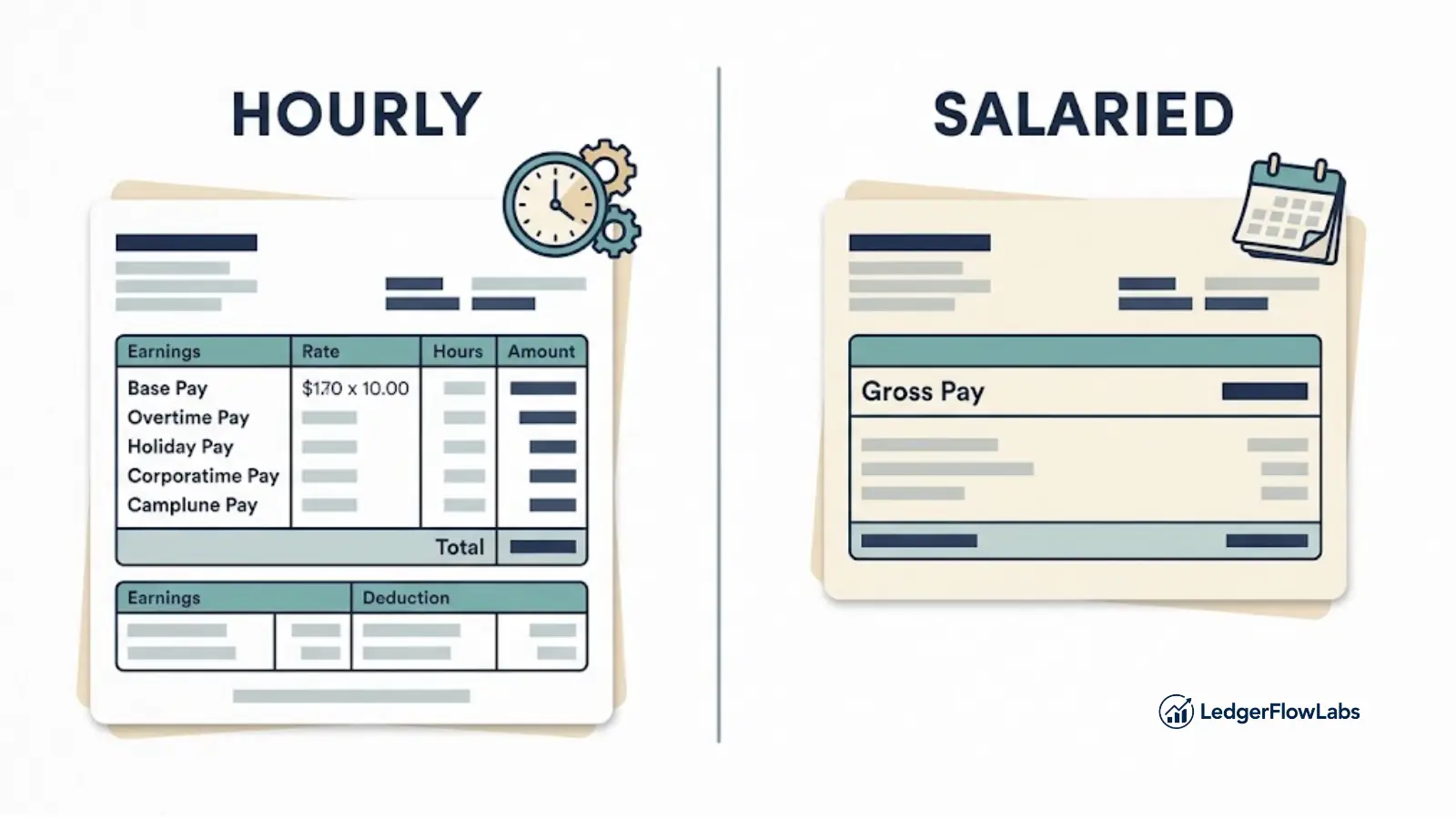
Short answer: the main salaried vs hourly pay stub difference is in the earnings section. An hourly stub lists hours multiplied by a rate, usually with separate lines for regular hours, overtime and paid leave, so gross pay moves every period. A salaried stub usually shows one fixed amount per period, your annual salary divided by the number of paydays, and the hours field, if it appears, is often a default figure rather than a record of time worked. Taxes, benefit deductions and net pay are calculated the same way on both. One thing does not change automatically: being salaried does not by itself end overtime.
This is educational information, not legal, tax or financial advice. It explains how the two kinds of stub differ. It cannot tell you how your own job is classified or whether your pay is correct.
Where this applies: the United States. Federal pay rules come from the Fair Labor Standards Act, and states can add their own. Pay statement requirements are largely set by each state.
Side by side: what each stub shows
| Stub section | Hourly stub | Salaried stub |
|---|---|---|
| Earnings lines | Regular hours × rate, overtime hours × overtime rate, paid leave, shift differential | Usually one salary line for the period, plus any bonus |
| Hours column | Hours actually recorded | Often a standard figure, or blank |
| Gross pay | Changes with hours worked | Usually the same every full period |
| Overtime | Shown when earned | Shown only if the role is non-exempt |
| Paid leave | Shown as hours at your rate | Often shown as a memo balance, since pay stays the same |
| Taxes and deductions | Same calculation | Same calculation |
| Year to date column | Present | Present |
If you have just moved from hourly to salary, the top half of your stub will look different. The bottom half should look familiar.
What the salary line actually is
On a salaried stub, gross pay for a full period is normally the annual salary divided by the number of pay periods in the year.
That is why a salary does not divide neatly into monthly deposits. Paid biweekly, a salary is spread across 26 paydays in most years, and a few months carry three. Paid semimonthly, it is spread across 24 fixed dates, so each check is larger but there is no extra payday. The same salary produces a different figure on the stub depending on the schedule. Our guides to biweekly and semimonthly pay and to the three-paycheck month cover how that plays out across the calendar.
A salaried stub may still show a rate. Some payroll systems print an hourly equivalent, the salary divided by an assumed number of hours, because they use it to value partial periods or paid leave. It does not mean you are being paid by the hour.
Why the hours on a salaried stub can look strange
People moving to salary often notice the hours column showing the same number every period, such as 80 on a biweekly stub, whatever they actually worked. For many salaried roles, the payroll system fills in a default because pay does not depend on hours.
That default matters only if the role is non-exempt. The Department of Labor's recordkeeping rules in Fact Sheet #21 (revised July 2008, read 2026-09-11) require employers to keep daily and weekly hours worked for non-exempt employees. For exempt employees, the stub's hours figure is commonly just a placeholder.
Salaried is not the same as exempt
This is the most important point on the page, and the one most often misunderstood.
"Salaried" describes how you are paid. "Exempt" describes whether federal overtime rules apply to you. The two usually travel together, but they are separate tests.
The Department of Labor's Fact Sheet #17A (revised September 2019, read 2026-09-11) describes the main white collar exemptions, for executive, administrative, professional, computer and outside sales employees. They generally require three things together: pay on a salary basis, pay at or above a set salary level, and job duties that fit one of the exemption categories. Job titles do not decide it.
The Department's salary levels page listed the federal standard salary level as $684 per week, equivalent to $35,568 a year, when read on 2026-09-11. That figure has been the subject of rulemaking and litigation and can change, so the page itself is the current authority. Some states set higher thresholds of their own.
What this means on paper: a salaried, non-exempt employee can have a stub that shows a salary line and overtime lines. If you are salaried and your stub has an overtime line, that is not necessarily a mistake. If you are salaried, regularly work over 40 hours in a workweek, and are unsure whether your role is exempt, the question sits with your employer, and unresolved federal questions with the Department of Labor's Wage and Hour Division.
When a salary can be smaller on the stub
A salaried stub is usually the same every period, but not always. For exempt employees, the Department of Labor's Fact Sheet #17G on the salary basis requirement (revised September 2019, read 2026-09-11) describes the general rule and its exceptions.
The general rule: an exempt employee receives "a predetermined amount of compensation each pay period," and the full salary for any week in which they perform any work, "regardless of the number of days or hours worked." Pay is not reduced because of the quality or quantity of work.
The fact sheet lists situations where deductions are permitted, including:
- One or more full days off for personal reasons other than sickness or disability
- Full-day absences for sickness, under a bona fide plan that replaces lost pay
- Unpaid leave under the Family and Medical Leave Act
- Offsets for jury duty, witness or military pay received
- Penalties for violations of significant safety rules
- Unpaid disciplinary suspensions for workplace conduct violations
It also states that an employer need not pay the full salary in the initial or final week of employment. That is why a first or last salaried stub is often prorated and smaller than a normal one.
If a salaried stub is smaller than usual and none of these apply, the difference is worth asking payroll about.
What stays the same on both stubs
Everything below gross pay works the same way whether you are paid hourly or on salary.
Pre-tax deductions such as a traditional retirement contribution or health premium are subtracted before tax is calculated. Federal income tax withholding, Social Security and Medicare, and any state or local tax follow. Post-tax deductions come next, and net pay is what remains. The year to date column runs from January 1 in both cases.
That is why the move from hourly to salary rarely changes the deduction section. Only gross pay changes shape, and every calculation below it adjusts to the new figure.
What changes for a budget
The practical difference is predictability.
An hourly stub moves with hours, overtime and shift changes, so budgeting from it resembles budgeting with irregular income: build from a lower, reliable figure and treat extra hours as extra. A salaried stub is steady across full periods, which makes a budget simpler to build, as long as it is built from net pay rather than the headline salary. That distinction is the subject of our guide to budgeting from gross or net income.
A change from hourly to salary can raise or lower take-home pay in a given month, even at a similar annual figure. Overtime that used to appear may stop, the number of paydays may change, and benefit eligibility can shift. Comparing one full salaried stub against a typical hourly one, line by line, shows where the difference comes from.
What a stub cannot tell you
A stub shows how you were paid. It does not show whether your role is correctly classified as exempt or non-exempt, and the payroll system usually cannot decide that on its own. That question depends on your salary, your duties and the rules in your state. Your employer, your state labor office (read 2026-09-11) and the Department of Labor are the places that answer it.
FAQ
What is the main difference between a salaried and an hourly pay stub? The earnings section. An hourly stub shows hours multiplied by a rate and changes each period. A salaried stub usually shows one fixed salary amount per period. Taxes and deductions are calculated the same way on both.
Why does my salaried pay stub still show hours? Many payroll systems fill in a standard number of hours for salaried employees, or print an hourly equivalent used for paid leave or partial periods. For an exempt role, it usually does not affect pay.
Can a salaried employee get overtime? Yes, if the role is non-exempt. Under the federal rules the Department of Labor describes, exemption generally depends on salary basis, salary level and job duties together, not on being salaried alone.
Why was my first salaried paycheck smaller? The Department of Labor's Fact Sheet #17G states an employer need not pay the full salary in the initial or final week of employment, so a first check is often prorated.
Sources: U.S. Department of Labor, Wage and Hour Division, Fact Sheet #17A (revised September 2019), Fact Sheet #17G, "Salary Basis Requirement" (revised September 2019), Fact Sheet #21, "Recordkeeping Requirements under the FLSA" (revised July 2008), and "Earnings thresholds for the Executive, Administrative, and Professional exemption" page, for the $684 per week standard salary level as listed on 2026-09-11. U.S. Department of Labor, "State Labor Offices" directory. All read 2026-09-11.