

Short answer: when your income changes every month, budget on the lowest month you have actually had in the last six to twelve months, not the average and not what you hope for. Everything above that figure is overflow, and overflow gets a job before it arrives. The second half of the method, which most guides leave out, is to hold incoming money in one account and pay yourself a fixed amount on a fixed date, which turns irregular income into a regular payday.
This is educational information, not financial advice. For decisions about your own money, consult a licensed financial advisor.
Where this applies: written for readers in the United States. This page is about which number to plan on and when to move it. It is not about how to earn irregular income, and it does not cover tax handling.
Why the average is the wrong number
The instinct is to add up the last twelve months and divide by twelve. It feels fair and it fails, for a reason worth stating plainly.
An average is a number you were at roughly half the time. A budget built on the average is therefore a budget that does not work in roughly half of your months. And the months where it fails are the months where failing is most expensive, because a shortfall lands on the same due dates as everything else.
The lowest-month rule inverts that. A budget built on your worst recent month works in every month you have had. As Ramsey Solutions and Clever Girl Finance both describe it, the approach is to look back over recent income, take the lowest figure, and treat that as the plan. What varies is not whether to do it, but the details nobody specifies.
Choosing the number: three details the guides skip
1. How far back to look
Six to twelve months. Shorter than six and one unusual stretch dominates the whole picture. Longer than twelve and you are budgeting on a version of your income that may no longer exist.
If your income is seasonal, use a full twelve months, because a six-month window can miss your entire lean season and hand you a baseline you cannot hold in February.
2. Which low months to keep, and which to exclude
This is where the rule needs a distinction almost no article makes. There are two kinds of low month:
- A lean month. Work was slow, hours were cut, the season was quiet. This can happen again. Keep it.
- A broken month. You were ill for three weeks, or a payment that was owed to you arrived in the following month instead. This was a one-time event, not your income floor. Exclude it, and write down why you excluded it.
The written reason matters, because the temptation is always to reclassify a lean month as a broken one so the number comes out higher. If you cannot state the specific event in one sentence, it was a lean month.
After excluding broken months, your baseline is the lowest lean month remaining.
3. Use the money that actually landed
Take the number from your bank statement, not from invoices, contracts or scheduled amounts. What matters for a budget is money that arrived and became spendable, which is a different figure and often a different month than the one you earned it in. The gap between those two dates is exactly the problem this whole cluster is about, and it is why available balance versus actual balance is worth reading alongside this.
When your lowest month does not cover your bills
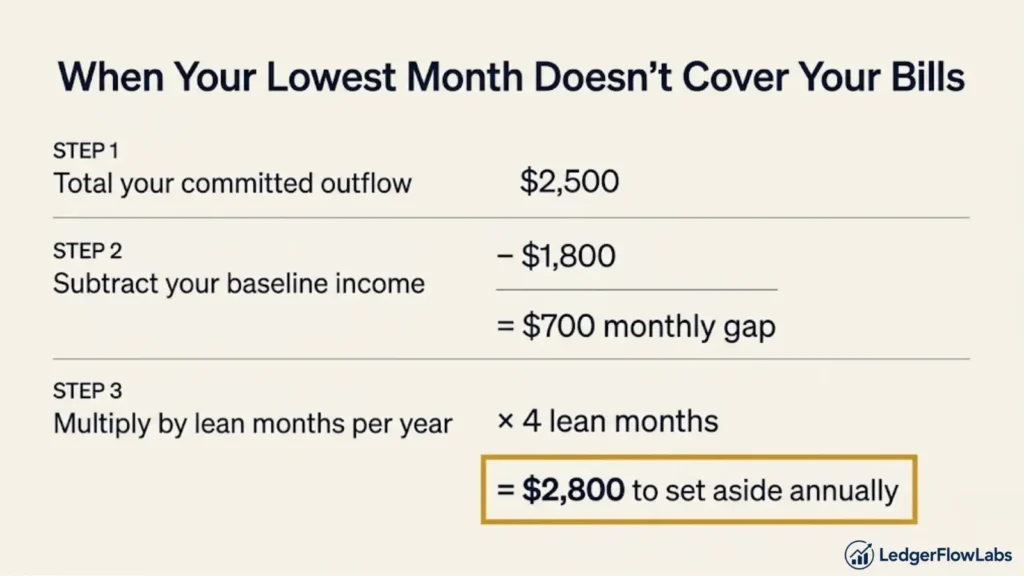
This happens often and it is the point where people abandon the method, concluding it does not apply to them. It applies. The result is information, not a verdict.
If your baseline is below your committed outflows, you have measured something specific: the size of the gap you have to bridge from your better months. That figure has a name and a use.
Work it out once:
- Total your committed outflow for a normal month.
- Subtract your baseline income.
- Multiply the difference by the number of lean months you typically have in a year.
That product is the amount your good months need to set aside annually. It converts a vague worry into a target you can actually fund, and it makes clear whether the gap is a timing problem or a shortfall problem. Those are not the same, and they have different answers. If the arithmetic says your income does not cover your life in any month, that is a different situation from an uneven one, and it deserves its own honest look rather than a budgeting technique.
The part that makes it work: pay yourself on a fixed date
Choosing a baseline is only half the method. The half that fixes the day-to-day is a structural change:
Send all incoming money to one account. Transfer a fixed amount to your spending account on a fixed date. Live on the transfer.
That holding account is not savings and it is not an emergency fund. It is a smoothing account. Money enters it unevenly and leaves it evenly. Everything else in your financial life then behaves as if you had a regular payday, which means the ordinary tools work again: a bill calendar, due dates aligned to that payday, autopay you can trust.
Three rules keep it honest:
- The transfer amount is your baseline, not your best month. Raise it deliberately, not because the account looks full.
- Pick the date once and leave it. The value comes from it being fixed. A payday that moves is the thing you were trying to escape.
- The holding account carries the overflow. When a good month arrives, the surplus simply stays where it is and gets assigned, rather than passing through your checking account where it will be spent.
Practically, this is a paycheck buffer with a different name and a bigger job, and people with irregular income need it more than anyone, because their gaps are longer than a few days.
What to do with the overflow, in order
When a month comes in above baseline, decide in advance where the excess goes. Deciding afterward means deciding while looking at a large balance, which never goes well.
A defensible order, and the reasoning rather than a rule to obey:
- Refill the smoothing account to cover your next lean stretch. This is the money that keeps the fixed transfer running.
- Fund known irregular bills. Insurance, registration, anything annual. See planning for annual bills.
- Emergency fund. A separate job from the smoothing account, explained in sinking funds versus emergency funds.
- Everything else.
The first item outranks the rest specifically because irregular income makes lean stretches predictable in kind even when they are unpredictable in timing.
When to change your baseline
Set a review date, quarterly is reasonable, and change the number only on that date. Two working rules:
- Raise it only when a new, higher floor has held for several months, not after one strong month.
- Lower it as soon as the evidence says so. The costs are asymmetric. Being wrong on the low side means an unassigned surplus. Being wrong on the high side means a missed payment.
That asymmetry is the whole logic of the method. Under-planning is inconvenient and over-planning is expensive.
FAQ
Should I use my average income or my lowest month?
The lowest recent month, excluding one-off broken months. An average produces a budget that fails in about half of your months, and it fails specifically in the tight ones.
How many months of history do I need?
Six as a minimum, twelve if your income is seasonal. Less than six and one unusual stretch distorts the baseline.
What if I have no income history yet?
Then start with your committed outflows rather than your income: work out what a bare month costs, treat that as the number to clear first, and build the history over the next few months before setting a baseline.
Does the smoothing account need to be a separate bank?
No. A second account at the same institution is enough. The point is that money you have not yet paid yourself is not sitting in the account you spend from.
What if my lowest month is far below my expenses?
Then the arithmetic above tells you how much your stronger months need to carry, which is useful whether or not it is comfortable. If no month covers your committed costs, that is a shortfall rather than a timing issue and deserves a separate, honest look.