
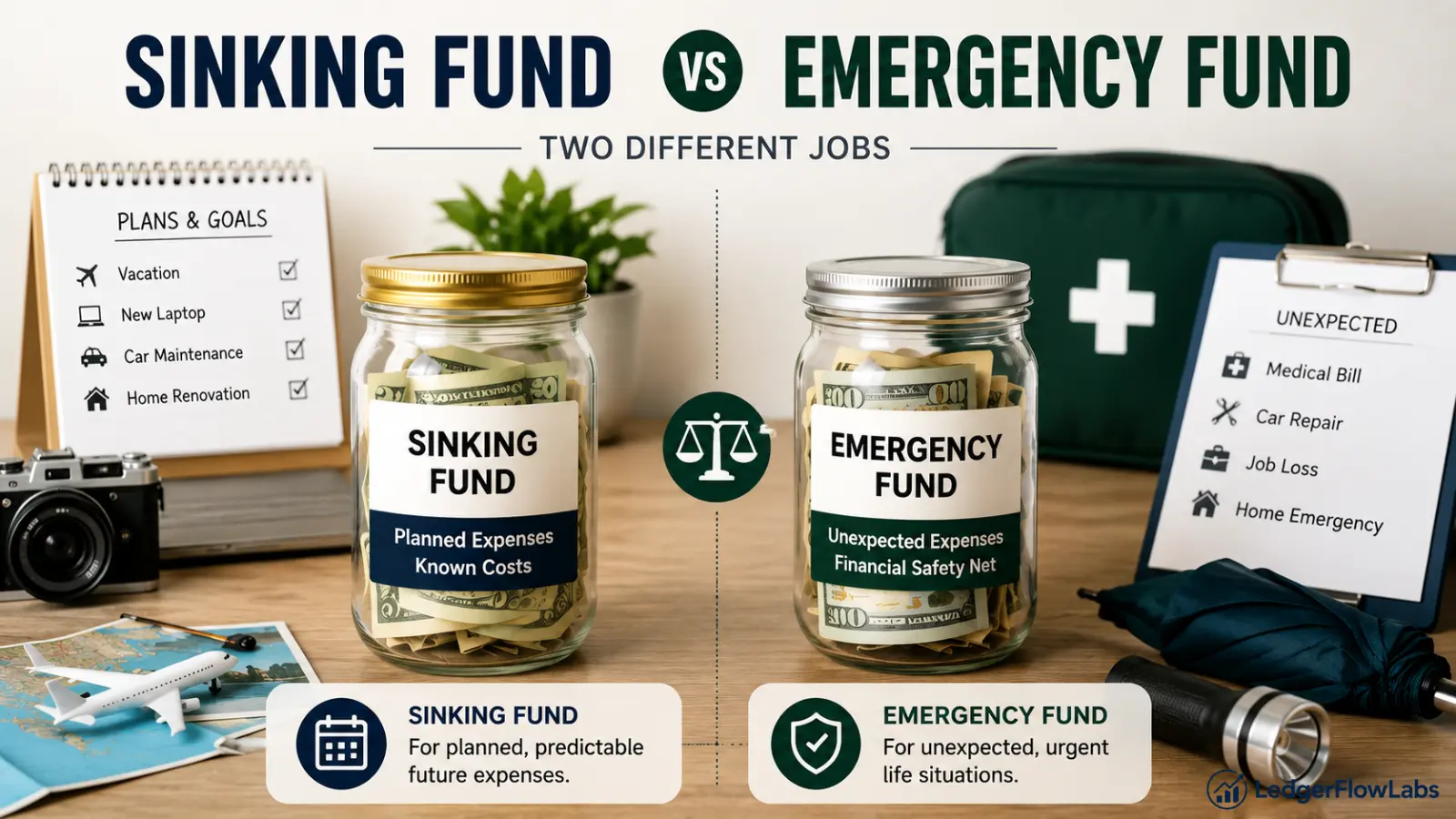
A sinking fund is money you save on purpose for an expense you already know is coming, even if you do not know the exact date, like a car registration renewal or a holiday season. An emergency fund is money set aside for the expense you genuinely could not have predicted, like a job loss or an unexpected medical bill. As reported by Experian, the core difference is known versus unknown: a sinking fund saves for a known upcoming cost, while an emergency fund covers something unforeseen. Both are savings. They are not the same job, and treating them as interchangeable is how one fund quietly gets drained for the wrong purpose.
This is educational information, not financial advice. For decisions about your own money, consult a licensed financial advisor.
A note on the figures: this guide is written for US readers. The emergency-fund range mentioned below is a commonly cited US guideline rather than a personalized target, and it is covered in more depth, with sourcing, in this cluster's dedicated emergency-fund sizing guide.
The one-line difference: known vs unknown
A sinking fund answers "I know this is coming, so let me spread the cost out instead of feeling it all at once." An emergency fund answers "I have no idea what this will be or when, but I need to be ready for something." One is planning. The other is insurance against the unplannable.
Both share the same mechanic, saving money before you need it, which is why they get confused. They differ entirely in what triggers you to use them.
What sinking funds are for, with examples
A sinking fund covers an expense you can name in advance, even without an exact date or amount. As reported by Ramsey Solutions, common uses include car maintenance and registration, holiday spending, an annual insurance premium, home repairs you know are due eventually, and gifts. The defining feature is predictability of category, not certainty of timing. You may not know exactly when your car will need new tires, but you know it will happen eventually, and a sinking fund is how you stop being surprised by it.
The mechanic is simple: estimate the rough annual cost of the category, divide by twelve, and set that smaller monthly amount aside so the larger cost, when it lands, does not blow up your month. This is the same "spread it across the months" logic our guide to why budgets fail covers as the fix for forgetting annual and irregular expenses.
What emergency funds are for, with examples
An emergency fund covers a genuine surprise: a job loss, an urgent medical expense, an emergency repair with no warning, or an unplanned major expense with no lead time. As reported by SoFi, an emergency fund's job is specifically to absorb the unpredictable, which is why the amount recommended for it is usually expressed as a multiple of your regular monthly expenses rather than tied to any one named cost.
This site's dedicated guide on how much an emergency fund should be covers the commonly cited ranges and who says so in full. The short version here: it is sized around ongoing survival if income stops, not around any single item you can list in advance.
The gray-area expense: which fund actually pays for it
Here is where people genuinely get stuck, and where most explanations stop short. Some expenses sit right on the line. A car repair can be routine wear you half expected, or it can be a genuine surprise breakdown. Which fund pays?
Use one honest test: did you know, even roughly, that a cost like this was coming, before it happened? If you knew your car was aging and repairs were increasingly likely, even without knowing the exact part or date, that is closer to a sinking-fund situation, and treating it that way keeps your emergency fund reserved for the truly unforeseeable. If the same repair came from a genuine, unpredictable failure with no prior warning sign at all, that leans emergency-fund territory. When you are honestly unsure, it is reasonable to split the difference: cover it from whichever fund has room, then rebuild both afterward. The goal of the test is not perfect precision. It is preventing the emergency fund from becoming the default answer to every unplanned expense, which is exactly how it gets emptied for things that were never truly emergencies.
Why keeping them separate (in your head or your tracking) matters
The two funds do different jobs, so mixing them into one undifferentiated "savings" pile causes a specific, predictable failure: you dip into what you think is emergency money for a holiday gift sinking-fund purpose, and then a real emergency arrives with less cushion than you believed you had. As reported by Discover, keeping the purposes distinct, even informally, is what prevents this kind of quiet erosion.
How you organize that separation is a personal choice and not something this guide prescribes. Some people track it with separate labeled categories in a simple spreadsheet or notebook. Some use separate savings goals within the same account. The mechanism matters far less than the discipline of knowing, at any moment, which pile of money is for what. Once you have paid yourself first, as covered in our guide to pay-yourself-first budgeting, deciding how that money splits between these two jobs is the natural next step.
FAQ
Do I need both a sinking fund and an emergency fund?
Most guidance recommends both, because they cover different situations. A sinking fund smooths out costs you can see coming. An emergency fund protects you from the ones you cannot. Having only one leaves a real gap on the other side.
What if an expense could be either a sinking-fund cost or an emergency?
Ask whether you had any advance sense it was coming, even roughly. If yes, it is closer to a sinking-fund expense. If it was a genuine, unpredictable failure, it leans toward the emergency fund. When you are unsure, cover it from whichever has room and rebuild both funds afterward.
Should these be in separate bank accounts?
That is a personal organizational choice. Some people separate them physically, others just track them as separate labeled categories. What matters is that you know which pile of money is for which purpose, not the specific number or type of accounts you use to do it.
Which one should I build first?
There is no universal order that fits everyone; it depends on your situation. Many people work on a starter emergency cushion and a near-term sinking fund (like an upcoming known bill) around the same time, in whatever proportion their budget realistically allows.
How much should each fund hold?
Sinking funds are sized to the specific cost you are saving for, divided across the months until it arrives. Emergency funds are typically discussed in terms of months of expenses rather than a single dollar figure; our dedicated guide on emergency fund sizing covers the commonly cited ranges and their sources.
Reminder: this article explains general savings concepts, not personalized advice. For decisions about your own money, consult a licensed financial advisor.