
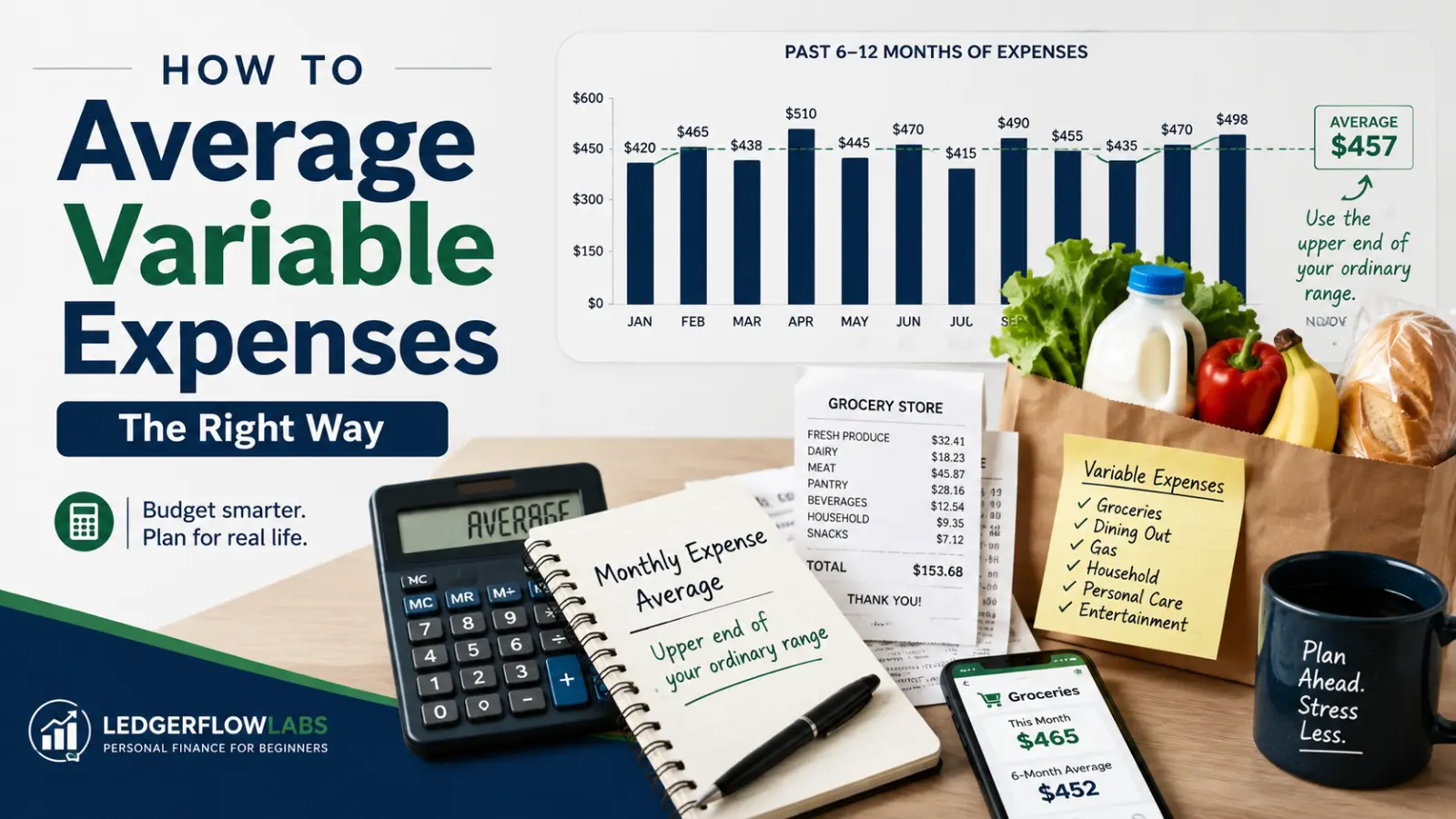
Short answer: to average a variable expense, pull six to twelve months of statements, remove the one-off purchases hiding inside the category, then budget the upper end of your ordinary range rather than the plain average. A mean is a number you exceed in roughly half your months, which is precisely the wrong property for a category that has to cover food. Then convert the monthly figure to a weekly rate, because your groceries follow the calendar and your paychecks do not.
This is educational information, not financial advice. For decisions about your own money, consult a licensed financial advisor.
Where this applies: written for readers in the United States.
Step one: pick the window, and know why
Six months is the working minimum. Twelve is better for anything seasonal.
The reason is not thoroughness. It is that short windows accidentally measure a mood. Three months that happen to include a holiday, a house guest and a cold snap will produce a grocery and utility figure you cannot repeat, and three quiet months will produce one you cannot hold.
Categories worth taking a full twelve months on: groceries, fuel, home energy, anything tied to weather or school terms. Categories where six is usually enough: household supplies, personal care, everyday transport.
Step two: remove the one-offs before you average anything
This step is missing from nearly every guide and it distorts more numbers than any other mistake.
Variable categories quietly contain purchases that are not variable spending at all. Inside “groceries” sits the bulk warehouse run you make twice a year. Inside “fuel” sits the road trip. Inside “household” sits the vacuum cleaner.
Those are irregular purchases wearing a category’s clothes. Leave them in and they inflate every month’s budget by a twelfth of something that happens twice. Take them out, average what remains, and give the one-offs their own line, which is what planning for annual and irregular bills is for.
Rule of thumb: if a single transaction is far larger than the others in that category and it repeats on a schedule of its own, it belongs to that schedule, not to the average.
Step three: the arithmetic, and why the mean is the wrong statistic
Here is where the standard advice quietly fails.
Take six months of grocery spending. These figures are hypothetical, used only to show the method:
| Month | Spend |
|---|---|
| 1 | $420 |
| 2 | $465 |
| 3 | $390 |
| 4 | $610 |
| 5 | $445 |
| 6 | $480 |
The mean is $468. That is the number almost every article tells you to write down.
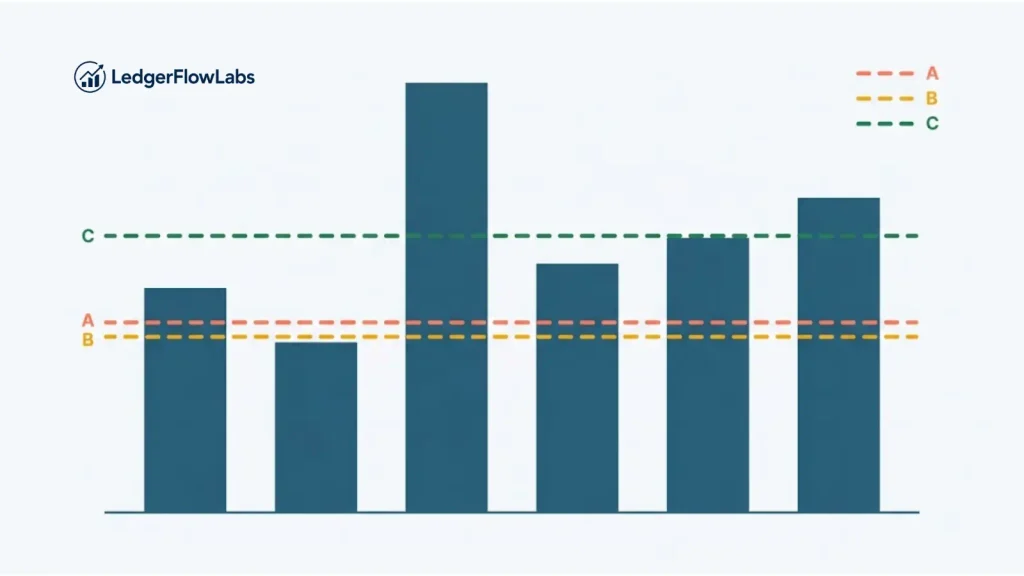
Now count: you exceeded $468 in two of six months, and you were within $12 of it in a third. A budget line set at the mean is a line you will breach regularly, and breaching a food line does not mean you overspent. It means your line was set at a number defined to be exceeded about half the time.
Three better options, and the trade-offs:
- The median ($452.50 here, the midpoint of the sorted values). Best for describing what a typical month looks like. Still exceeded half the time.
- The second-highest ordinary month ($480 here, ignoring the $610 outlier). This is the one I would use for a category that must not run out. It covers almost every normal month and does not build the worst month into every month.
- The highest month ($610). Safe and wasteful. It permanently reserves money for an event that happened once, which is money that could be doing a job elsewhere.
The point is not which one you pick. It is that “average” is a decision about how often you are willing to be short, and picking the mean by default is picking “about half the time” without noticing.
Worth checking the $610 month before deciding anything: if it was a genuine one-off that step two should have caught, remove it and average five months. If it was a normal high month, it belongs in the range.
Step four: convert to a weekly rate, because the month is not the unit
This is the step nobody takes, and it is the one that makes the number usable.
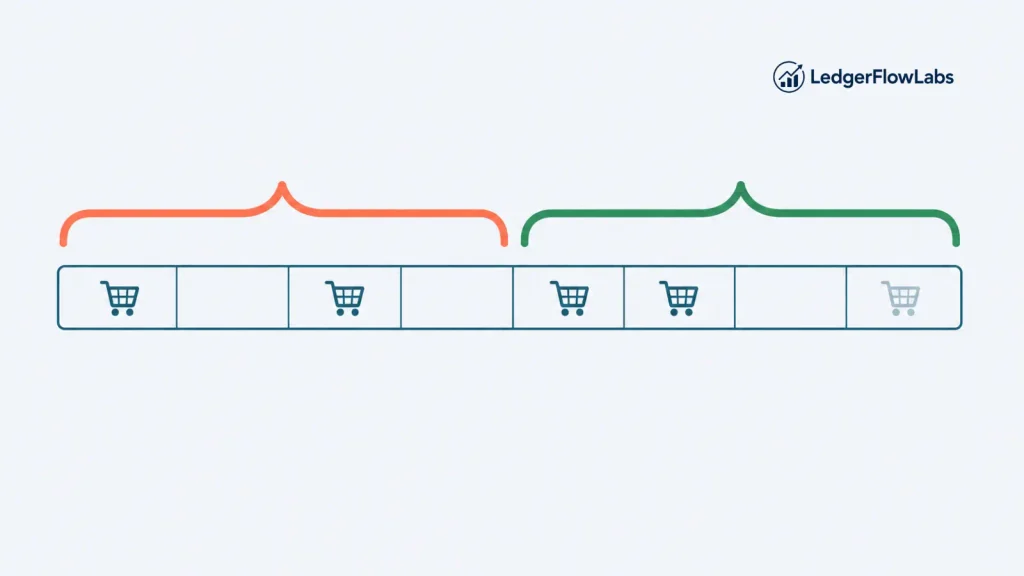
A monthly grocery figure assumes you buy groceries by the month. You do not. You buy them by the week, and the number of shopping weeks between two paychecks is not constant. If you are paid every two weeks, you will regularly hit a stretch where three shopping trips fall before the next deposit, not two, for reasons laid out in biweekly versus semimonthly pay.
So do the division:
Weekly rate = your chosen monthly figure divided by 4.33 (52 weeks over 12 months).
Using the $480 figure above, that is roughly $111 a week. Now, instead of asking “am I on track for the month,” you can look at a pay period, count the weeks inside it, and know what that period actually needs. A three-shop stretch needs about $333, not half of $480.
That single conversion explains a lot of months that felt inexplicable. The spending was not higher. The period was longer. It is the same effect that makes the three-paycheck month feel like a windfall from the other direction.
Step five: decide where the difference goes
An average is a fiction unless the variance has somewhere to live. If a good month leaves money in the category and it silently gets absorbed into general spending, then a bad month has nothing to draw on, and your average has become a floor rather than an average.
Two workable approaches:
- Roll it forward inside the category. Under by $40, that $40 stays assigned to groceries. This is closest to how zero-based budgeting treats a category.
- Sweep it to a variable-expense cushion. One pooled amount that all variable categories can draw from. Simpler to run, less precise.
Either is fine. Doing neither is what turns a well-calculated average into a monthly disappointment.
What averaging cannot do
Honest limits.
An average describes your past. It does not predict a change. If prices in a category move, or your household size changes, or your commute changes, the history is no longer evidence and the number needs rebuilding rather than adjusting.
It also will not smooth a category that is genuinely lumpy. Car repairs are not a variable expense to be averaged. They are an irregular expense to be funded, and treating them as an average produces a line that is wrong every single month: too high when nothing breaks, far too low when something does.
And it does not survive being set once and forgotten. Rebuild these numbers on a schedule, which is one of the jobs of the monthly budget review.
FAQ
How many months of spending should I average? Six as a minimum, twelve for anything seasonal such as groceries, fuel or home energy. Fewer than six months tends to measure an unusual stretch rather than a pattern.
Should I use the average or round up? Round up, and be deliberate about how far. Budgeting the upper end of your ordinary range, rather than the mean, means the line holds in most months instead of about half of them.
Do I include the big warehouse trip in my grocery average? No. Remove it, average what remains, and treat the bulk trip as an irregular expense with its own schedule. Leaving it in inflates every month.
What is the difference between a variable expense and an irregular one? A variable expense happens every month at a different amount, such as groceries. An irregular expense happens occasionally at an unpredictable time, such as a car repair. Averaging works for the first and misleads for the second.
Why does my grocery spending blow past the budget some months for no reason? Often because that pay period contained an extra shopping week. Converting the monthly figure to a weekly rate and counting the weeks in the period usually explains it.