
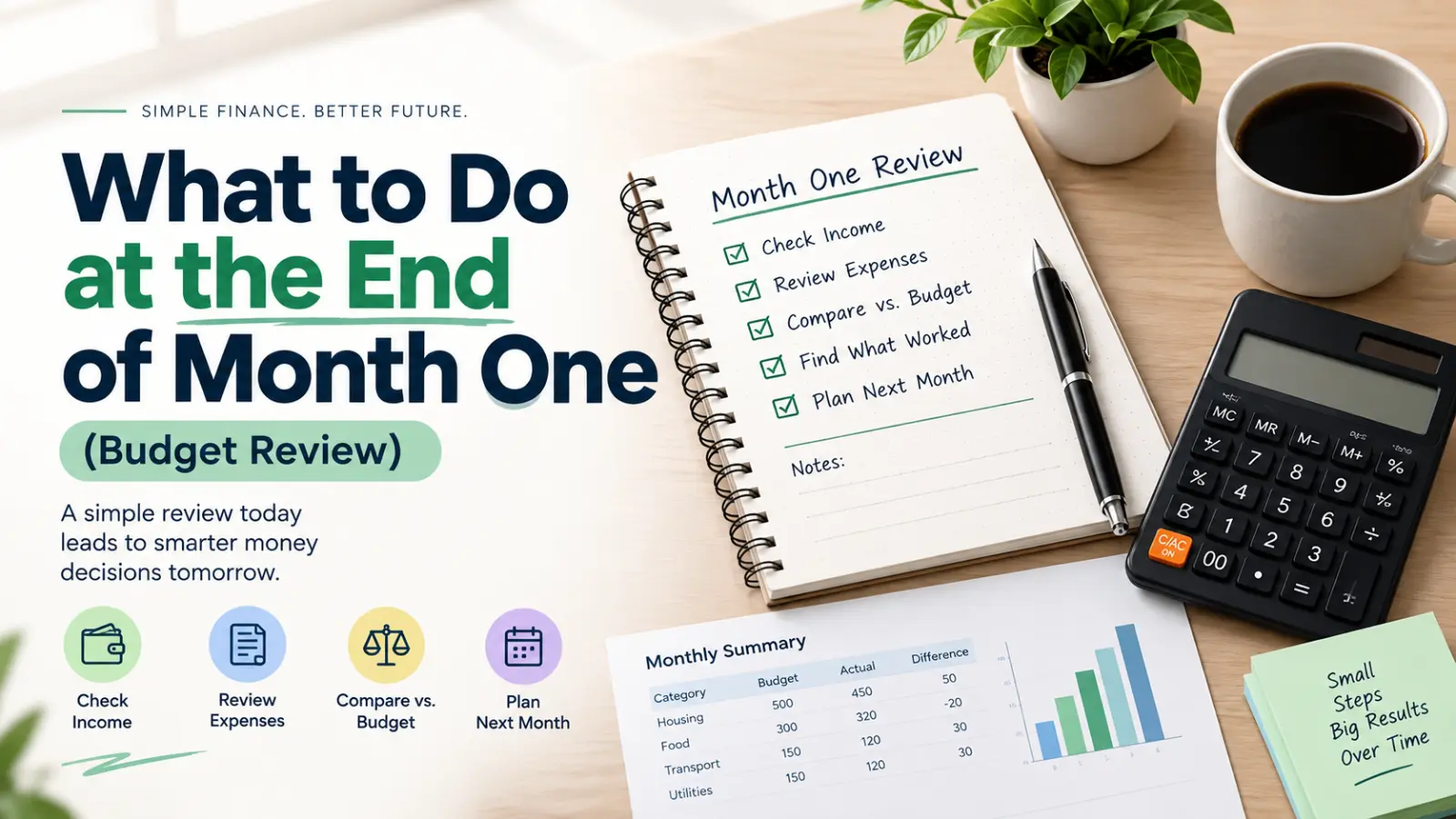
Your first month’s numbers were probably off, and that is expected, not a sign your budget failed. At the end of month one, compare what you actually spent against what you planned, category by category, flag anything meaningfully over or under, and decide for each one whether the miss was a bad number (your estimate was unrealistic) or a bad habit (the estimate was fine and spending drifted). That comparison, not a perfect first month, is the actual point of building a budget at all.
This is educational information, not financial advice. For decisions about your own money, consult a licensed financial advisor.
Month one is a diagnostic, not a verdict
A first budget is a set of educated guesses. It cannot be anything else, because you have not yet watched a full month unfold against it. Reading a rough first month as proof that budgeting “does not work for you” is exactly the mistake our guide to why budgets fail identifies as the single biggest reason people quit: they treat month one as a final exam instead of a rough draft.
Treat month one as data collection. It tells you where your estimates were close and where they were fantasy, and that information is the entire value of the exercise. A budget that turned out to be wrong in a few places and got corrected is working exactly as intended.
The five-step review checklist
As reported by The Balance, evaluating a budget means comparing what you planned against what actually happened, category by category, then using that comparison to build the next month. Here is that process broken into five concrete steps.
- Gather the real numbers. Pull your actual spending for the month from your bank or card statements, or from whatever tracking you kept, so you are comparing your budget against reality, not memory.
- Line them up against your plan. Put your planned amount and your actual amount for each category side by side. This is easiest to do all at once, at the end of the month, rather than trying to hold it in your head.
- Flag the categories that missed. As reported by FinancialAha, a common practical threshold is flagging any category that came in more than roughly 10 to 15 percent over or under its planned amount, rather than treating every tiny variance as a problem worth solving.
- Diagnose each flagged category. For every one that missed by a meaningful margin, ask why, specifically. This is the step most people skip, and it is covered in detail below.
- Write next month’s numbers based on what you just learned. Adjust the categories that needed it. Leave alone the ones that were already close. This becomes your new baseline, closer to reality than your first guess was.
For each category that missed: is it the number, or the behavior?
This is the single most useful question in the whole review, and most guides do not spell it out clearly enough. When a category comes in over budget, there are really only two possible explanations, and they call for opposite fixes.
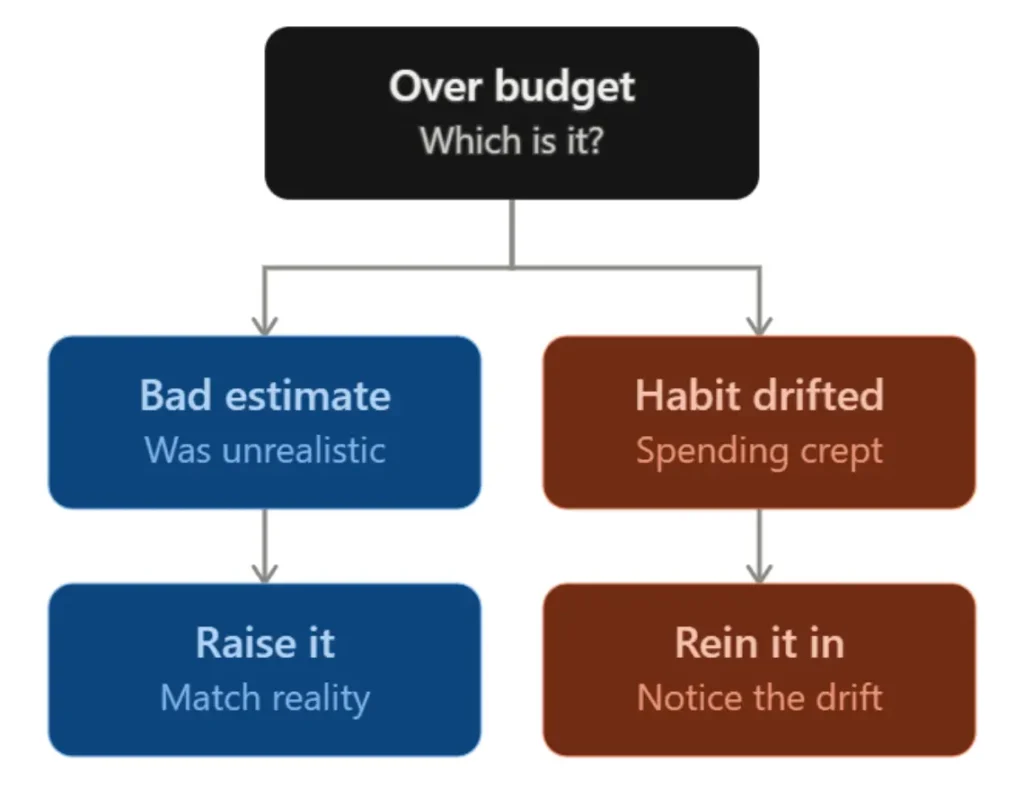
The number was wrong. Your grocery estimate was based on a guess, not your actual recent spending, and reality simply costs more than you assumed. This is not a discipline problem. The fix is to raise the number to match your real, honest spending level, then look for savings from that accurate baseline if you want to trim it, rather than repeatedly “failing” against a number that was never realistic.
The behavior drifted. Your estimate was reasonable, based on real recent spending, but you spent beyond it anyway, often in small, easy-to-miss increments. This is the pattern our guide to needs versus wants covers under reclassification creep, where a want quietly gets treated as unavoidable. The fix here is behavioral, not numerical: notice where the extra spending happened and decide, consciously, whether to allow it going forward or actively rein it in.
Confusing these two causes is one of the fastest ways to keep having the same “failed” month over and over. Raising a number fixes a bad estimate. It does nothing for a drifting habit, and tightening a number that was never realistic in the first place just sets you up to miss it again.
What “close enough” looks like (the threshold most guides use)
Not every variance deserves attention. As reported by FinancialAha, a commonly used practical rule flags a category only when it is roughly 10 to 15 percent off from the plan, which filters out ordinary month-to-month noise (a slightly bigger grocery trip, a slightly cheaper utility bill) from genuine misses worth addressing. Chasing every dollar of variance in every category is exhausting and, for a beginner, usually not worth the effort it costs. Reserve your attention for the categories that missed by a real margin.
Building month two from what you actually learned
Month two should not look like month one guessed again. It should look like month one, corrected. Categories that were realistic and held steady stay as they are. Categories where the number was wrong get raised (or lowered) to match reality. Categories where the behavior drifted get a deliberate decision, either an adjustment to the plan or a conscious choice to hold the line going forward. This is the loop a budget is supposed to run on, month after month, not a one-time setup you get right on the first try.
If your first month revealed that a specific method is not fitting how you think about money, it is worth revisiting the comparison in our budgeting for beginners overview before assuming the problem is you rather than the method. And if the review process itself feels like the part that is not sticking, our first-budget guide covers building the initial structure this review is meant to check against.
FAQ
Is it normal for my first month’s budget to be way off?
Yes. A first budget is built on estimates before you have any real data to check them against, so a rough first month is expected, not a sign that budgeting does not work for your situation.
What percentage over budget actually matters?
A commonly used practical threshold flags a category once it is roughly 10 to 15 percent off from the plan. Smaller variances are usually ordinary noise and not worth chasing down individually.
Should I rebuild my whole budget after one bad month?
No. Adjust the specific categories that missed, based on whether the number or the behavior was the problem, and leave the categories that were already close alone. A full rebuild is rarely necessary after just one month.
How do I know if a missed category is a bad estimate or a bad habit?
Check whether your original number reflected your real recent spending. If it did and you still went over, the spending drifted. If the number itself was a guess disconnected from reality, the estimate was the problem, not your behavior.
How often should I do this review after month one?
Doing it at the end of every month is a common and reasonable cadence, since it keeps each month’s plan grounded in the previous month’s actual results rather than compounding an old guess indefinitely.
Reminder: this article explains a general review process, not personalized advice. For decisions about your own money, consult a licensed financial advisor.