
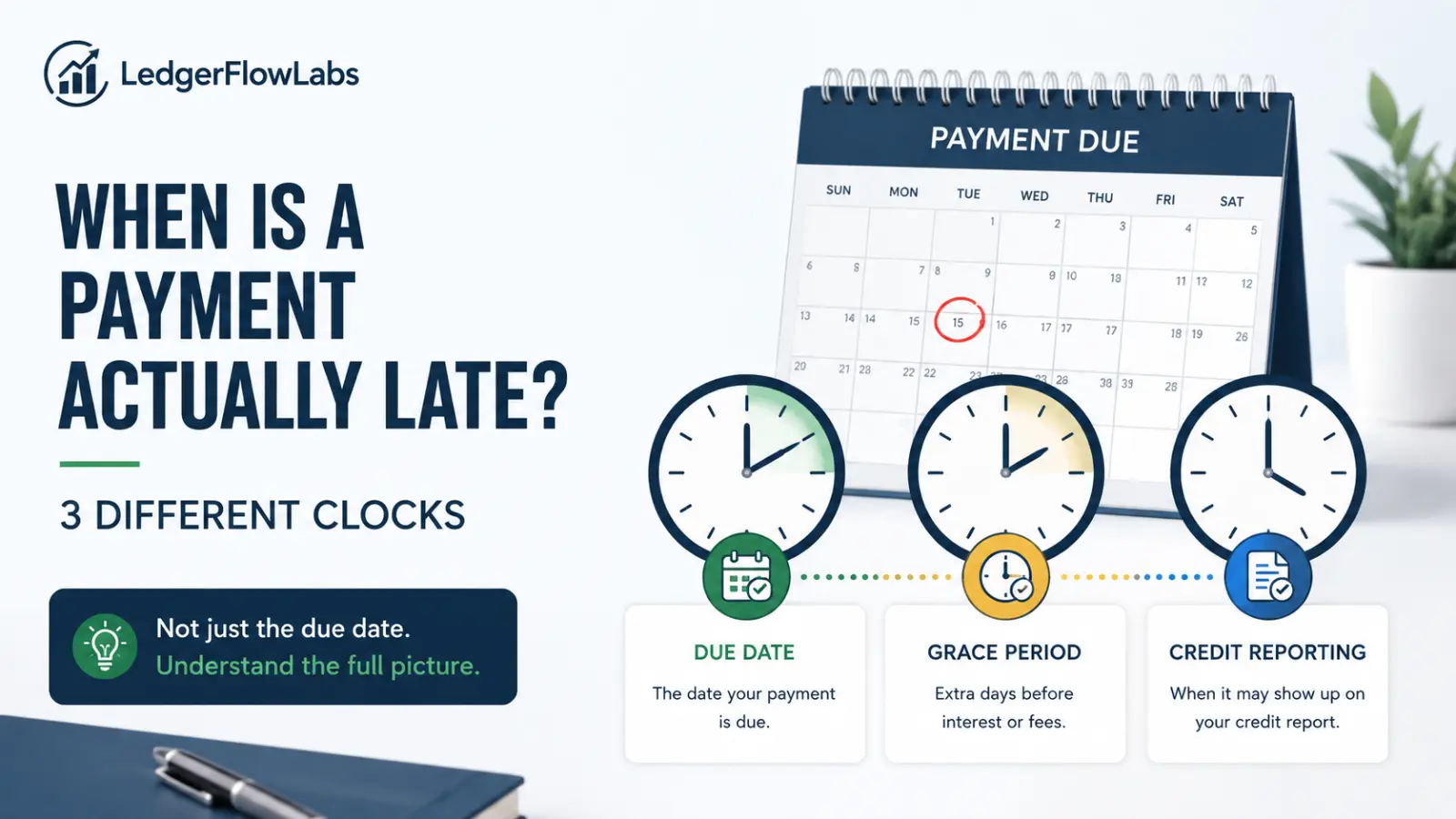
Short answer: in the United States, a payment is late the moment it misses the due date and cut-off time in your agreement. Three separate clocks then start. The grace period decides whether you are charged interest. The late fee starts at the due date. Credit reporting is a third clock, and the widely repeated "30 days" is a lender's reporting practice, not a rule that makes a payment not late.
Where this applies: the United States. Canada's credit card rules are federal and separate, published by the Financial Consumer Agency of Canada, and other countries set their own rules again.
This is educational information, not financial advice and not legal advice. What happens on your account depends on your agreement, your lender and your state.
Three different clocks, side by side
Most articles on this question blend the three together, which is why the answer feels contradictory depending on where you read it. They are set in three different places and can all run at once.
| Clock | What it decides | What starts it | Where it is set |
|---|---|---|---|
| Grace period | Whether a periodic interest rate is charged on purchases | The end of the billing cycle | Your card agreement, within Regulation Z |
| Late fee | Whether a penalty fee is charged | The due date and its cut-off time | Your agreement, with limits in Regulation Z |
| Credit reporting | Whether the account is reported as delinquent | The lender's own reporting cycle | The lender's practice, within the FCRA |
Read the middle column. Only one of these clocks is about lateness at all.
Clock one: the grace period is about interest, not lateness
Regulation Z, which implements the Truth in Lending Act, defines a grace period narrowly. In 12 CFR § 1026.5(b)(2)(ii)(B)(3), read on the CFPB's regulation pages on August 24, 2026, it is "a period within which any credit extended may be repaid without incurring a finance charge due to a periodic interest rate." The official commentary to that section is explicit that a period after the due date during which a late fee is not charged is not a grace period under the regulation.
That distinction resolves most of the confusion here. A grace period sits between the close of your billing cycle and the due date. It is not a cushion after the due date.
Two further points from the CFPB's grace period guidance, last reviewed September 23, 2024. Card companies are not required to give one, although most cards give one on purchases. And not paying in full by the due date loses it, so interest is charged on the unpaid balance and on new purchases from the date of each purchase.
Clock two: the late fee starts at the due date and time
Under Regulation Z § 1026.10(b)(2)(ii), a creditor may set reasonable cut-off times for payments, but they cannot be earlier than 5 p.m. on the payment due date. The CFPB's consumer-facing version, last reviewed December 9, 2024, is that card companies generally cannot treat a payment as late if it is received by 5 p.m. on the day it is due, in the time zone stated on the billing statement, or the next business day if the due date is a Sunday or a holiday.
Two related protections sit in the same section, both read on August 24, 2026. Section 1026.10(d) says that where a creditor does not receive or accept mailed payments on the due date, a payment received the next business day generally may not be treated as late. Section 1026.10(f) bars a late fee for 60 days where an issuer's own material change to its payment address or procedures caused the delay.
The fee size is limited too. Section 1026.52(b)(1) lets an issuer charge a fee that is a reasonable proportion of its costs for that type of violation, or use safe harbor amounts the CFPB adjusts annually. Section 1026.52(b)(2)(i)(A) says a fee "must not exceed the dollar amount associated with the violation," and § 1026.52(b)(2)(ii) bars more than one fee "based on a single event or transaction."
Clock three: credit reporting runs on the lender's calendar
The third clock is not in Regulation Z at all. It sits under the Fair Credit Reporting Act, and what the FCRA governs is accuracy and duration, not the day a lender chooses to report.
Three provisions matter, read on August 24, 2026. Under 15 U.S.C. § 1681s-2(a)(1)(A), a furnisher "shall not furnish any information relating to a consumer to any consumer reporting agency if the person knows or has reasonable cause to believe that the information is inaccurate." Under § 1681s-2(a)(5)(A), a furnisher reporting an account placed for collection or charged to profit or loss must, within 90 days, report the date of delinquency, defined as "the month and year of the commencement of the delinquency on the account that immediately preceded the action." Under § 1681c(a)(4) with § 1681c(c)(1), the seven-year window for such an account begins 180 days after that same commencement.
The CFPB's plain version, last reviewed September 5, 2025, is that most negative information can be reported for seven years, and that accurate negative information cannot be removed on request.
Why "30 days late" is not when a payment is actually late
Notice what is missing from all of that. Nothing in the FCRA, and nothing in Regulation Z, says a payment stops being late until it is 30 days overdue. The FCRA places duties on "a person who furnishes information," which are duties about how and for how long, not an instruction to report on a particular day.
So the 30-day figure describes reporting practice rather than lateness. No regulator is cited for it here because there is none to cite: it is an industry convention, and lenders differ.
That is why "you are not late until 30 days" is wrong in a way that costs money. Before a delinquency could be reported at all, the late fee has usually been charged, the grace period lost, and interest started. Two clocks finished a month earlier. The reverse is not safe either: because reporting is a practice and not a threshold, a payment fixed inside that window is not certain to stay off a credit report.
If an account is already past due and heading toward collections, the free route exists before any paid one. The CFPB publishes consumer guidance at consumerfinance.gov, and the National Foundation for Credit Counseling lists nonprofit member agencies at nfcc.org.
Where the real answer for your account is written
For a large part of this question the honest answer is that it is in your paperwork, and Regulation Z says where.
Section 1026.7(b)(11), read on August 24, 2026, requires a credit card periodic statement to show the due date, and to show "the amount of any late payment fee and any increased periodic rate(s) (expressed as an annual percentage rate(s)) that may be imposed on the account as a result of a late payment." An issuer may show a range or the highest fee, so the figure you see can be a ceiling rather than the exact charge.
The grace period, and whether the card has one at all, is in the account agreement. On a mortgage, auto loan or personal loan, any contractual window before a late fee is in the note, a term of that contract rather than a federal standard, which is why no typical number belongs in an article like this.
One label worth separating: the 21 days often mistaken for a grace period is a delivery rule. Section 1026.5(b)(2)(ii)(A)(1) requires issuers to have procedures designed to ensure statements are mailed or delivered at least 21 days before the due date.
Bills that are not credit cards run on different rules again
Rent, utilities, phone and insurance are not credit card accounts, so the Regulation Z timing rules above do not apply to them. Their late fees come from the lease, the tariff or the contract, and some of these creditors do not report to the credit bureaus at all. That is much of why someone can be late on several bills and see nothing on a credit report, then be late once on a card and see it.
Debt in collections has its own timing rule. Regulation F, 12 CFR § 1006.30(a), read on August 24, 2026, requires a debt collector to take a required action before furnishing information about a debt to a credit reporting agency: either speaking to the consumer about the debt in person or by telephone, or mailing a letter or sending an electronic message and waiting a reasonable period.
Because the clocks sit in different documents, the practical picture is a calendar problem first. Seeing every due date in one place through a bill calendar makes the gaps visible, and those gaps are the subject of payday versus due date. Where a provider allows it, moving a due date changes the date the first two clocks run from.
The timing traps that make a payment late anyway
A payment can be sent on time and still arrive late, which is a different failure from forgetting. Transfers and bill-pay services take time to move, and money leaving your account is not the same event as the biller receiving it. That gap is the one described in pending versus posted transactions, and it is why an on-time click can still be a late payment.
Incoming money has the same problem in reverse: if a payment is timed around a deposit that has not settled, how long a deposit takes to clear decides whether the funds are really there. When the shortfall is structural, the pattern behind it is covered in why you run out of money before payday. None of that changes the rules above. It changes which day the payment lands on, and that is the input all three clocks run on.
FAQ
Is being one day late actually a problem? In the United States, yes, on the first two clocks. A payment received after the cut-off time on the due date can trigger a late fee, and paying less than the full balance loses the grace period, so interest applies. Whether one day reaches a credit report is a separate question, decided by the lender's reporting practice.
Does a grace period mean I can pay a few days after the due date? No. Under Regulation Z § 1026.5(b)(2)(ii)(B)(3) a grace period is the window in which credit can be repaid without a finance charge from a periodic interest rate, and the official commentary states that a period after the due date without a late fee is not a grace period. Some other loan agreements do include a window after the due date, but that is a contract term.
If my due date falls on a Sunday or a holiday, is Monday late? The CFPB's guidance, last reviewed December 9, 2024, says a payment is generally not late if received by 5 p.m. on the due date, or the next business day where the due date is a Sunday or holiday. Regulation Z § 1026.10(d) covers the case where the creditor does not receive or accept mailed payments on the due date.
How long can a late payment stay on a credit report? The CFPB states, last reviewed September 5, 2025, that most negative information can be reported for seven years and that accurate negative information cannot be removed on request. For an account placed for collection or charged to profit and loss, 15 U.S.C. § 1681c(c)(1) starts that period 180 days after the delinquency that immediately preceded the action.
Who decides when my lender reports a late payment? The lender does, within the FCRA's accuracy duties. 15 U.S.C. § 1681s-2(a)(1)(A) bars furnishing information the furnisher knows or has reasonable cause to believe is inaccurate, and § 1681s-2(a)(5)(A) governs the date of delinquency reported. Neither sets a fixed day on which a late payment must be sent to the bureaus.