
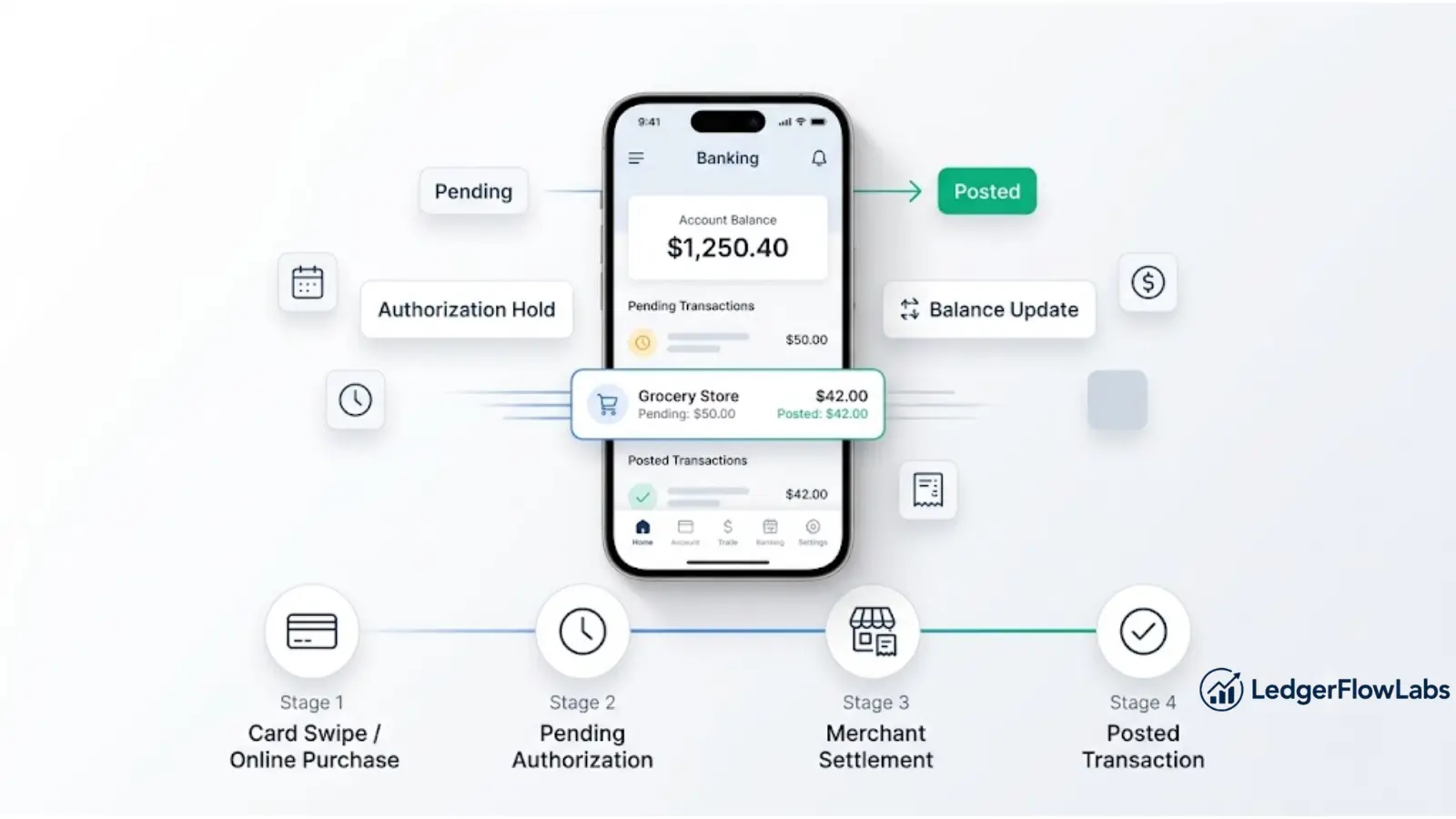
You buy something for 42 dollars. It shows up on your account as 50. Two days later it is 42 again, and the date on it has changed. Nothing has gone wrong. A card transaction passes through four separate stages before it is final, run by two different organizations on two different clocks, and the balance you see reflects wherever it currently sits in that process.
This guide draws the timeline, which is the thing the bank explainers on this subject describe in words and never lay out in order.
This is educational information, not financial advice. For decisions about your own money, consult a licensed financial advisor.
Where this applies: written for readers in the United States. Payment practice differs by country, and the sources named below are US ones.
The four stages, in order
Stage one: authorization. You present the card. Within seconds, a request goes to your bank asking whether the funds exist. Your bank answers yes or no. Nothing has moved. A permission has been granted.
Stage two: the hold. Having said yes, your bank sets that money aside so it cannot be spent twice. This is what a pending transaction is: a promise your bank has made on your behalf and is holding funds against. As reported by Capital One, a pending transaction is one that has been initiated but not yet fully processed.
Stage three: settlement. The merchant submits the day's transactions for payment, usually in a batch at the end of their business day rather than at the moment of sale. Money now genuinely moves between institutions.
Stage four: posting. Your bank records the completed transaction against your account. As reported by Country Bank and by Coastal Bank, a posted transaction is final: the amount is settled and it does not change afterward.
Most people think of buying something as one event. It is four, and typically spread across one to three business days.
What each stage does to your balance
This is where the two balances come from, and it is worth mapping precisely.
At authorization, nothing changes anywhere.
At the hold, your available balance drops. Your current balance usually does not, because from a bookkeeping perspective the money is still in the account. This is the source of the gap covered in available balance versus actual balance, and it is why the two numbers disagree most on the days you have spent the most.
At settlement, still typically no visible change to you. This stage happens between the merchant and the banks.
At posting, both balances update and agree, and the transaction moves out of the pending list into your ordinary history, usually with a date that may not match the day you actually made the purchase.
That last detail confuses people reasonably often. The date attached to a posted transaction is frequently the posting date rather than the purchase date, which is why a Saturday purchase can appear as a Monday line.
Why the amount changes between pending and posted
Pending amounts are estimates. Posted amounts are final. As reported by Finance Strategists, pending transactions are temporary and subject to change while posted transactions are permanent. Four common reasons the two differ.
Merchant holds sized above the purchase. Where the final total is not known when the card is presented, businesses commonly authorize a higher figure. As reported by Capital One and by PNC, gas stations, hotels and rental car companies do this routinely, holding an amount intended to cover the maximum likely charge. The purchase settles at the real amount and the excess is released.
Tips. A restaurant runs the card for the bill, and the tip is added after. The pending figure is the bill; the posted figure includes the tip.
Partial fulfillment. An order authorized in full and shipped in parts can settle for less than was authorized, or in more than one piece.
The merchant simply has not finalized it. The permission was granted and the business has not yet submitted the transaction for payment. Nothing is wrong; it is stage three that has not happened.
None of these is unusual and none of them is an error. The only case worth attention is a pending amount you cannot connect to anything you did, and the answer to that is in the last section.
Why a pending charge sometimes disappears
A pending item can vanish without ever posting. Three ordinary causes.
The merchant never completed the transaction. A canceled order, an abandoned hotel reservation, a purchase reversed at the till. The authorization expires and the hold falls away.
The hold expired on its own. Authorizations do not last forever. If the merchant does not settle within the window, the hold is released. The length of that window is set by the institution and the transaction type, so there is no universal figure and this site will not invent one.
It was a verification charge. Some services confirm a card is valid by authorizing a small amount and immediately reversing it.
The variant that genuinely confuses people: a pending item disappears, and then a charge appears days later at a different amount. That is usually a hold that expired before the merchant settled, followed by the settlement arriving on its own through the normal process. Two events, one purchase, and a gap in the middle where it looked like nothing was happening.
Why weekends and holidays stretch the whole thing
Settlement runs on business days. Authorization does not.
So a purchase on a Friday evening is authorized instantly, held immediately, and then waits. The merchant submits on Monday, settlement runs on Monday, and posting may not appear until Tuesday. Add a public holiday and the same purchase can sit pending for four or five days.
This matters more than it sounds, because it is the mechanism behind a specific and avoidable failure. A person checks their account on Sunday, sees a balance that looks fine, and spends against it. What they are looking at is three days of accumulated authorizations that have not yet caught up. The account is not as full as the screen suggests, and Monday and Tuesday bring the reconciliation.
The general rule: the further you are from the last business day, the less your posted history reflects reality, and the more you should rely on the pending list rather than on the transaction history.
Pending is not proof of payment, and that matters for bills
The single most practical point on this page.
If you pay a bill and the payment shows as pending, the bill is not yet paid. You have instructed a payment. The money has not arrived at the other end, and whether it arrives before the deadline depends on stages three and four, which are not under your control.
For a purchase, this is a technicality. For a bill with a due date, it is the difference between on time and late.
This is precisely why our guide to building a bill calendar recommends recording the date the money must leave, several days before the deadline, rather than the date printed on the bill. The Consumer Financial Protection Bureau's own bill calendar guidance does the same, telling people to mark the payment date with a lead time rather than the due date itself. The lead time is not caution for its own sake. It is the four-stage process above, converted into days.
It also explains why a narrow gap between a paycheck and a due date is riskier than it looks. If the payment leaves the day before the deadline and settlement takes two business days across a weekend, the payment can be late despite having been made on time. Payday versus due date covers how to find those narrow gaps in your own schedule before they cost anything.
What to do if something still looks wrong
If a pending item does not resolve, or you cannot connect a charge to anything you did, the answer is short and it is deliberately short.
Contact your bank and ask about that specific transaction. They can see the merchant identifier, the authorization date and the status, none of which is visible to you and none of which any website can determine on your behalf.
This site explains how the mechanics work. It does not diagnose individual charges, and it is not a guide to disputing one. If you believe something on your account is not yours, your bank is the correct and the fastest first call, and it should be made rather than researched.
For the ordinary case, where the amount changed or the date moved or an item sat pending over a long weekend, nothing is wrong at all. That is the machinery working exactly as described above. The wider picture of how that machinery interacts with your pay dates and your due dates is covered in why you run out of money before payday.
FAQ
How long does a transaction stay pending?
It depends on the merchant and the institution, and on whether business days intervene. Common purchases often post within one to three business days, and certain merchant holds run longer. Treat any single number presented as universal with caution, and ask your bank about a specific item.
Can I cancel a pending transaction?
Generally the merchant controls it, because the transaction is theirs to submit or abandon. Contacting the business is usually the more direct route. Neither this page nor your bank can promise an outcome.
Why is the pending amount higher than what I spent?
Almost always a merchant hold sized above the purchase, which is standard at fuel pumps, hotels and rental companies. It settles at the real amount and the excess is released.
Does a pending payment count as paid on time?
No. Pending means instructed, not completed. For anything with a deadline, allow time for settlement rather than paying on the due date itself.
Why does the date on a posted transaction not match the day I bought it?
Because the recorded date is often the posting date rather than the purchase date. The lag is the four-stage process, stretched by weekends and holidays.
Do these stages apply to a direct deposit too?
Deposits move through their own process with their own timing, and availability rules differ from card settlement. That is covered separately in this cluster.
Reminder: this article explains general mechanics, not personalized advice. For decisions about your own money, consult a licensed financial advisor.