
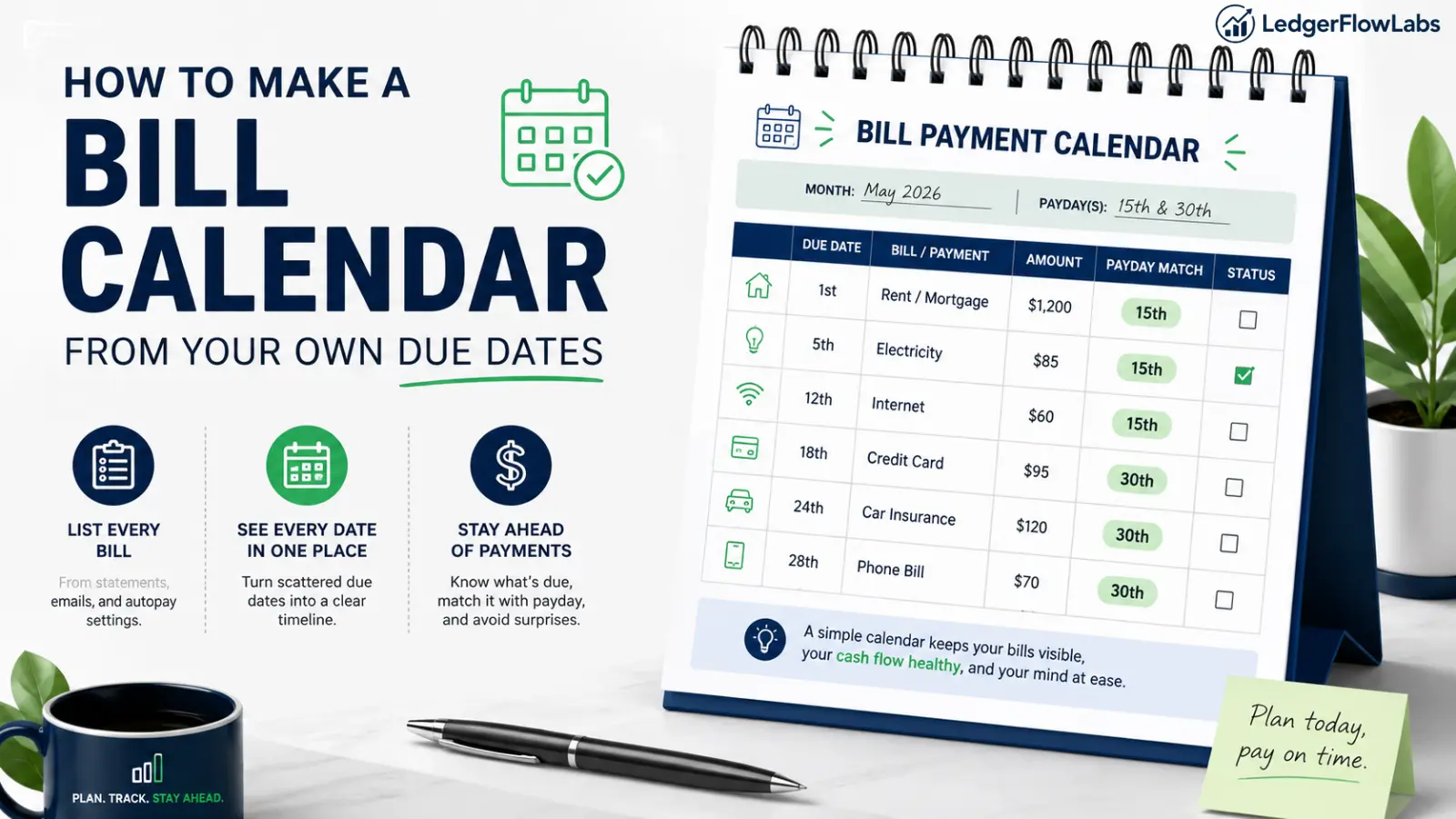
A bill calendar is one page that lists every recurring payment you owe, in date order, next to the dates you get paid. That is the whole idea. It is not a budget, it does not track categories, and it does not need software. What it does is turn a set of dates scattered across statements, emails and autopay settings into a single timeline you can actually read.
This is educational information, not financial advice. For decisions about your own money, consult a licensed financial advisor.
Where this applies: written for readers in the United States. The source named below is a US federal agency.
What a bill calendar is, and what it is not
Most people who get surprised by a bill were not ignorant of it. They knew the bill existed. What they did not know was that it was landing on the eleventh, three days before a different bill, and two days before their paycheck.
A budget cannot tell you that. A budget is a monthly container: it confirms that your outgoings fit inside your income across a whole month. A bill calendar is a sequence. It tells you the order things happen in and how far apart they are. Both are useful and they answer different questions.
The Consumer Financial Protection Bureau, the US federal consumer agency, publishes a free printable bill calendar worksheet and recommends recording, for each bill, what it is for, the amount owed, and the due date, then adding your income dates to the same page. That is the minimum viable version and it is genuinely enough to start.
What this page adds is the part that stops people: the dates themselves. Roughly half the work of a bill calendar is finding due dates you do not currently know.
Step 1: find every recurring payment, including the ones you forgot
Start with what you can list from memory. Housing, utilities, phone, insurance, any loan or card minimum, transport, childcare. That is usually eight to twelve items and it is usually not all of them.
The reliable way to catch the rest is to work backwards from your account activity rather than from memory. Look at the last three months of transactions on every account money leaves from, which for most people means a checking account and one or two cards. Read every line. Anything that appears in all three months is recurring, whether or not you think of it as a bill.
Three months rather than one, because monthly items appear three times and are easy to spot, and because quarterly items appear once and would be invisible in a single month.
Then add the things that never show up in a three-month window at all:
- Annual insurance premiums
- Annual subscriptions and memberships
- Property tax or vehicle registration, if you pay those directly
- Anything billed quarterly or twice a year
These are the items that wreck a month, precisely because they are not part of the normal rhythm and so they are not in anyone’s mental model of “my bills.”
Step 2: recover the due date when you cannot find it
This is the step no other guide covers, and it is where most attempts stall. You know you pay a company. You do not know what date it is due.
If it is on autopay, the payment date in your transaction history is not necessarily the due date. It is the date you or the company chose to pay. The due date is the deadline behind it, and the two can be more than a week apart. Look at the bill itself rather than the payment.
If you get a paper or email statement, the due date is on it, but be careful which date you copy. A statement carries several: the statement date, the closing date of the billing period, and the payment due date. Only the last one is the one you want.
If you have no statement at all, log in to the account and look for the current bill. Almost every provider shows the next amount and the next due date on the account summary page.
If it is a card, the due date is fixed relative to when the statement closes rather than to the calendar month, which is why it can appear to move by a day or two. Write down the usual date and note that it shifts slightly.
If it is rent or a loan, the due date is in the agreement, and it does not change unless the agreement changes.
Write down the date you found and where you found it. You will want to know next year whether the date came from the actual bill or from a guess.
Step 3: write down the date the money must leave, not the date printed on the bill
This is the single most useful adjustment on the page, and it is the one the CFPB worksheet builds in.
The date on the bill is the deadline for the payment to arrive. It is not the date you can safely start the payment. Those are different, sometimes by several days, because payments move in stages rather than instantly.
The CFPB’s own bill calendar instructions tell people to mark the payment date rather than the due date, and to leave a lead time: several days if paying by mail, a shorter lead if paying online. The exact lead depends on how you pay and who you pay, so build in your own margin rather than copying a number.
The reason behind the lead time is worth understanding, because it applies to everything in this cluster. Money you have instructed to move is not money that has moved. Our guide to pending versus posted transactions covers the stages a payment passes through and why a payment that shows as pending is not yet a payment that has been made.
So each line of your calendar gets two dates: the due date, and the earlier date you actually need to act. Plan around the second one.
Step 4: add your pay dates to the same page
A list of bills with no income on it is only half a picture. Write your pay dates onto the same timeline, in the same date order, so that money in and money out sit next to each other.
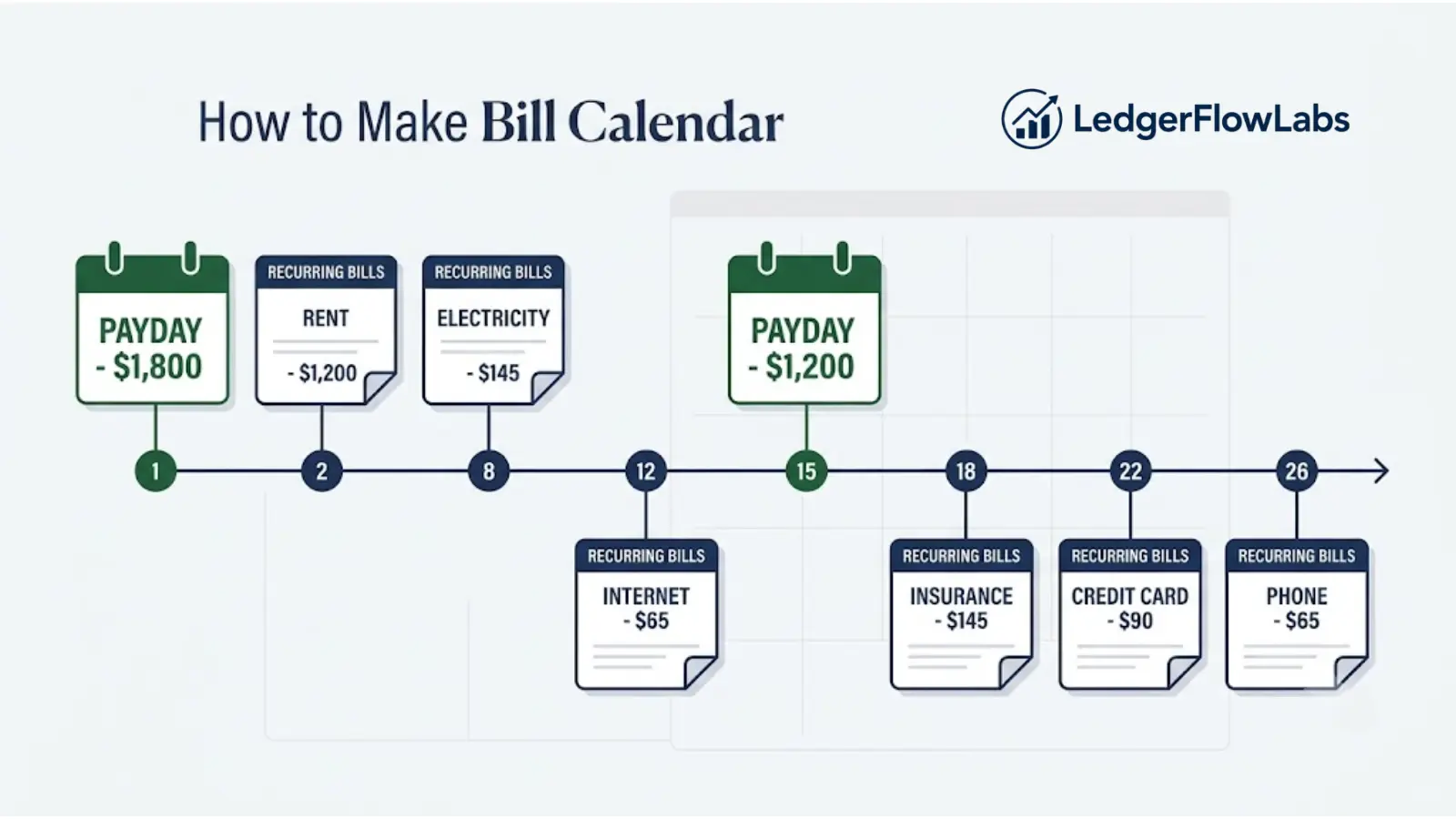
Write actual calendar dates rather than a rule. “Every other Friday” is a rule; the calendar needs the dates. If you are paid biweekly you will notice immediately that the dates walk forward through the month all year, and that some months contain three of them. That drift is a real cause of month-to-month instability and it is covered in weekly, biweekly and semimonthly pay.
With both sets of dates on one page, the gaps become visible. Reading them, and deciding what to do about them, is the subject of payday versus due date.
Step 5: handle the bills that are not monthly
Annual and quarterly bills need a decision, not just a date, because writing “car insurance, March 4” on a calendar is accurate and completely unhelpful in February.
Two workable approaches, and the choice is yours.
Record it on the month it lands and plan that month as an unusual one. Simple, honest, and it means one month a year is genuinely tight in a way you can see coming.
Divide it across the months in between and set that share aside as it accrues. Slightly more work, and it removes the spike entirely. This is the mechanic behind a sinking fund, which our guide to sinking funds versus emergency funds explains in full, including why money for a known future cost is doing a different job from money for an emergency.
Either way, the annual bill goes on the calendar. The failure mode is leaving it off because it is not a monthly item.
Keeping it current without turning it into a chore
A bill calendar goes stale. Providers change billing cycles, subscriptions renew at different dates, you move, you switch a payment method. If updating it feels like a project, it will not happen.
Two habits keep it usable, and neither takes long.
Look at it weekly. The CFPB’s own guidance is to keep the calendar somewhere you will check it weekly. The point is not to admire it. It is to see the next seven to ten days before they arrive.
Rebuild it once a year, from scratch. Not edit it: rebuild it. Run the three-month transaction sweep from step 1 again. Things will have appeared and disappeared without your noticing, and a fresh sweep catches them where an edit does not.
Medium does not matter. Paper on a wall works. A generic spreadsheet works. A wall calendar with dates written on it works. This site does not recommend any particular app or product, and for this task none is necessary: the value is entirely in having the dates in one place and in date order.
The final thing to say is what a bill calendar cannot do. It does not create money, it does not decide what you can afford, and it will not fix a month where the total genuinely does not cover the total. What it does is remove surprise, and a surprisingly large share of money stress is surprise rather than shortage. The full picture of why that is sits in why you run out of money before payday.
FAQ
Should I use paper or a spreadsheet?
Whichever you will actually look at. The calendar is the method, not the medium. Paper has one real advantage: it can live somewhere you pass every day, which makes the weekly check happen by itself.
How far ahead should the calendar go?
Twelve months. A shorter window hides the annual bills, and the annual bills are the ones that do the damage.
What about bills where the amount changes every month?
Record the date, which is stable, and estimate the amount on the high side. A utility bill in a hot or cold month is the classic case. Estimating high means a good month is a pleasant surprise rather than a bad month being a shock.
Do I still need this if everything is on autopay?
Yes, and arguably more. Autopay controls whether the payment happens. It does not control whether the money is there when it happens, and an automatic payment against a thin balance is exactly how a scheduling problem becomes a fee. Knowing the dates is what lets you see that coming.
What if I find a subscription I forgot about?
That is the sweep working. Whether to keep it is a spending question rather than a timing one, and our guide to needs versus wants covers how to make that call honestly.
Reminder: this article explains general mechanics, not personalized advice. For decisions about your own money, consult a licensed financial advisor.