
Search for the difference between biweekly and semimonthly pay and almost every result is written for the employer. They compare processing costs and payroll runs, because that is who is choosing between the two. Almost nobody writes it for the person receiving the check, and that person has a completely different question: why does my budget hold together in some months and fall apart in others?
The answer is usually the shape of the pay schedule. Here is what each one does to a month.
This is educational information, not financial advice. For decisions about your own money, consult a licensed financial advisor.
Where this applies: written for readers in the United States. Pay-frequency conventions differ by country, and the sources named below are US ones.
The four schedules, in one paragraph each
Weekly. Paid every week, on the same day of the week. Fifty-two paychecks a year. The smallest individual checks and the shortest gaps, which suits people whose expenses are frequent and small, and creates the most administrative noise if your bills are monthly.
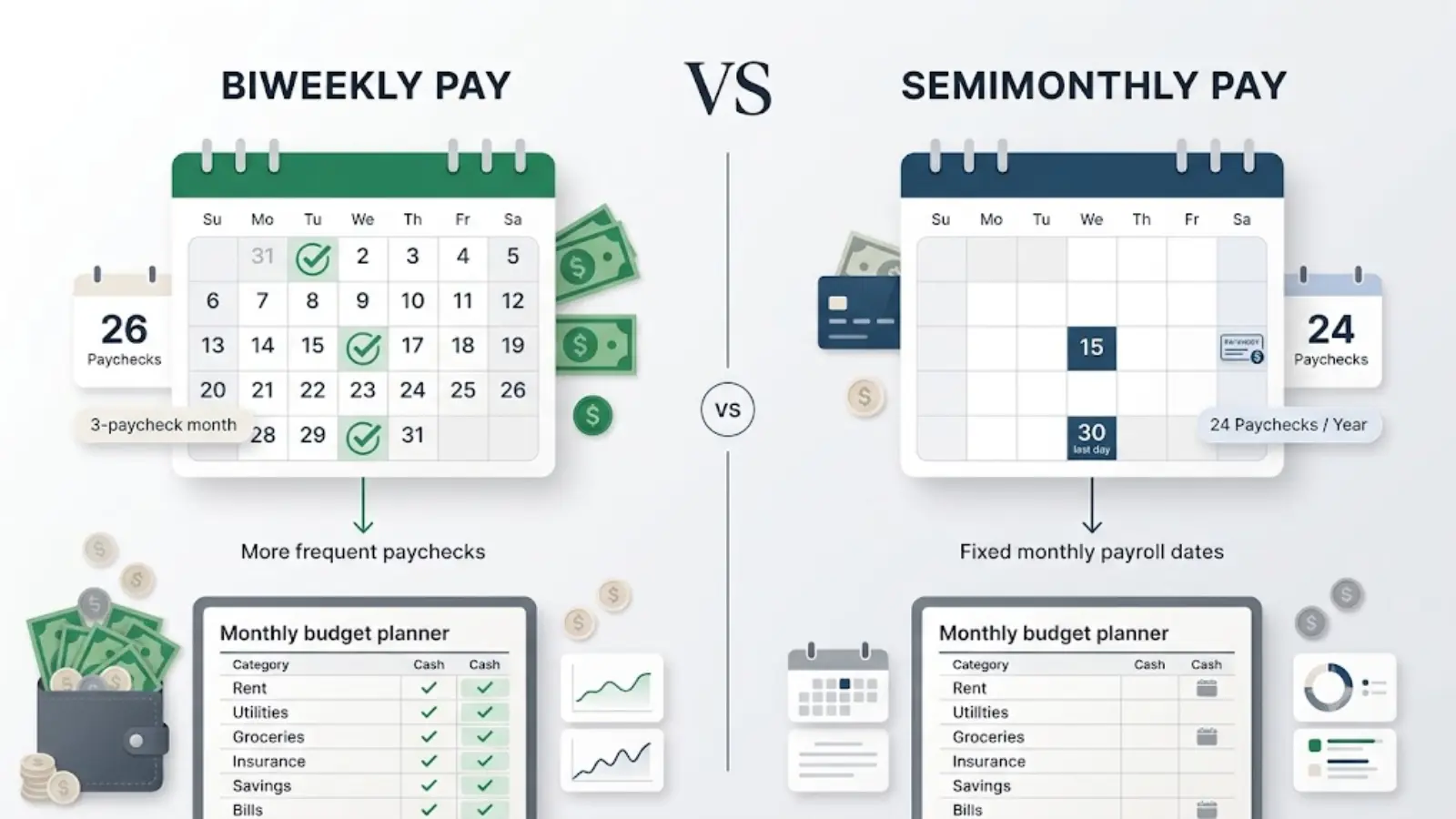
Biweekly. Paid every two weeks, on the same day of the week, so every other Friday or every other Thursday. As reported by Indeed and by payroll provider Patriot Software, this produces 26 paychecks a year. The pay dates are anchored to a day of the week, which means they walk forward through the calendar all year.
Semimonthly. Paid twice a month on two fixed calendar dates, commonly the fifteenth and the last day of the month, or the first and the sixteenth. 24 paychecks a year. The dates do not drift. If a pay date falls on a weekend or holiday, employers commonly move it, but the anchor date itself stays put.
Monthly. One paycheck a month, on a fixed date. Twelve a year. The largest individual check and the longest gap to manage, which makes the last week of the month the pressure point for almost everyone on this schedule.
The two in the middle are the ones people mix up, partly because "biweekly" and "semimonthly" both roughly mean twice a month and partly because for most of the year they behave similarly.
The number that matters: how many checks land in a month
Forget annual totals for a moment. The number that governs whether a month works is how many paychecks arrive inside it.
Semimonthly: always two. Every month, without exception, because the dates are fixed to the calendar. Two checks against one month of bills, every time. Your month has a stable shape and you can plan it once.
Biweekly: usually two, sometimes three. Twenty-six checks distributed across twelve months does not divide evenly. Ten months get two, and two months get three. Which months those are depends entirely on your own first pay date of the year, which is why nobody can tell you in advance which months yours will be. The three-paycheck month covers how to work out yours from your own dates.
Weekly: four, sometimes five. The same effect, more often.
This is the mechanic behind the complaint that a budget works in some months and not others. It is not inconsistency on your part. Two of your months genuinely contain 50 percent more income than the other ten, and the ten are each slightly short of what a monthly budget assumes.
Why biweekly pay and monthly bills never line up
Here is the structural version, and it is worth understanding because it explains a lot of otherwise confusing months.
A monthly bill is anchored to a calendar date. Rent on the first. A card payment on the eighteenth. Those dates hold whatever the day of the week is.
A biweekly paycheck is anchored to a day of the week. Every other Friday. That is a fourteen-day cycle laid against months that are 28, 30 or 31 days long.
Two cycles of different lengths, sliding past each other continuously. The distance between your last paycheck of the month and the first of the following month is not a fixed number. It is different in January than in June, and it changes gradually all year. In some months rent falls three days after a paycheck, and four months later it falls two days before one.
Nothing has changed about your income or your spending. The calendar moved underneath you.
This is why building a timeline over three months rather than one is worth the effort, and it is the input for payday versus due date, which covers how to find and close the gaps that this drift produces.
Semimonthly is steadier, and has its own catch
Semimonthly pay solves the drift completely. Two checks, fixed dates, every month the same shape. If you are choosing between offers and your bills are monthly, this is the easier schedule to plan against.
The catch is the gap length. A semimonthly schedule pays on two dates that are not evenly spaced: the fifteenth and the last day of a 31-day month are 16 days apart in one direction and 15 in the other. In February the second gap is shorter still. Not a large difference, but if your account routinely runs thin at the end of a cycle, the longer half of the month is where the pressure lands, and it is always the same half.
The other thing semimonthly does is make each check slightly larger than the biweekly equivalent, which is arithmetic rather than generosity. Same annual salary, divided by 24 instead of 26.
Same salary, different rhythm: what does and does not change
This is the part where a lot of confusion sits, so it is worth stating flatly.
Does not change: your annual pay. As reported by Indeed, a salaried employee receives the same amount per year whether paid semimonthly or biweekly. Twenty-six smaller checks and twenty-four larger ones add to the same total. Nobody earns more by being paid more often.
Changes: the size of each check. For a hypothetical salary of 60,000 dollars a year, a semimonthly gross check would be 2,500 dollars and a biweekly gross check would be about 2,308 dollars. Those figures are arithmetic illustrations, not a claim about typical pay, and both are gross rather than take-home.
Changes: how many checks arrive in a given month, as covered above.
Changes: which weeks feel tight. On a fixed schedule the tight week is the same one every month. On a drifting schedule it moves through the year.
May change: how deductions land per check. Some deductions are taken per pay period, so on a schedule with more pay periods each one carries a smaller share. Reading your own stub line by line is a separate subject with its own mechanics and is not covered here.
The thing to take from this is that a pay schedule is a distribution question, never an income question. If a schedule change makes your month harder, the money did not shrink; it arrived in a different pattern.
How to budget on the schedule you actually have
The practical advice differs by schedule, and generic budgeting guidance tends to assume semimonthly without saying so.
If you are paid semimonthly or monthly, a standard monthly budget matches your reality directly. Split your bills across the two halves of the month so each check covers what follows it, and the plan will hold. Whether you build that plan on gross or take-home pay is a separate decision, covered in should you budget gross or net income.
If you are paid biweekly, plan every month as a two-paycheck month. This is the single most useful adjustment available on this schedule. Build a plan that works on two checks, which is ten months of the year, and treat the third check in the other two months as separate rather than as part of the normal cycle. The alternative, budgeting on an average that includes the extra checks, means your plan is slightly short in ten months out of twelve and slightly loose in two.
If you are paid weekly, the same logic with different numbers: plan on four checks, and treat the fifth as separate.
If your income also varies in amount, not just in timing, that is a different problem again and it has its own method, which involves planning on your lowest recent month rather than your average. That is a separate guide in this cluster and it is not written yet.
The general principle underneath all of it: plan on the number that occurs most often, not on the average. An average is a number that describes no actual month. Our overview of why you run out of money before payday covers why planning on an average is one of the quieter ways a reasonable budget fails, and why budgets fail covers the rest of them.
FAQ
Is biweekly better than semimonthly?
Neither is better in terms of what you earn. Semimonthly is easier to budget against if your bills are monthly, because the shape of the month never changes. Biweekly gives you two months a year with an extra check, which some people find useful and others find disruptive.
Do I earn more on 26 paychecks than on 24?
No. The same annual salary is divided into more, smaller pieces. The two extra checks are what makes each one smaller, not a bonus on top.
Why was one of my paychecks smaller than usual?
Several things can cause it, including how a particular deduction is timed against a pay period. The check itself is not the place to diagnose it; the stub is. Reading a pay stub line by line is its own subject and is covered separately in this site's paycheck series.
Does the three-paycheck month happen on semimonthly pay?
No. Semimonthly means two checks in every month by definition, so there is no extra one. It is a biweekly and weekly phenomenon. See the three-paycheck month.
My employer changed our schedule. Will I lose money?
Your annual salary does not change with the schedule. What changes is the size and timing of each check, and there is usually one transitional period where the change is noticeable. Plan the transition month as an unusual one rather than as the new normal.
Reminder: this article explains general mechanics, not personalized advice. All salary figures above are hypothetical illustrations. For decisions about your own money, consult a licensed financial advisor.