
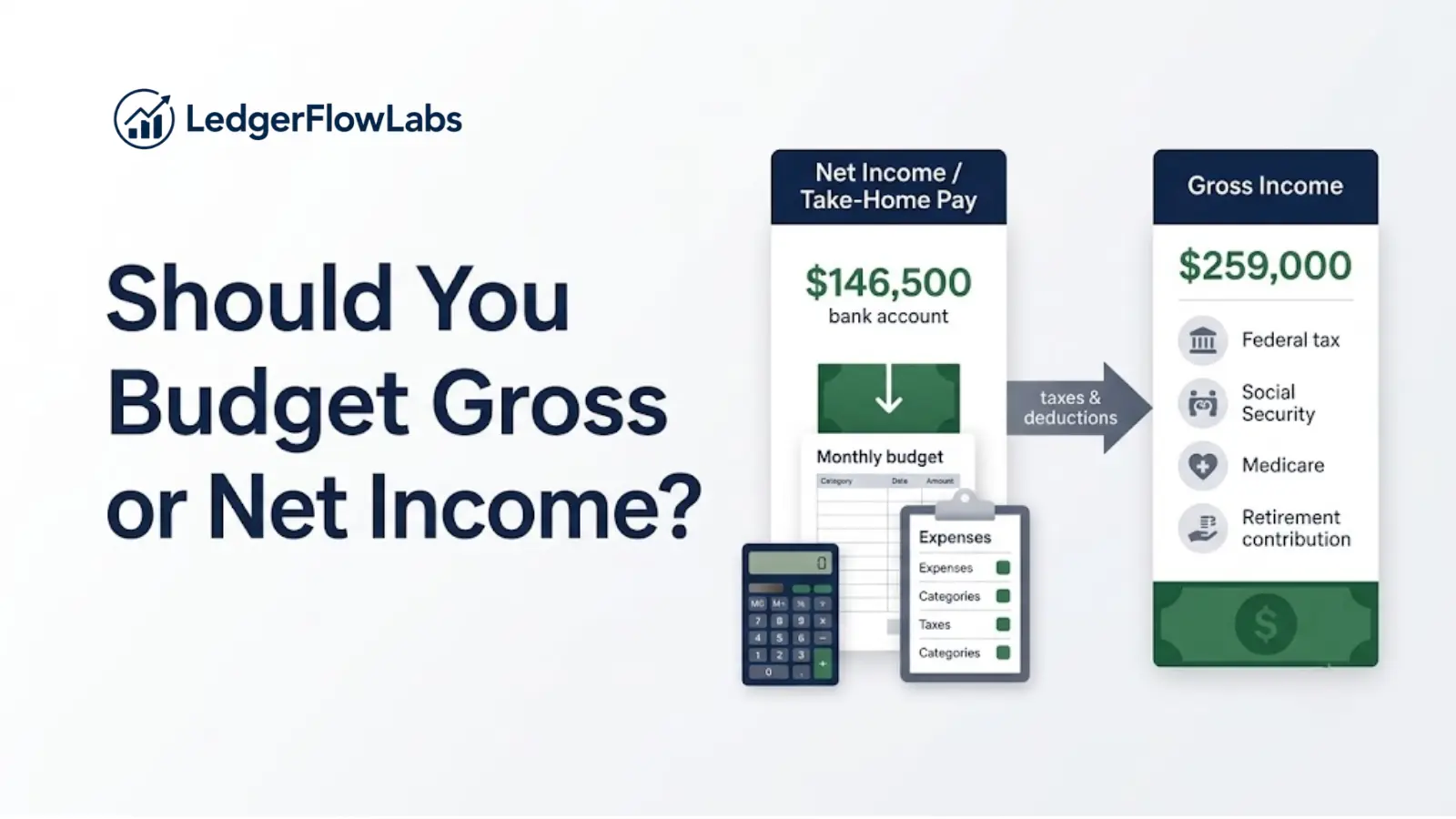
Budget from your net income, also called take-home pay: the amount that actually lands in your account after taxes and deductions come out. Not your gross salary, which is the bigger number on your offer letter before anything is withheld. Building a budget on gross income is one of the most common beginner mistakes, because it plans around money you never actually get to spend, and every category in the budget ends up a little too generous as a result.
This is educational information, not financial advice. For decisions about your own money, consult a licensed financial advisor.
A note on where this applies: this guide is written for US readers, and the deductions named below are the ones that appear on a standard US pay stub: federal income tax withholding, Social Security and Medicare (together, FICA), state income tax if your state levies one, and any workplace retirement contribution or health premium you elected.
The short answer: budget from your net (take-home) pay
Gross income is what you earn before anything is taken out. Net income, or take-home pay, is what is left after taxes and other deductions, and it is the number that actually shows up in your account. As reported by the National Foundation for Credit Counseling (NFCC), net income is the better figure for a household budget because it represents the money you genuinely have available to spend, while gross income includes money that is already spoken for before you ever see it.
This single choice, gross versus net, is one of the most common places a first budget goes wrong. Plan around the bigger number and every category looks more affordable than it really is, right up until the bills come due and the money simply is not there.
Why gross income overstates what you actually have
The gap between gross and net can be larger than people expect. As reported by SmartAsset, someone earning $50,000 a year gross might take home somewhere in the range of $34,000 to $39,000 depending on their withholding and benefit elections, a difference that can run into the tens of thousands of dollars annually. That figure is illustrative, not a claim about any specific person's situation, since actual withholding depends on your own tax filing status, location, and benefit choices.
If you build a budget on the gross figure, you are effectively planning to spend money that has already been committed elsewhere before your paycheck was even issued. The rent number might look easily affordable against your gross salary and genuinely tight against what actually arrives. Only one of those numbers is the one you can spend.
What "net" quietly includes (pre-tax deductions are not lost money)
Here is a nuance that trips people up in the opposite direction: not everything subtracted between gross and net is money you have lost. A workplace retirement contribution and a pre-tax health insurance premium both lower your take-home pay, but neither one has vanished. The retirement contribution is still yours, invested for later. The health premium is buying you something (coverage) even though it never touches your checking account.
The practical rule: budget from what actually lands in your account (your true net), and treat pre-tax benefits you have chosen as decisions you already made, not as a mystery gap to investigate every month. If you want to change how much goes into a workplace retirement plan or which health plan you are on, that is a real decision worth revisiting periodically, but it belongs to your benefits elections, not to a monthly budgeting session.
When your net pay itself is not the same every check
Gross versus net is the easy part. The harder question for a lot of beginners is what to do when even the net figure moves around: overtime some weeks, a shift differential, a bonus period, or hours that simply vary. A single "correct" net number does not exist for income like this, so chasing one is the wrong goal.
The practical fix: look at your last two or three pay periods and use a stable, lower recent figure as your baseline, rather than your best month. Build your fixed needs around that conservative number. In a stronger month, the extra becomes a bonus you assign on purpose (savings, a bill paid ahead, a sinking fund) instead of money that quietly gets absorbed into slightly looser spending because it "felt like more this time." This is the same logic this site uses for irregular income generally: plan on your low end, and treat anything above it as a decision, not a windfall to spend by default.
The one case gross income is worth writing down too
There is exactly one situation where noting your gross figure helps: if you are trying to understand your full compensation picture, for example when comparing job offers or checking that your withholding looks reasonable for your situation. In that narrow case, write gross income down as a reference number, then still build your actual monthly budget on net. Two numbers, two different jobs: gross tells you what you are worth on paper, net tells you what you can spend this month. Self-employed and business income involve a different set of gross-to-net questions (business expenses, estimated payments) that fall outside a simple paycheck and are not covered here.
Getting this one number right changes the accuracy of everything downstream. Once you have your real net figure, applying it is straightforward, whether you are using the 50/30/20 rule, building a first monthly budget from scratch, or working out honestly what in your spending is a need versus a want. Our guide to why budgets fail lists budgeting off gross income as the single most common beginner mistake, precisely because it quietly inflates every category at once. And if you are still deciding between budgeting methods generally, the budgeting for beginners overview compares the main approaches side by side, all of them assuming net pay as the starting figure.
FAQ
Why not just budget my full salary instead of the smaller take-home number?
Because your full salary includes money already committed to taxes and other deductions before it reaches you. Planning around it means every budget category looks more affordable than it actually is, until the real bills arrive and the gap shows up.
Are retirement contributions and health insurance premiums money I am losing?
No. Both lower your take-home pay, but neither disappears. A retirement contribution stays yours, invested for later. A health premium buys you coverage. Budget from your true net pay and treat those elections as decisions already made, not as expenses to chase down every month.
What if my paycheck amount is different every time?
Use a stable, lower figure from your last two or three pay periods as your baseline rather than your best-case check. Build fixed needs around that conservative number, and treat anything above it in a stronger period as a bonus you assign on purpose.
Is there ever a reason to look at gross income?
Yes, mainly when comparing job offers or sanity-checking your own withholding, since gross reflects your full compensation. Even then, your actual monthly budget should still be built on net income, the amount you can genuinely spend.
Which deductions come out before tax, and why does that matter?
Traditional 401(k) contributions and most employer health premiums are withheld pre-tax, which means the federal income tax withholding on your check is calculated on a smaller number. A Roth 401(k) contribution comes out after tax instead. Either way the money leaves your paycheck and belongs in your budget math, but only the pre-tax ones also reduce your taxable income for the year.
Reminder: this article explains general principles, not personalized advice. For decisions about your own income and taxes, consult a licensed financial advisor or accountant.