
To make your first monthly budget, work through five steps in one sitting: (1) add up your take-home (net) income, (2) list your expenses and split them into fixed and variable, averaging the variable ones over your last two to three months of statements, (3) set one or two clear goals for the money, (4) choose a simple method to organize it, and (5) track your spending through the month and adjust. A first draft usually comes together in under an hour, and it is meant to be refined over the next few months, not perfected on day one.
This is educational information, not financial advice. For decisions about your own situation, consult a licensed financial advisor. What follows is a plain walkthrough you can do once, start to finish, with nothing fancier than your bank statements and a notepad or a spreadsheet.
If you want the bigger picture first (what budgeting is and which method suits you), start with our full beginner’s guide to budgeting. This page is the opposite of that one: less theory, more doing. We are going to actually build the thing.
Before you start: what you need
You need two things, and neither costs anything. First, your last two to three months of bank and card statements. Most banks let you download or view these in a few clicks. Second, about 30 to 60 minutes of quiet time.
You do not need an app to make your first budget. Pen and paper works. A free spreadsheet works. The tool matters far less than the honesty of the numbers you put in it. When I first tried to get a grip on my money, the thing that changed everything was not software. It was finally seeing, in one place, how much small impulse purchases were quietly draining each month. You cannot fix a leak you cannot see, and the statements are how you see it.
Step 1: Calculate your take-home (net) income
Add up all the money that actually lands in your account each month after taxes and deductions. This is your take-home pay, also called net income. It is the real number you have to work with.
Use net, not gross. Budgeting off your gross salary (the figure before taxes come out) is one of the most common beginner mistakes, because it makes you feel like you have more money than you do. If you are paid a steady salary, take the amount that hits your account and, if you are paid every two weeks, be careful: some months you receive three paychecks, not two, so plan around your normal two-paycheck month and treat the extra as a bonus. Our full guide on budgeting from gross or net income covers this decision in more depth.
If your income changes month to month, use a cautious baseline. A common approach is to build your budget around the lowest of your last three months, so a slow month never breaks the plan. We go deeper on variable income in the method deep-dives below.
Step 2: List and categorize your expenses
Now list where the money goes. Pull up those statements and write down every recurring cost. Then sort each one into two buckets:
- Fixed expenses stay roughly the same every month: rent, loan payments, insurance, subscriptions.
- Variable expenses move around: groceries, gas, eating out, shopping, utilities that swing with the season.
Fixed costs are easy because the number is the number. Variable costs are where most first budgets go wrong, because people guess. Do not guess. Instead, average your variable spending across your last two to three months of statements. As Experian explains in its guide to budgeting for fixed and variable expenses, looking back over several recent months gives you a realistic estimate instead of a hopeful one. Add up three months of groceries, divide by three, and that average is a far better starting number than what you wish you spent.
One practical add-on: give your variable estimates a small cushion, because the whole point of a variable expense is that it varies. Do not forget the sneaky ones either: annual and irregular costs like car registration, holidays, or a yearly subscription. Divide those by twelve and set the money aside monthly so they never ambush you.
Step 3: Set one or two clear goals for the money
A budget without a goal is just a spreadsheet of bills. The goal is what makes it worth doing on a hard day.
Keep it to one or two goals for your first month. Make them specific and small enough to feel real: starting an emergency fund, paying down a card, or simply not overspending. A vague goal like “save more” is hard to stick to. A concrete goal like “move a set amount into savings the day I get paid” is something you can actually check off. Treat that savings transfer as a bill you pay to yourself first, not as whatever happens to be left over at the end of the month, because usually nothing is left over.
Step 4: Choose a method (a quick recap)
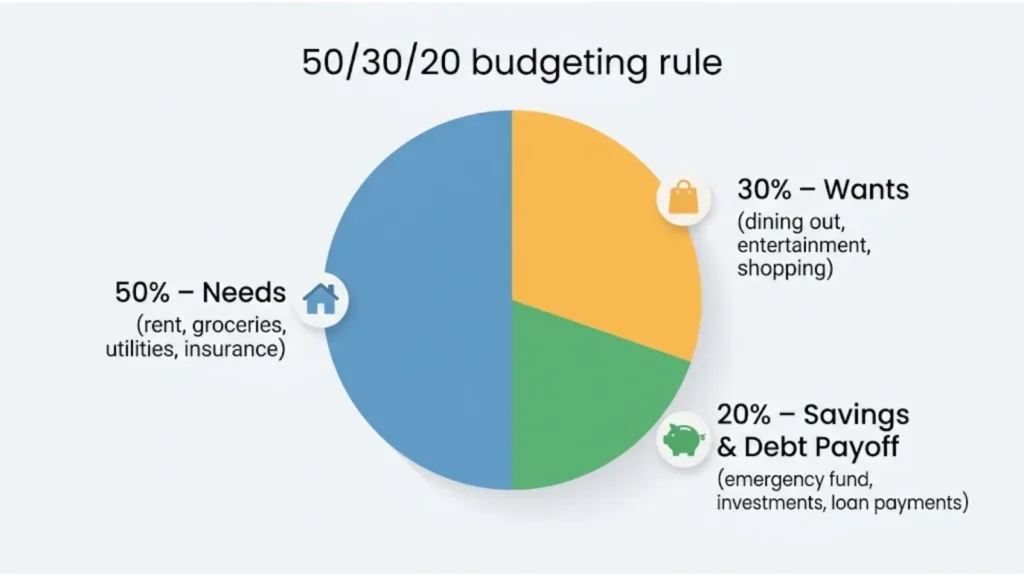
A method is just a framework for organizing the numbers you gathered in Steps 1 and 2. There is no single correct one; there is only the one you will keep using. For a first budget, the two most beginner-friendly options are:
- The 50/30/20 rule: split your take-home pay into roughly 50 percent needs, 30 percent wants, and 20 percent savings and debt payoff. Best if you want something simple you can start today without tracking every dollar.
- Zero-based budgeting: give every dollar a job until your income minus your assignments equals zero. Best if you want total control and do not mind more effort up front.
If you are not sure, start with the simpler percentage approach for month one. You can always switch later. The method is a tool, not a personality test.
Step 5: Track and adjust through the month
Here is the step that turns a plan into a budget: at the start of the month, decide how you will spend your money, then each day write down what you actually spent, and at the end of the month compare the two. That plan-track-review loop is the core of the “Making a Budget” guide from consumer.gov, the U.S. government’s plain-language consumer site, and it is the part most people skip.
Tracking does not have to be elaborate. A note on your phone, a spreadsheet, or a running list works. The goal is not perfection; it is awareness. When you can see a category running hot by mid-month, you can ease off before the money is gone instead of finding out afterward.
What to do at the end of month 1
Your first budget will be wrong in a few places. That is normal, and it is not failure. It means you now have real data instead of guesses.
At the end of the month, sit down for ten minutes and ask three questions: Which categories did I underestimate? Which did I overestimate? What is one number I will change for next month? Then adjust and run it again. A budget is a loop, not a one-time task, and most people say it takes a few months of these small corrections before the numbers really fit their life. Our dedicated guide on what to do at the end of month one turns this into a full five-step checklist, including how to tell whether a missed category was a bad estimate or a habit that needs attention.
If your first attempt fell apart, do not scrap it. Restarting is normal and expected. It helps to know the traps ahead of time, so it is worth reading the most common reasons budgets fail before month two, because almost all of them are avoidable once you see them coming.
A filled-in example, step by step (a hypothetical)
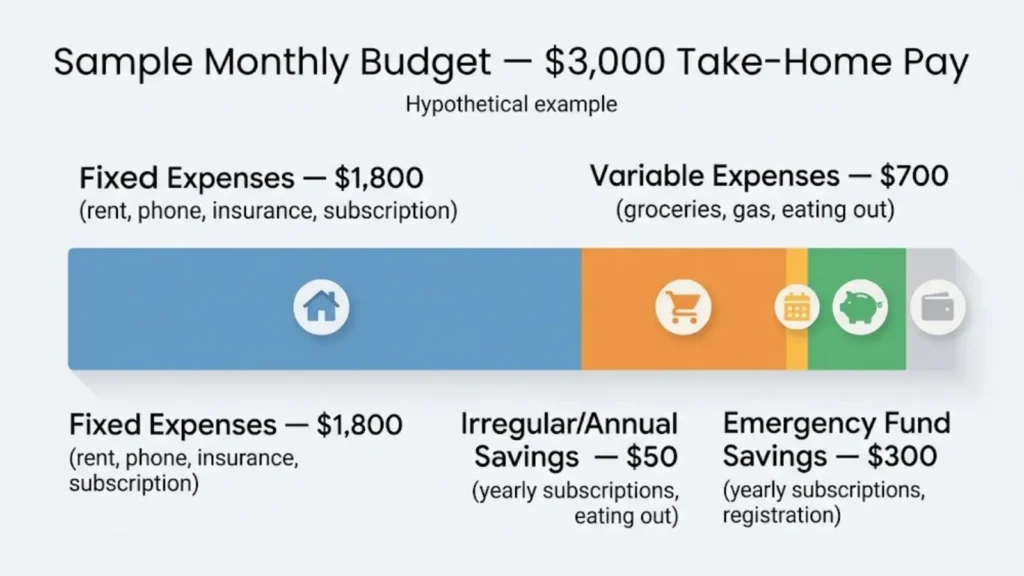
The numbers below are a labeled hypothetical to show how the steps connect. They are not a recommendation, an average, or a real person’s finances. Your own numbers will look different.
Imagine a reader who takes home a hypothetical $3,000 a month after taxes.
- Step 1 (income): $3,000 net, from steady biweekly pay, planned around a normal two-paycheck month.
- Step 2 (expenses): Fixed costs come to a hypothetical $1,800 (rent, phone, insurance, a subscription). Variable costs, averaged over three months of statements, come to about $700 (groceries, gas, eating out), and they set aside a hypothetical $50 a month for once-a-year expenses.
- Step 3 (goal): Start an emergency fund by moving a set amount to savings on payday.
- Step 4 (method): They pick the simple percentage approach for month one.
- Step 5 (track and adjust): Income $3,000 minus $1,800 fixed minus $750 variable and irregular leaves a hypothetical $450. They assign $300 to the emergency-fund goal and keep $150 as a buffer. Mid-month they notice eating out is running high, so they ease off for the last week.
At month-end, this hypothetical reader finds groceries were underestimated and eating out was overestimated, adjusts both, and runs it again. That small correction, repeated, is the whole game.
FAQ
How long does it take to make a first budget?
For most beginners, a first draft comes together in well under an hour once your statements are in front of you. Do not aim for a perfect budget on day one. Expect to refine it over the next couple of months as real spending data comes in.
Should I use my gross or net income for a budget?
Use your net (take-home) income, the amount that actually reaches your account after taxes and deductions. Budgeting off gross income is a classic beginner mistake because it makes your available money look bigger than it is.
How do I budget for expenses that change every month?
Average them. Add up a variable category, such as groceries, across your last two to three months of statements and divide to get a realistic monthly figure, then add a small cushion. As Experian notes, recent history is a better estimate than a guess.
Do I need a budgeting app to make my first budget?
No. Pen and paper or a free spreadsheet works completely. An app can make tracking more convenient, but it does not make the budget more accurate. The honesty of your numbers matters far more than the tool.
What should I do at the end of my first month?
Compare what you planned against what you actually spent, note which categories were off, change one or two numbers, and run the budget again. Budgeting is an ongoing loop, and most people need a few rounds of small adjustments before it fits.
This is educational information, not financial advice. For decisions about your own money, consult a licensed financial advisor.
Sources referenced: Experian, “How to Budget for Fixed and Variable Expenses”; consumer.gov (U.S. FTC), “Making a Budget.”