
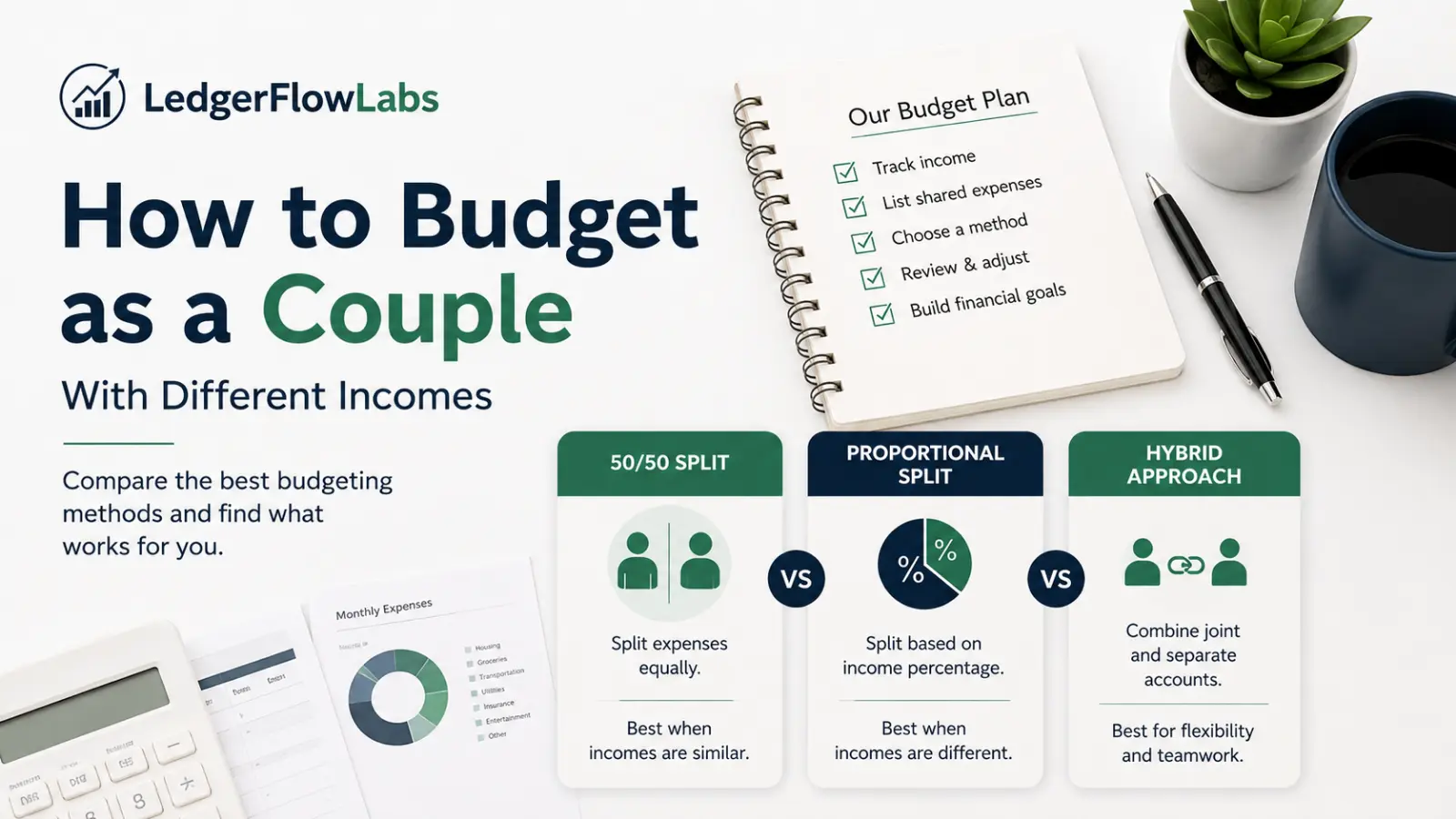
Couples typically budget together using one of a few structures: splitting shared expenses 50/50, splitting them proportionally based on each partner's income, pooling everything into a joint account, dividing up specific bills between partners, or a hybrid of separate personal accounts alongside one joint account for shared costs. None of these is universally "correct." The right one depends on how equal your incomes are, how much you want to keep separate, and how much you are each willing to track.
This is educational information, not financial advice. For decisions about your own money, consult a licensed financial advisor.
A note on scope: this guide is written for US readers and covers budgeting mechanics only. Legal ownership, marital property, and whether to file your federal return jointly or separately are separate questions that belong with a licensed tax professional or attorney, not a budgeting guide.
The methods, compared plainly
| Method | How it works | Fits best when |
|---|---|---|
| 50/50 split | Each partner pays half of every shared expense | Incomes are similar |
| Proportional split | Each partner contributes a percentage of shared costs matching their share of household income | Incomes are meaningfully different |
| Full joint account | Both incomes go into one account; all expenses, shared and personal, come from it | Partners want full transparency and simplicity |
| Delegated bills | Each partner takes ownership of specific bills (one pays rent, the other pays utilities) | Partners prefer independence with less joint tracking |
| Hybrid (separate plus joint) | Each partner keeps a personal account; both contribute to one joint account for shared costs only | Partners want joint transparency on shared costs and full independence on personal spending |
None of these requires a specific bank product or app. They are agreements about where money goes, and any of them can be run with ordinary accounts you already have.
The proportional split, worked with a hypothetical example
Splitting every shared bill exactly in half can feel unfair when incomes are meaningfully different, since the same fixed dollar amount is a much bigger share of a smaller income. The proportional method fixes that by contributing to shared costs based on each partner's share of total household income, not a flat half each.
Here is a fully hypothetical worked example, chosen for clean math and not describing any real household. Imagine Partner A takes home $4,000 a month and Partner B takes home $2,000 a month, for a combined $6,000. Partner A earns roughly 67 percent of the household total; Partner B earns roughly 33 percent. If shared expenses (rent, utilities, groceries, and similar joint costs) total $1,800 a month, Partner A would contribute around $1,206 (67 percent) and Partner B around $594 (33 percent), rather than splitting the $1,800 evenly at $900 each. Each partner still keeps the same proportion of their own income left over for personal spending and savings, which is the specific fairness the method is designed to produce.
Why "what's a need" is the harder conversation than the split method
Choosing a splitting method is largely arithmetic. The genuinely difficult conversation, and the one that causes more friction long after the split method is settled, is agreeing on what counts as a shared "need" in the first place. Our guide to needs versus wants covers the two-question test for classifying spending, and that same test gets harder, not easier, with two people, because each partner brings their own honest sense of what feels essential.
One partner's gym membership might feel like a need for their wellbeing; the other might see it as a want that competes with savings. Neither view is automatically wrong, but a couple has to agree, together, on which shared expenses count as joint "needs" that get funded first, and which are personal wants that come out of each partner's own remaining money. Having this conversation explicitly, using the same needs-vs-wants language as an individual budget, tends to surface disagreements early instead of letting them resurface every time money feels tight.
Starting the conversation when one partner has never budgeted
If one partner already tracks money closely and the other has never really budgeted, do not start by presenting a finished plan. Start with the numbers both partners can agree are simply facts: combined take-home pay (see our guide on gross versus net income if either partner is unsure which figure to use) and the list of genuinely fixed shared bills. Agreeing on the facts first, before choosing a splitting method or debating categories, removes a lot of the emotional charge, because nobody is defending a personal spending habit yet. The method conversation goes far more smoothly once both people are looking at the same real numbers.
What stays separate either way
Whichever structure a couple chooses, most approaches still leave room for money that is entirely personal to each partner, unaccounted to the other, so that neither person feels they need to justify every individual purchase. Even couples who pool everything into one joint account often carve out a personal allowance line for exactly this reason. Deciding on that personal-spending amount, alongside the shared-expense split, is usually what makes a couple's budget something both people can actually live with, rather than a system one partner tolerates and the other enforces.
Once the split is agreed, the underlying budgeting mechanics are the same ones covered throughout this cluster; our budgeting for beginners overview compares the common methods, and either partner (or the couple jointly) can apply whichever one fits from there.
FAQ
What if one partner earns much more than the other? A proportional split, where each partner contributes a percentage of shared costs matching their share of household income, is a commonly used approach for this situation, rather than splitting every bill exactly in half.
Should couples have a joint bank account? It is one option among several, not a requirement. Some couples fully pool income, some keep everything separate and just split specific bills, and many use a hybrid with a joint account for shared costs plus separate personal accounts. No single structure is necessary for a couple's budget to work.
What if my partner does not want to budget at all? Starting with facts both people can agree on (combined take-home pay, the list of genuinely fixed shared bills) rather than a finished plan tends to lower resistance, since nobody has to defend their own spending habits before the numbers are even on the table.
Does the 50/30/20 rule work for couples? Yes, it can be applied to combined household take-home pay the same way it applies to one person's income, once the couple has agreed on their shared needs, wants, and savings goals together.
Is this the same as a legal or tax question about combining finances? No. This guide covers budgeting mechanics only. Questions about marital property, joint tax filing, or legal ownership of joint accounts are separate matters and should go to a licensed professional.
Reminder: this article explains general budgeting structures, not personalized, legal, or relationship advice. For decisions about your own situation, consult a licensed financial advisor.