
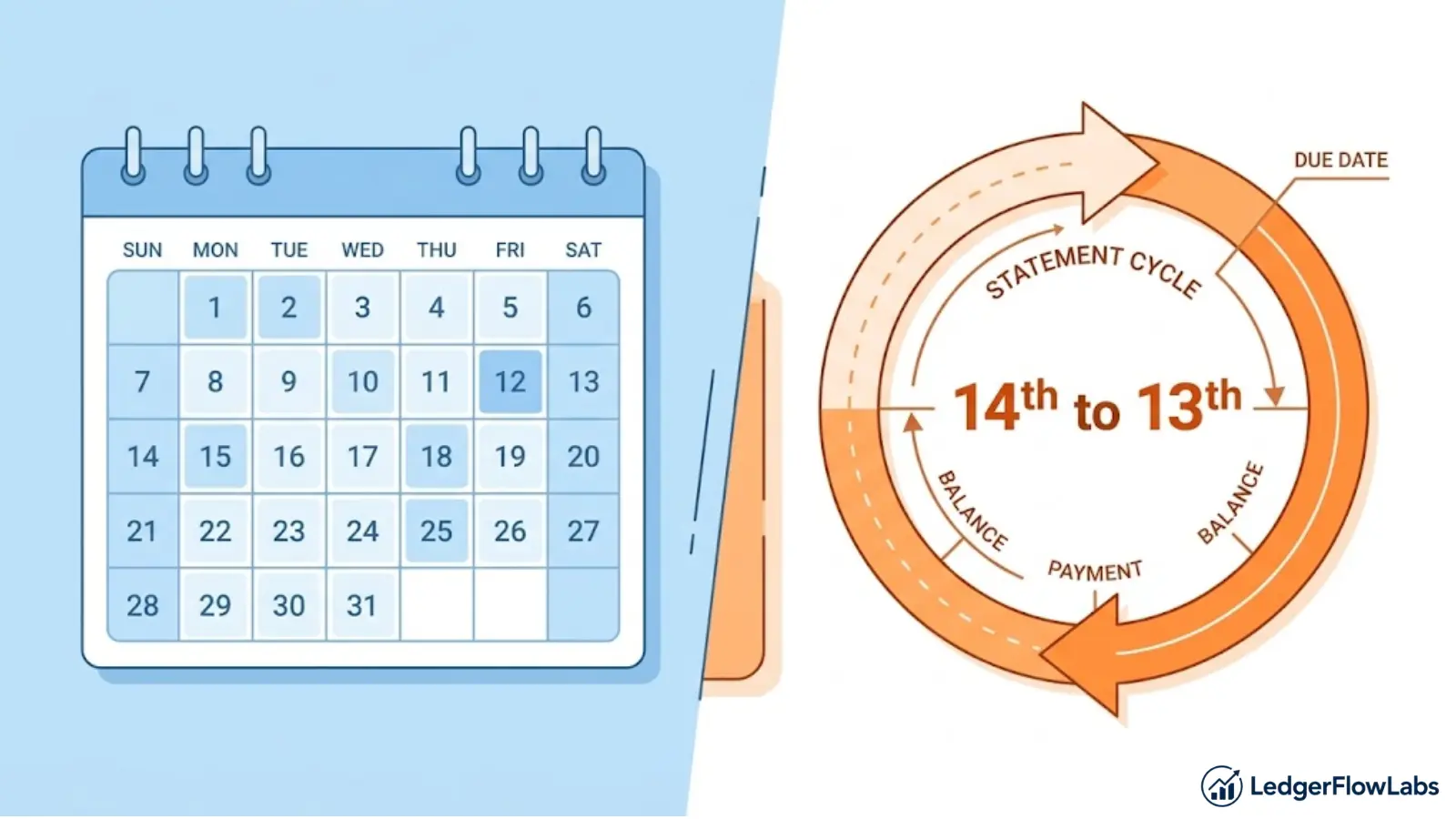
Short answer: in the United States, a credit card billing cycle is not a month. Regulation Z defines it by your statement dates rather than by the calendar, so it can be 28 days long or 31, it can start on the 14th, and the spending on the statement headed with a January date is mostly December's. Meanwhile the due date is pinned to one day of the month by rule. Those two facts pull in opposite directions, and almost every confusing thing about a card statement comes out of the gap between them.
Where this applies: the United States. Canada's credit card rules are federal and separate, and other countries set their own.
This is educational information, not financial advice. What happens on your account depends on your agreement and your issuer.
What a billing cycle legally is
Regulation Z, which implements the Truth in Lending Act, defines it at 12 CFR 1026.2(a)(4), read on the CFPB's regulation pages on August 26, 2026. A billing cycle is:
"the interval between the days or dates of regular periodic statements. These intervals shall be equal and no longer than a quarter of a year."
Read that closely, because it is doing something unusual. The cycle is not defined by a length, a month, or a date range. It is defined by the statements. The interval between one statement and the next is the cycle, by definition. The only constraints are that the intervals must be equal to each other and no longer than three months.
That is why your cycle can close on the 17th, and why it does not care what the calendar is doing.
The closing date is the pivot, and it is printed on your statement
Regulation Z requires the periodic statement to disclose, at 1026.7(b)(10), "The closing date of the billing cycle and the account balance outstanding on that date."
Everything about the statement is anchored to that date, not to the date you received the statement and not to the date you look at the app.
The practical consequence is the one that makes people think their statement is wrong:
- A purchase made the day before the closing date appears on that statement, and its due date is a few weeks away.
- A purchase made the day after the closing date does not appear on that statement at all. It waits an entire cycle, and only then becomes due weeks after that.
Two purchases one day apart can therefore sit on statements a month apart, with due dates a month apart. Nothing has gone wrong. The closing date fell between them.
This is also the cleanest explanation of why the balance in your app rarely equals the balance on your statement. The statement balance was frozen at the closing date. The app balance is now. And "now" includes things that have not finished settling, which is a separate mechanic entirely and one worth having straight before comparing the two numbers: see the difference between a pending and a posted transaction, and, on the bank side of the same confusion, available balance versus actual balance.
The due date is anchored to the calendar, and the cycle is not
Here is the collision at the center of this page.
Regulation Z requires the statement to disclose the due date, and at 1026.7(b)(11) it adds a constraint: "The due date disclosed pursuant to this paragraph shall be the same day of the month for each billing cycle." The same paragraph also requires disclosure of "The amount of any late payment fee and any increased periodic rate(s) (expressed as an annual percentage rate(s)) that may be imposed on the account as a result of a late payment."
So the due date is fixed to a day of the month. The cycle is not fixed to a month at all. Something has to absorb the difference, and what absorbs it is the number of days between the closing date and the due date, which is why that gap is not identical every month even though your due date never moves.
That is the answer to a very common and perfectly reasonable question: no, you are not imagining that some months feel shorter. February closes and settles into a due date the same way as March does, on a cycle several days shorter.
The three timing rules that sit on top
Regulation Z at 1026.5(b)(2)(ii) sets minimum gaps between the statement arriving and money being expected. All three were read on the CFPB's pages on August 26, 2026.
For credit card accounts, at (A), a card issuer must adopt reasonable procedures designed to ensure that "Periodic statements are mailed or delivered at least 21 days prior to the payment due date disclosed on the statement," and that the issuer "does not treat as late for any purpose a required minimum periodic payment received by the card issuer within 21 days after mailing or delivery of the periodic statement disclosing the due date for that payment."
Where a grace period applies, at (B)(1), statements must be mailed or delivered "at least 21 days prior to the date on which the grace period expires," and the creditor must not impose finance charges from losing the grace period if a qualifying payment arrives within 21 days of the statement.
Regardless of a grace period, at (B)(2), for open-end plans generally, statements go out "at least 14 days prior to the date on which the required minimum periodic payment must be received in order to avoid being treated as late for any purpose."
Notice that these are procedural duties on the issuer rather than extra time granted to you. They set how early the statement must arrive, not how late the payment may be.
The word "grace period" does not mean what most articles say it means
Since it appears in the rule above, it is worth pinning down. Regulation Z defines it, for these purposes, at 1026.5(b)(2)(ii)(B)(3):
"For purposes of paragraph (b)(2)(ii)(B) of this section, 'grace period' means a period within which any credit extended may be repaid without incurring a finance charge due to a periodic interest rate."
That is a window about interest. It sits between the close of the cycle and the due date. It is not a cushion after the due date during which a payment is still treated as on time, and a great deal of published writing on card statements uses the phrase as though it were.
What all of this changes about reading your own statement
You need two dates off the statement, and neither of them is the date you got it.
- Find the closing date. Regulation Z requires it to be there. Everything on the statement happened on or before it.
- Find the due date. It will be the same day of the month every time.
- Count the days between them. That gap is your real window, and it is the number that varies while the due date does not.
- Note where today sits relative to the closing date. If today is just after it, anything you spend now has the longest possible wait before it is due. If today is just before it, the opposite.
That last point is the whole reason this article exists as a money-timing piece rather than a definition. The card's cycle and the household's pay cycle are two independent clocks, and neither is a calendar month. Building a calendar that shows both is the only way to see where they collide, which is what a bill calendar is actually for. If you are paid every two weeks, the mismatch is structural rather than occasional, because a fortnightly pay pattern does not divide evenly into monthly cycles: that arithmetic is set out in biweekly versus semimonthly pay.
What this page does not cover
It does not cover when a payment counts as late, which is a separate set of clocks with its own rules about cut-off times and reporting. It does not cover how interest is calculated across a cycle. And it does not tell you what to do with any of this, because that depends on your agreement, your issuer and your own circumstances.
If money is genuinely short rather than merely mistimed, free non-profit credit counseling exists for that, and the Consumer Financial Protection Bureau publishes information on finding it. Anyone charging a fee up front is selling something that a non-profit provides free.
FAQ
How long is a credit card billing cycle? Regulation Z at 12 CFR 1026.2(a)(4) defines it as the interval between the days or dates of regular periodic statements, with the intervals equal and no longer than a quarter of a year. It is defined by your statement dates rather than by the calendar, so it can be 28 days or 31 and can start on any day of the month.
Why did two purchases made a day apart land on different statements? Because the closing date fell between them. A purchase made the day before the closing date appears on that statement; one made the day after waits an entire cycle and becomes due weeks after that. Nothing has gone wrong.
Does the due date move with the cycle? No. Regulation Z at 1026.7(b)(11) requires the disclosed due date to be the same day of the month for each billing cycle. The number of days between the closing date and the due date is what absorbs the difference, which is why that gap varies while the due date does not.
Is the grace period extra time after the due date? No. As Regulation Z defines it at 1026.5(b)(2)(ii)(B)(3), a grace period is a period within which credit extended may be repaid without incurring a finance charge due to a periodic interest rate. It is a window about interest, sitting between the close of the cycle and the due date, not a cushion after the due date.
Why does the balance in my app not match my statement balance? The statement balance was frozen at the closing date, while the app balance is now, and "now" includes items that have not finished settling. The two figures are answering different questions about different moments.