
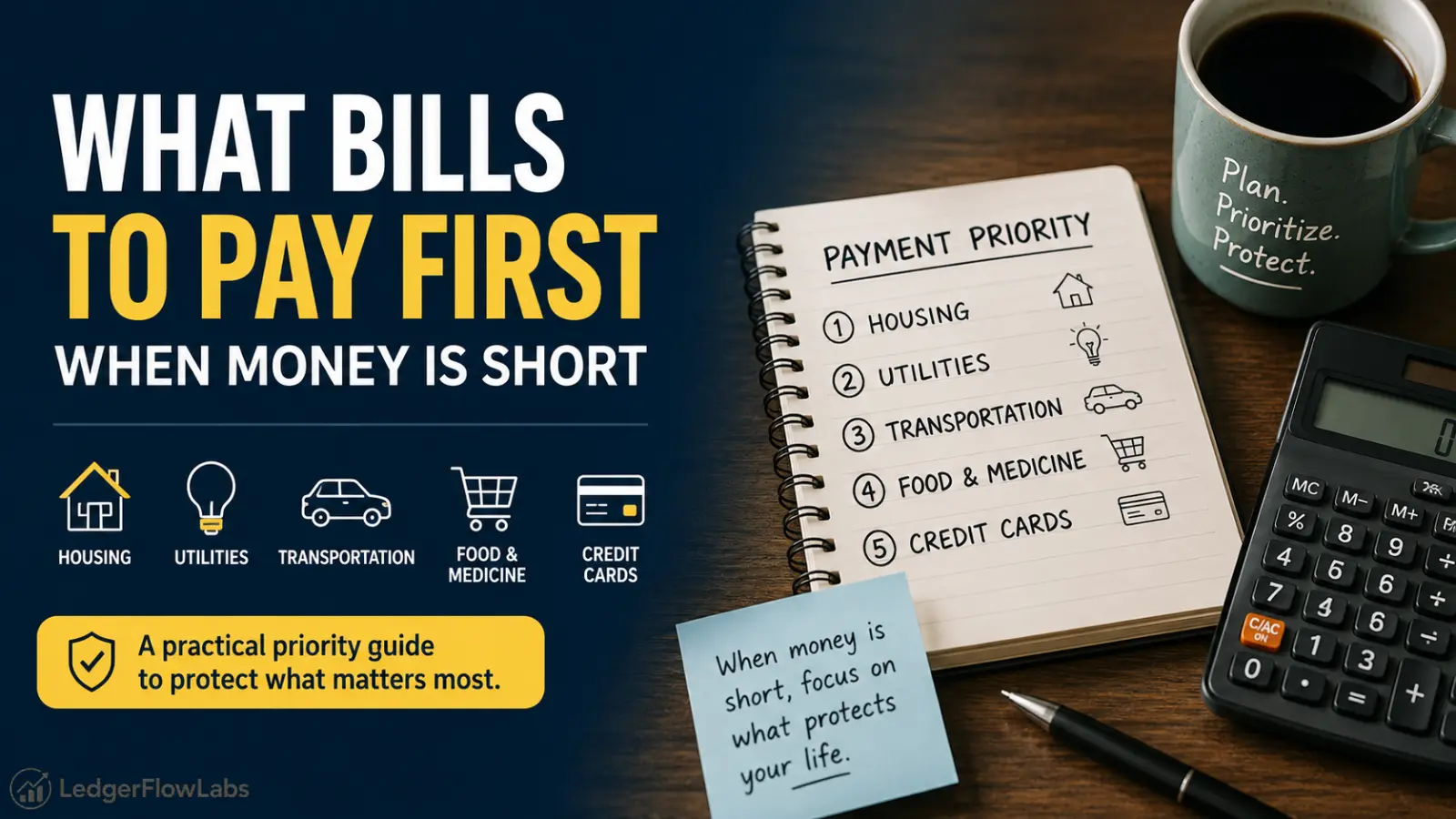
Short answer: when there is not enough to cover everything, the principle that protects you is keep the roof, keep the heat, and keep the way you get to work. Housing comes first, then utilities that are facing disconnection, then anything that secures a debt against your home or car, then food and medicine, and unsecured credit such as credit cards comes last. That order is not a moral ranking. It is a ranking by how fast a consequence arrives and how expensive it is to reverse.
This is educational information, not financial advice, and it is not legal advice. Timelines, protections and options vary by state, by utility and by lender.
Where this applies: written for readers in the United States.
Free help exists, and it is worth calling before you decide anything
The search results around this question are crowded with companies that charge money to help people who do not have any. Before any of that, there are two free places to start.
Call 211. It is a free, confidential referral line operated by United Way, available in most of the United States, and it connects you to local programs for rent, utilities, food and medical costs. You can also search 211.org. Local assistance is the fastest thing on this page, because a single utility grant can remove the whole question you came here with.
Contact an NFCC member credit counseling agency. The National Foundation for Credit Counseling is a nonprofit, founded in 1951, and its member agencies employ certified counselors. NFCC states that the majority of its services are provided at no or low cost, though cost varies by agency and by state law, so ask what a session costs before you begin. Its agency finder is at nfcc.org, and it publishes 1-800-388-2227 as its counseling line.
For home energy specifically, the federal Low Income Home Energy Assistance Program (LIHEAP) helps eligible households with energy costs, and it is administered through state and tribal programs. 211 can point you to the office that runs it where you live.
None of those three requires you to pay anyone to talk to you. If a company asks for a fee up front to negotiate your debts, that is a different kind of business, and it is not what this section is pointing you toward.
Why the order is about consequences, not fairness
Everybody you owe money to would like to be paid. When you cannot pay everyone, the useful question is not who deserves it. It is: what happens next, how fast does it happen, and what does it cost to undo?
That second part is the one most lists leave out. Two consequences can be equally serious on paper and completely different in practice, because one is reversible with a phone call and the other is not reversible at all.
| Bill type | How fast the consequence lands | How reversible it is |
|---|---|---|
| Rent or mortgage | Slower to start, then very serious | Hardest to undo. Losing housing changes everything else |
| Utilities facing disconnection | Fast once notice is given | Reconnection usually costs more than staying connected, and may require a deposit |
| Car loan, if the car gets you to work | Can be fast for secured debt | A repossessed vehicle is expensive and slow to replace, and it can cost you the income |
| Food and essential medicine | Immediate | Skipping is not a saving. Health costs return larger |
| Insurance required for home or car | Delayed | A lapse can be costly to restart and can breach a loan agreement |
| Unsecured credit cards and personal loans | Slowest | Damaging to credit and stressful, but nothing is seized in the short term |
Read down the "reversible" column rather than the "fast" one. That is the real ordering principle: protect the things that cost far more to restore than to maintain.
Secured versus unsecured is the mechanical version of the same idea. A secured debt has something attached to it, usually your home or your car, which the lender has rights over. An unsecured debt does not. That is why a card balance sits at the bottom of the ladder even when it feels the loudest, because the phone calls are unpleasant and nothing is attached to it.
This article does not tell you to stop paying anyone. It describes what typically follows non-payment so you can make your own decision with the consequences in view. What happens in your specific case depends on your state, your provider, your contract and your circumstances.
The ladder, with the reasoning
1. Housing. Rent, mortgage, and the things that go with owning: property taxes, homeowners insurance, association fees, lot rent. Housing sits first because every other item on the list depends on having somewhere to live, and because housing consequences take the longest to unwind.
2. Utilities that are actually facing disconnection. Note the qualifier. A utility bill that is late is not the same as one carrying a disconnection notice, and treating them the same wastes money you may need elsewhere. If a notice has arrived, that bill moves up. Many states and utilities have formal disconnection procedures, required notice periods, payment plans, medical certifications and seasonal protections, but these vary widely and your utility and your state's public utility commission are the authorities on yours. Call and ask.
3. Anything securing a debt against your home or car, where losing the item would cost you your housing or your income. The test is not the size of the payment. It is what the lender can act on and what you lose if they do.
4. Food and essential medicine. Some lists put this first, and that is a defensible order. It sits here because these are usually the costs you can reduce and get help with fastest through local programs and SNAP, rather than costs you must pay in full to a single creditor.
5. Required insurance, particularly cover your mortgage or auto loan requires. A lapse can create a second, larger problem with the lender.
6. Everything else, with unsecured credit last. Credit cards, store accounts, personal loans, most medical bills. Falling behind here has real consequences, including damage to your credit report and eventually collections activity, and those are genuinely serious. They are also the slowest to arrive and the most negotiable.
What to do before you miss anything, which is the part that actually changes the outcome
Prioritizing is the second decision. The first one is calling, and it works better before the due date than after.
Ask each provider a specific question rather than explaining your situation and waiting. The useful requests, by type:
- Utilities: ask about a payment arrangement, budget or level billing, hardship programs, and whether the company can flag your account so that disconnection is paused while an application is pending.
- Landlord or mortgage servicer: ask what options exist for a missed or partial payment, and get whatever you are told in writing. Mortgage servicers in particular have defined processes, and the CFPB publishes plain-language guidance on what to ask for.
- Auto lender: ask what deferral or extension options exist, and specifically what it costs, because a deferral is not usually free.
- Card issuers and other unsecured creditors: ask about hardship programs. Many exist and are not advertised.
- Medical bills: ask about financial assistance, charity care and interest-free payment plans before the bill goes anywhere near collections.
Two things are true about these calls. They are unpleasant. And they are the single highest-value hour available to you, because a provider that knows in advance has options that a provider chasing a missed payment does not.
The part that is easy to miss
When money is short, the instinct is to pay the smallest bills first so that fewer people are chasing you. It genuinely feels better. It also spends limited money on the items lowest on the ladder, which is exactly backward when housing or a utility is at risk.
The other easy miss is the partial payment. Paying part of a bill does not always stop the consequence, and on some accounts it does not pause a disconnection or a late fee at all. Ask what a partial payment actually achieves before making one, because "some is better than none" is true for some bills and not for others.
And one thing worth naming: a short month and an unaffordable life are two different problems. If this is a timing problem, where the money exists but arrives after the bills, then the tools in what to do when a bill arrives before your paycheck and how to change a bill due date can fix it permanently, and a one-paycheck buffer prevents the next one. If the arithmetic says the money is not there in any month, no ordering trick will solve that, and the free counseling above is the right next call rather than a budgeting technique.
After this month
When the immediate week is handled, two things reduce the chance of a repeat: seeing every due date in one place, which is what a bill calendar does, and understanding why the shortfall arrives when it does, which is the subject of why you run out of money before payday.
Neither of those helps this week. Both of them help the next one.
FAQ
What bill should I pay first if I can only pay one? Generally the one whose consequence is fastest and hardest to reverse, which for most households is housing, or a utility that is facing disconnection. Your own situation may order these differently, and free counseling through an NFCC member agency can help you look at it with someone.
Is it better to pay a little on every bill or all of one? It depends on the bill. On some accounts a partial payment stops a fee or a disconnection, and on others it does nothing. Ask each provider what a partial payment actually prevents before spreading money thin.
What happens if I miss a credit card payment? Typically a late fee, then reporting to the credit bureaus once the account is sufficiently past due, and eventually collections activity. Exact timelines and thresholds vary by issuer and are set out in your card agreement. This is serious, and it is still slower and more reversible than losing housing or a vehicle.
Where can I get free help in the US right now? Call 211 for local emergency assistance with rent, utilities and food, and contact an NFCC member agency through nfcc.org or 1-800-388-2227 for nonprofit credit counseling. For home energy costs, ask about LIHEAP. These are free or low cost, and you can ask what a service costs before you start.
Should I use a debt settlement company? That is a decision only you can make, and it is worth understanding the costs and risks first. Speaking to a nonprofit credit counselor is free or low cost and does not commit you to anything, which makes it a reasonable first call before agreeing to pay any company a fee.