
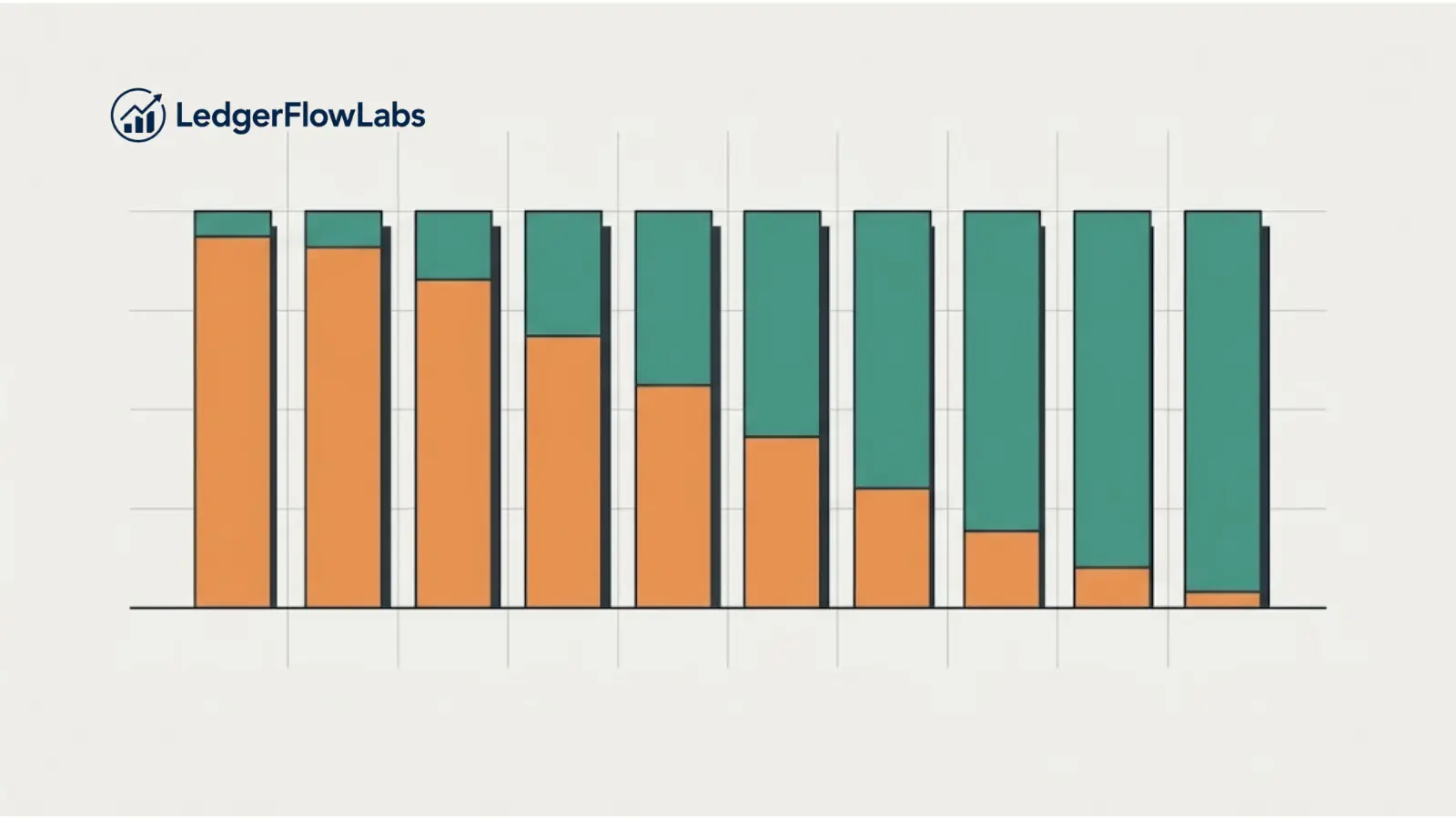
Short answer: nothing is being front-loaded deliberately. A fixed-payment loan charges interest on the balance outstanding, the balance is at its largest at the start, and the payment is the same every month. So in month one, a large share of a level payment covers interest and a small share reduces the principal. As the principal falls, the interest portion falls with it and the principal portion grows, automatically, without anything changing in the agreement.
Two years in and the balance has hardly moved is the correct behavior of the arithmetic, not evidence of a trick.
Where this applies: the arithmetic is universal. The disclosure rules referred to are United States rules.
This is educational information, not financial advice. Nothing here tells you what to do about your own loan.
The arithmetic, month by month
The figures below are invented for the arithmetic. They are not a rate anybody is offering, not a typical loan, and not a claim about any product.
A loan of $10,000 at 6% a year, with a fixed monthly payment of $200.
The monthly interest rate: 6% ÷ 12 = 0.5%.
Month 1.
- Interest: $10,000 × 0.5% = $50.
- Principal: $200 − $50 = $150.
- Balance: $9,850.
Month 2.
- Interest: $9,850 × 0.5% = $49.25.
- Principal: $200 − $49.25 = $150.75.
- Balance: $9,699.25.
Month 3.
- Interest: $9,699.25 × 0.5% = $48.50.
- Principal: $151.50.
- Balance: $9,547.75.
Notice what is moving. The payment does not change. The interest falls a little each month because the balance fell. The principal portion grows by exactly the amount the interest portion shrank.
And notice the split. In month one, a quarter of the payment goes to interest. Later in the loan, at these invented figures, almost all of it goes to principal. That crossover is the whole shape of an amortization schedule.
Why the early months feel so unproductive
Two things combine.
The balance is at its maximum. Interest is a percentage of the balance, so the interest charge is at its maximum too, in the month when you have paid the least.
The payment is level by design. A fixed payment is convenient for budgeting, and its consequence is that the split inside it changes over time rather than the payment itself changing.
A higher rate makes the early months worse. At a higher rate, the interest portion of month one is larger, the principal portion is smaller, and the crossover point comes later in the loan. That is why the same payment on the same balance behaves differently at different rates, and it is why the rate is the number to look at rather than the payment.
What extra payments do, mechanically
Because interest is charged on the balance, anything that reduces the balance reduces every future interest calculation.
An extra amount applied to principal removes that amount from every subsequent month's interest base. The effect is not a one-off saving of one month's interest; it compounds through the remaining schedule.
Three practical cautions, none of which is advice.
The payment has to be applied to principal. Depending on the loan and the servicer, an extra amount may be treated as an early payment of the next installment rather than as a principal reduction. Which it is, is a matter for your own agreement and your servicer.
Some agreements have terms about early repayment. Whether yours does is in the agreement.
Whether to do it at all is your decision. This site does not tell readers where to direct their money.
Reading a loan statement
A loan statement is a different document from a credit card statement and it answers a different question.
What to look for: the payment amount, the split between interest and principal for the period, the remaining balance, and, on a mortgage, any escrow line, which is money held for taxes and insurance and is not a loan repayment at all.
Why the balance does not fall by the payment amount: because part of the payment was interest. The month-by-month table above is the whole explanation, and once you have seen it, a statement that shows a $200 payment reducing a balance by $150 stops looking like an error.
Why a mortgage payment can change even on a fixed rate: the escrow portion is not fixed. Taxes and insurance move, and the payment moves with them while the loan's own terms do not change. That is the single most common source of confusion on a fixed-rate mortgage.
How this differs from a credit card
They are often explained in the same breath and they behave differently.
A loan has a schedule. Fixed payment, fixed term, a known end date, and interest computed on a declining balance.
A credit card has no schedule. The balance moves with your activity, the minimum payment moves with the balance, and interest is commonly computed on daily balances. Regulation Z § 1026.7(b)(5) requires the periodic statement to show "the amount of the balance to which a periodic rate was applied and an explanation of how that balance was determined, using the term Balance Subject to Interest Rate," precisely because that balance is constructed rather than obvious.
And a card statement carries a disclosure a loan statement does not. § 1026.7(b)(12) requires a Minimum Payment Warning, together with minimum payment repayment estimates, total cost estimates and credit counseling service information. That is the closest thing a card has to an amortization schedule, and it is required because a card does not otherwise have one.
What this page will not do
It will not tell you to overpay. That is a decision about your own money.
It will not print a typical rate, term or payment. Every figure in the worked example is invented for the arithmetic, and yours are on your own agreement and statement.
It will not compare loan products or recommend a refinance. LedgerFlow Labs takes no affiliate or referral income from any financial product.
It will not calculate your schedule for you. What it will do is show you the four lines that produce every row of one, so you can check any schedule you are given.
The four lines that produce a schedule
Every row of an amortization table is these four steps, repeated.
| Step | The sum |
|---|---|
| 1. Period interest | Balance × (annual rate ÷ periods per year) |
| 2. Principal portion | Payment − period interest |
| 3. New balance | Balance − principal portion |
| 4. Repeat | With the new balance |
That is all of it. A schedule with hundreds of rows is those four lines run hundreds of times, and you can check any single row of one with a calculator in under a minute.
FAQ
Why does my loan balance barely move in the early years? Because interest is charged on the balance, the balance is largest at the start, and the payment is level. So the interest share of each payment is at its maximum early on and the principal share is at its minimum.
Is the interest front-loaded on purpose? No. It is a consequence of charging interest on a declining balance while keeping the payment fixed. Nothing in the agreement changes over the life of the loan; the split inside the payment changes on its own.
What does an extra payment actually do? If it is applied to principal, it removes that amount from the balance used to calculate every future period's interest. Whether an extra amount is treated as a principal reduction or as an early payment of the next installment depends on your loan and your servicer.
Why did my fixed-rate mortgage payment go up? Most often the escrow portion, which holds money for taxes and insurance, rather than the loan itself. That part is not fixed even where the interest rate is.
How is this different from a credit card? A loan has a fixed payment, a fixed term and a schedule. A card has none of those, which is why Regulation Z § 1026.7(b)(12) requires a Minimum Payment Warning with repayment and total cost estimates on the statement instead.
How do I check a schedule I have been given? Take any row. Multiply the balance by the annual rate divided by the number of periods in a year to get the interest. Subtract that from the payment to get the principal. Subtract the principal from the balance to get the next balance. If the schedule agrees, the schedule is right.
Sources: Regulation Z, 12 CFR Part 1026, read on consumerfinance.gov 2026-08-28. § 1026.7(b)(5) for the balance subject to interest rate and the explanation of how it was determined; § 1026.7(b)(12) for the Minimum Payment Warning together with the minimum payment repayment estimates, total cost estimates and credit counseling service information. The $10,000 balance, 6% annual rate and $200 monthly payment in the worked example are invented for the arithmetic and are not a rate, a typical figure or a claim about any product; the monthly figures shown are rounded. No mortgage, auto or personal loan rate figure appears anywhere on this page.