
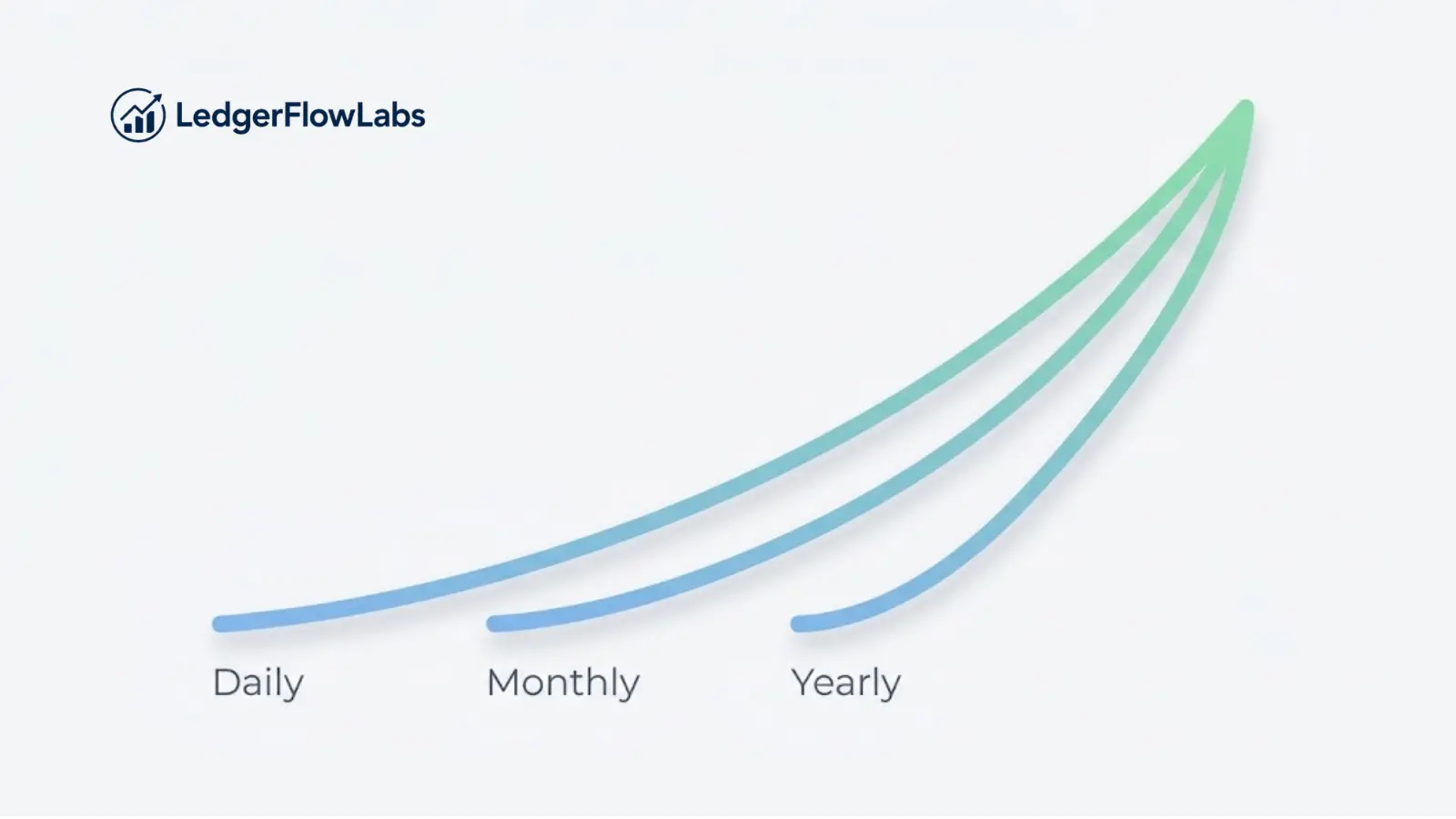
Short answer: it matters, and it matters less than most articles imply. More frequent compounding adds interest to the base more often, so the base grows sooner and the next calculation runs on a slightly larger number. And you do not have to do the arithmetic yourself, because in the United States the figure that folds frequency in is already required to be disclosed: Regulation DD defines annual percentage yield at 12 CFR § 1030.2(c) as "a percentage rate reflecting the total amount of interest paid on an account, based on the interest rate and the frequency of compounding for a 365-day period," and § 1030.4(b)(1)(i) requires an institution to disclose "the 'annual percentage yield' and the 'interest rate,' using those terms."
Two accounts with the same APY have already been made comparable on frequency. That is exactly what the figure exists for.
Where this applies: the United States. Regulation DD is a US rule.
This is educational information, not financial advice. No product is recommended anywhere on this site.
The arithmetic, with numbers that are not real
The figures below are invented for the arithmetic. They are not a rate anyone is offering and they are not a claim about any product.
Take $1,000 at 12% a year, over one year, at three frequencies.
Annually. One calculation. $1,000 × 12% = $120. Balance $1,120.
Monthly. The rate per period is 12% ÷ 12 = 1%, applied twelve times to a growing balance. $1,000 × (1.01)^12 = about $1,126.83. Interest about $126.83.
Daily. The rate per period is 12% ÷ 365 = about 0.03288%, applied 365 times. $1,000 × (1 + 0.12/365)^365 = about $1,127.47. Interest about $127.47.
Set them side by side.
| Frequency | Interest on $1,000 at 12% for one year |
|---|---|
| Annually | $120.00 |
| Monthly | about $126.83 |
| Daily | about $127.47 |
The part nobody says out loud
Look at the gap between monthly and daily: about sixty-four cents on a thousand dollars over a year.
The big step is from annual to monthly. From monthly to daily, and from daily to anything more frequent, the additions shrink quickly. There is a mathematical ceiling that continuous compounding approaches and never exceeds.
Which is why "compounded daily" as a marketing line is doing less work than it appears to. It is genuinely better than annually. It is barely different from monthly at the same rate, and a lower rate compounded daily loses to a higher rate compounded monthly without much difficulty.
The rate is the bigger lever. Frequency is a smaller one. Both are folded into the APY, which is the reason to compare that figure rather than to reason about the components.
Where frequency changes more than the arithmetic
There is a second effect that has nothing to do with the sum, and it is worth more attention than the sixty-four cents.
When interest is added decides when it is available. An account that credits interest monthly puts the money in the balance monthly. One that credits annually does not. If interest is being withdrawn rather than left to accumulate, the compounding advantage disappears entirely, because there is nothing being added to the base.
And the period the rate lasts for matters more than the frequency. § 1030.4(b)(1)(i) requires, for fixed-rate accounts, "the period of time the interest rate will be in effect." A rate that changes in six months makes the compounding frequency a second-order question.
The same idea on the borrowing side
Compounding frequency runs the other way on credit, and the mechanism is identical.
Interest on most credit cards is charged on daily balances, and what is charged is added to the balance, so the next cycle's calculation runs on a figure that includes it.
The figure disclosed for credit is not a compound figure. Regulation Z § 1026.14(b) computes the annual percentage rate for open-end credit by "multiplying each periodic rate by the number of periods in a year." Multiplication, not compounding. Which is why the amount charged over a year at a constant balance and the APR are not the same number, and why the balance the rate was applied to is the thing to look at: § 1026.7(b)(5) requires the statement to show it, "using the term Balance Subject to Interest Rate."
The asymmetry is worth noticing. On deposits, the regulation gives you a figure that includes compounding. On open-end credit, the headline figure does not.
How to compare two accounts without doing any of this
Three steps and no arithmetic.
1. Find the APY on each. § 1030.4(b)(1)(i) requires it, using that term.
2. Compare APY to APY. Frequency is already inside both figures per § 1030.2(c). Do not adjust for it a second time.
3. Check how long each rate lasts. For fixed-rate accounts the disclosure includes the period the rate will be in effect.
If one account quotes you an interest rate and the other quotes an APY, you are comparing a figure that excludes compounding, per § 1030.2(o), with one that includes it. Ask for the missing figure rather than estimating it.
What this page will not do
It will not project what you would have. No "save this and you will have that." That is a projection presented as an outcome and this site does not publish them.
It will not tell you which frequency to look for. That is a product decision about your own money.
It will not print a typical rate. Every rate in the worked example above is invented for the arithmetic, and yours is on your own disclosure.
FAQ
Does compounding frequency really matter? It matters, and less than most articles imply. On the invented example above, $1,000 at 12% for a year returns $120 compounded annually, about $126.83 monthly and about $127.47 daily. The big step is from annual to monthly; the step from monthly to daily is about sixty-four cents.
Is daily compounding always better than monthly? At the same rate, more frequent compounding produces slightly more. A lower rate compounded daily can easily produce less than a higher rate compounded monthly, which is why comparing the APY is the reliable method.
Do I need to calculate this myself? No. Regulation DD § 1030.2(c) defines the annual percentage yield as reflecting the interest rate and the frequency of compounding, and § 1030.4(b)(1)(i) requires it to be disclosed. Comparing APY to APY has already accounted for frequency.
Why is my card's APR not what I paid over the year? Because for open-end credit, § 1026.14(b) computes the APR by multiplying each periodic rate by the number of periods in a year, which is a multiplication rather than a compounding, while charging is commonly daily on daily balances.
Does compounding help if I withdraw the interest? No. Compounding works by adding interest to the base. If the interest is withdrawn, the base does not grow and the advantage is gone.
What matters more, the rate or the frequency? The rate, at any realistic frequency. Both are folded into the APY, which is why that is the figure to compare.
Sources: Regulation DD, 12 CFR Part 1030, read on consumerfinance.gov 2026-08-28. § 1030.2(c) for the definition of annual percentage yield as reflecting the interest rate and the frequency of compounding for a 365-day period; § 1030.2(o) for the definition of interest rate as not reflecting compounding; § 1030.4(b)(1)(i) for the disclosure of both terms and, for fixed-rate accounts, the period the rate will be in effect. Regulation Z, 12 CFR Part 1026, read the same day. § 1026.14(b) for the annual percentage rate computed by multiplying each periodic rate by the number of periods in a year; § 1026.7(b)(5) for the balance subject to interest rate disclosure. The $1,000 principal, 12% rate and one-year term in the worked example are invented for the arithmetic and are not a rate, a typical figure or a claim about any product; the totals shown are rounded.