
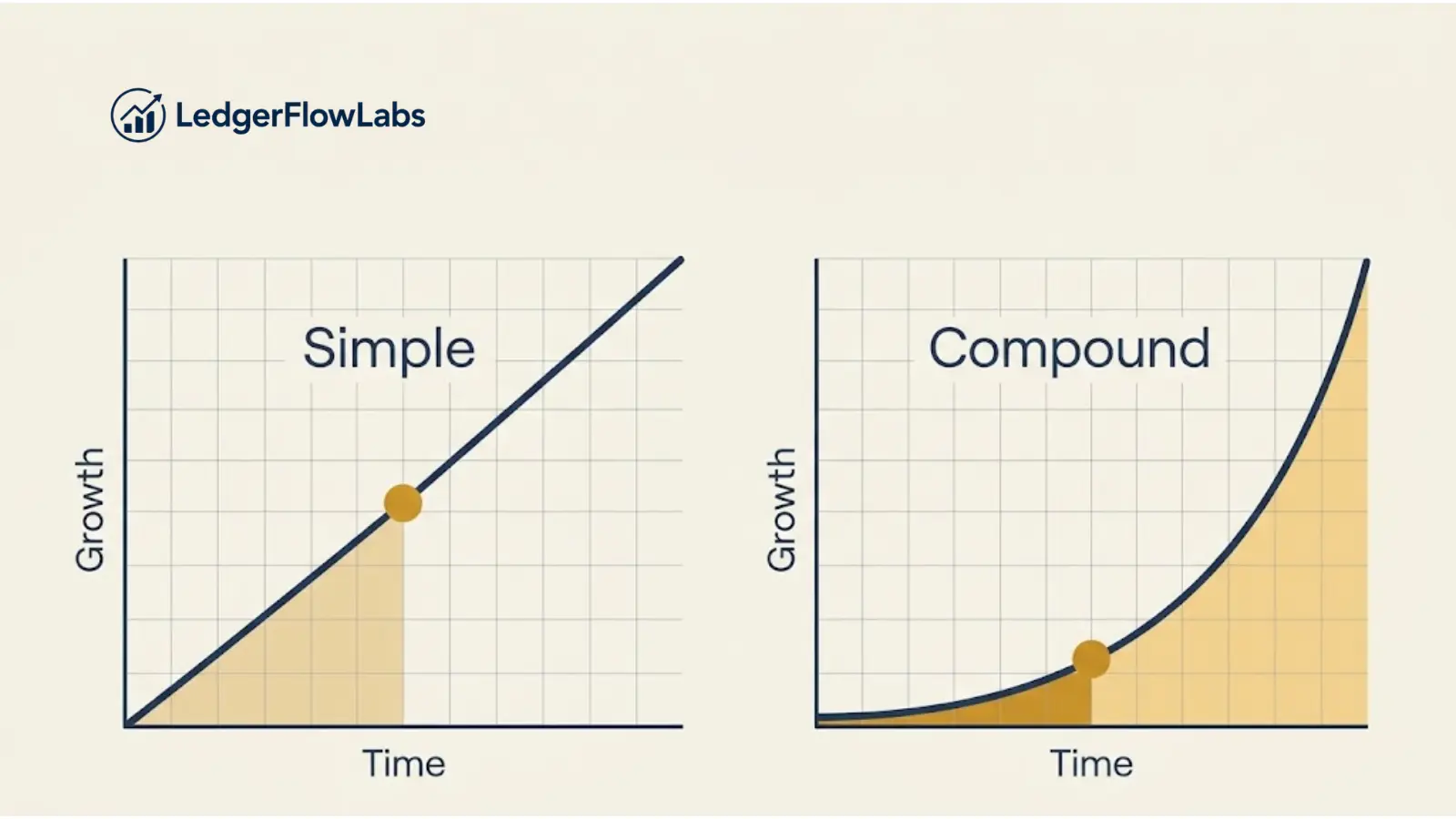
Short answer: simple interest is charged or paid on the original amount only. Compound interest is charged or paid on the original amount plus the interest already added to it. That is the whole difference, and it shows up in the disclosure rules: Regulation DD defines annual percentage yield at 12 CFR § 1030.2(c) as "a percentage rate reflecting the total amount of interest paid on an account, based on the interest rate and the frequency of compounding for a 365-day period," and defines interest rate at § 1030.2(o) as "the annual rate of interest paid on an account which does not reflect compounding."
One of those two definitions includes compounding and the other excludes it, in the same regulation, on purpose. If you can remember which is which, you can read any deposit disclosure correctly.
Where this applies: the United States. Regulation DD is a US rule.
This is educational information, not financial advice. No product is recommended anywhere on this site.
The two sums, side by side
The figures below are invented for the arithmetic. They are not a rate anyone is offering and they are not a claim about any product.
Take $1,000 at 10% a year, for three years.
Simple interest. Interest is calculated on the original $1,000 each year.
| Year | Interest | Balance at end |
|---|---|---|
| 1 | $100 | $1,100 |
| 2 | $100 | $1,200 |
| 3 | $100 | $1,300 |
Total interest: $300.
Compound interest, compounded annually. Interest is calculated on the balance, which now includes previous interest.
| Year | Interest | Balance at end |
|---|---|---|
| 1 | $1,000 × 10% = $100 | $1,100 |
| 2 | $1,100 × 10% = $110 | $1,210 |
| 3 | $1,210 × 10% = $121 | $1,331 |
Total interest: $331.
Thirty-one dollars over three years on a thousand. That is the entire difference, and it is small at three years and large at thirty, because the gap grows with time rather than with the rate.
Why "compound interest is powerful" is a statement about time
The two lines above start together and diverge slowly. That is what people mean when they call compounding powerful, and it is worth being precise about which variable does the work.
Time does most of it. Each period adds interest to a base that is bigger than the one before, so the increments grow. Three periods produce a small gap. Many periods produce a large one.
Frequency does some of it. Compounding daily rather than annually adds interest more often, so the base grows more often. That is a separate lever from the rate and it has its own page.
The rate scales everything. But at a given rate, the two curves above only separate as periods accumulate.
What this page will not do is project a figure for you. No "if you save X you will have Y" appears here, because that is a projection presented as an outcome, and this site does not make them.
How to tell which one you are looking at
You often do not have to work it out, because the disclosure tells you.
On a deposit account, § 1030.4(b)(1)(i) requires disclosure of "the 'annual percentage yield' and the 'interest rate,' using those terms, and for fixed-rate accounts the period of time the interest rate will be in effect."
Compare the two figures. The official interpretation to Regulation DD notes that "if the annual percentage yield is the same as the interest rate, institutions may disclose a single figure but must use both terms."
So: where the APY is higher than the interest rate, compounding is adding something over the period. Where they are equal, it is not. That is a two-second check on a document you already have, and it is more reliable than any general claim about how a product works.
On a credit account, the equivalent figure is the annual percentage rate, and Regulation Z § 1026.14(b) computes it for open-end credit by "multiplying each periodic rate by the number of periods in a year." Multiplication is not compounding, which is why an APR and the amount actually charged over a year on a card with daily charging are not identical figures.
The borrowing side, where the same mechanism runs against you
The arithmetic does not change direction. Only the sign does.
On a credit card, interest is commonly charged on daily balances and added to the balance, and the next cycle's interest is computed on a balance that includes it. That is compounding, running the other way.
Which is why the balance the charge is computed on matters so much, and why it is a required disclosure: § 1026.7(b)(5) requires "the amount of the balance to which a periodic rate was applied and an explanation of how that balance was determined, using the term Balance Subject to Interest Rate."
There is one case where none of it runs. § 1026.54(a)(1)(ii) prohibits a card issuer from imposing finance charges on "any portion of a balance subject to a grace period that was repaid prior to the expiration of the grace period," and § 1026.5(b)(2)(ii)(B)(3) defines that grace period as "a period within which any credit extended may be repaid without incurring a finance charge due to a periodic interest rate."
Where each type turns up
Stated as a general shape rather than as a rule about any specific product, because product terms vary and yours are in your own agreement.
Deposit accounts are described using an interest rate and an APY, and the gap between the two is the compounding.
Credit cards are described using an APR, with interest commonly charged on daily balances.
Loans with a fixed schedule are a third case, where each payment covers the interest accrued since the last one and the rest reduces the principal. That structure produces its own pattern over the life of the loan and it deserves its own explanation rather than being folded in here.
What to check on your own paperwork
| Question | Where it is required to be | The rule |
|---|---|---|
| What is the interest rate | Deposit account disclosure | § 1030.4(b)(1)(i) |
| What is the APY | Deposit account disclosure | § 1030.4(b)(1)(i) |
| How long is the rate in effect | Deposit account disclosure, fixed-rate accounts | § 1030.4(b)(1)(i) |
| What is the APR | Credit card periodic statement | § 1026.7(b)(4) |
| What balance was interest charged on | Credit card periodic statement | § 1026.7(b)(5) |
Everything on that list is on a document you already hold. None of it requires a calculator on somebody else's website.
FAQ
What is the difference between simple and compound interest? Simple interest is calculated on the original amount only. Compound interest is calculated on the original amount plus interest already added. On $1,000 at 10% for three years, the invented example above gives $300 of simple interest and $331 of compound interest.
How do I tell whether an account compounds? Compare the two figures Regulation DD requires to be disclosed. § 1030.2(c) defines annual percentage yield as reflecting the interest rate and the frequency of compounding; § 1030.2(o) defines the interest rate as not reflecting compounding. If the APY is higher than the interest rate, compounding is adding something.
Why do people say compound interest is powerful? Because the gap grows with the number of periods. Over three periods the difference is small. Over many periods it is large, and that is a statement about time rather than about the rate.
Does a credit card compound? Interest is commonly charged on daily balances and added to the balance, so the next cycle's charge is computed on a figure that includes it. Regulation Z requires the statement to show the balance a periodic rate was applied to, under § 1026.7(b)(5).
Is an APR a compound figure? Not on open-end credit. § 1026.14(b) computes it by multiplying each periodic rate by the number of periods in a year, which is a multiplication rather than a compounding.
How much would I have if I saved a certain amount? This site does not produce projections. What it will point at is the two disclosed figures on your own account, which is where a real answer for your circumstances starts.
Sources: Regulation DD, 12 CFR Part 1030, read on consumerfinance.gov 2026-08-28. § 1030.2(c) for the definition of annual percentage yield; § 1030.2(o) for the definition of interest rate; § 1030.4(b)(1)(i) for the disclosure of both terms and the period a fixed rate is in effect, together with the official interpretation on disclosing a single figure using both terms. Regulation Z, 12 CFR Part 1026, read the same day. § 1026.14(b) for the annual percentage rate computed by multiplying each periodic rate by the number of periods in a year; § 1026.7(b)(4) and § 1026.7(b)(5) for the periodic statement disclosures; § 1026.5(b)(2)(ii)(B)(3) for the definition of a grace period; § 1026.54(a)(1)(ii) for the prohibition on charging finance charges on a portion of a balance subject to a grace period repaid before it expired. The $1,000 principal, 10% rate and three-year term in the worked example are invented for the arithmetic and are not a rate, a typical figure or a claim about any product.