
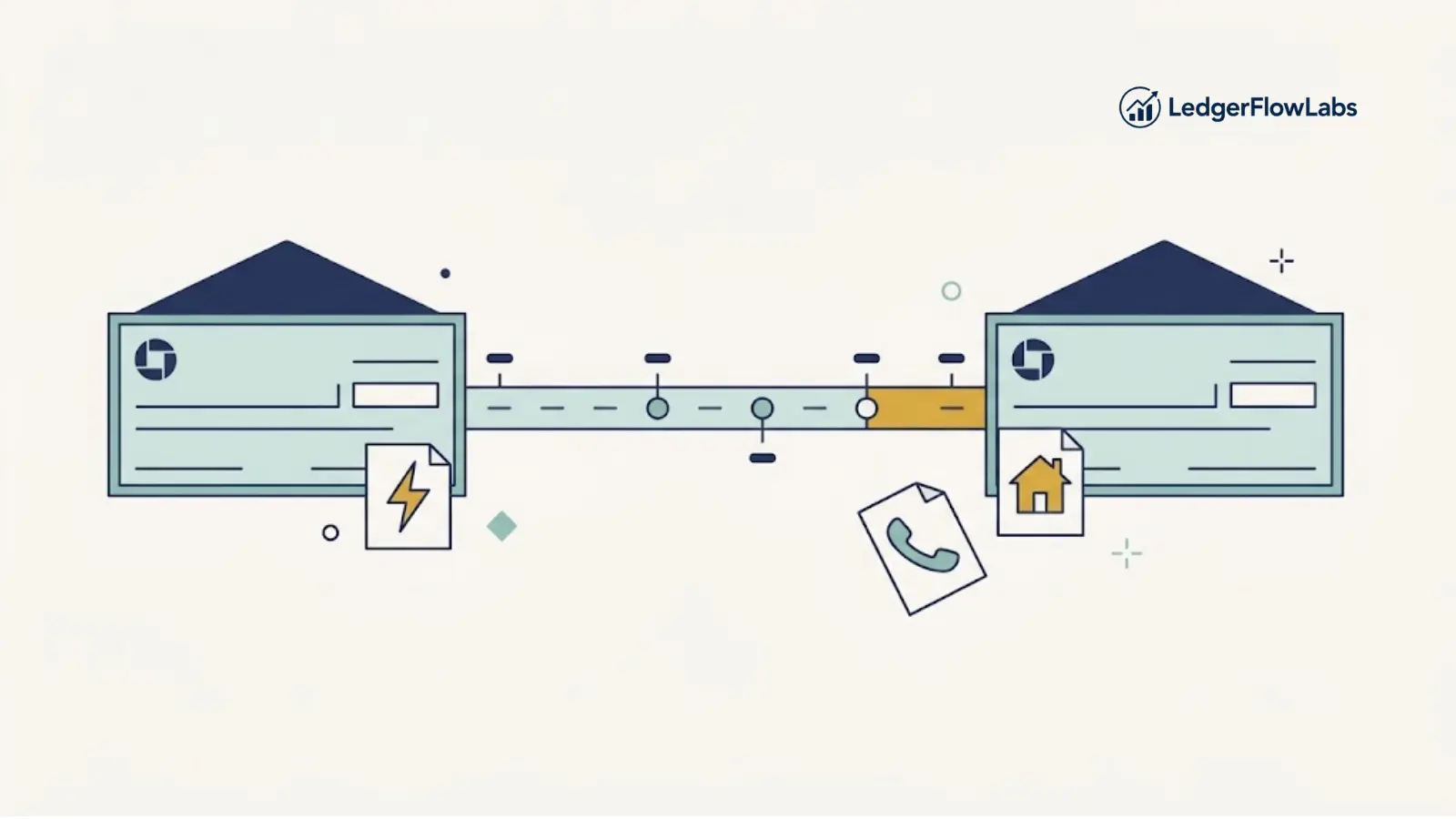
Short answer: there are two methods and they are not equally good. Halving puts half the monthly total aside from each paycheck. Assignment gives each specific bill to the paycheck that arrives before it is due. Halving is easier arithmetic and it fails whenever a due date sits in the wrong half of the month or your pay schedule drifts. Assignment takes one afternoon to set up, survives a biweekly calendar, and tells you immediately which bills are the ones causing the pinch.
Where this applies: the United States. Pay frequency conventions and posting practices differ elsewhere.
This is educational information, not financial advice. Which method suits your household is your decision.
Why halving breaks
Halving assumes the month is symmetrical. It is not.
Most large bills cluster. Rent or a mortgage, a car payment and insurance tend to land in the first few days of the month. If half your monthly total sits waiting from the middle of the previous month, halving works. If you started the method mid-month, the first cycle is short by the whole of that cluster.
Biweekly pay is not twice a month. Twenty-six paychecks a year, not twenty-four, means the dates move forward through the month and two months a year contain three of them. A method that assumes "first paycheck covers the first half" stops being true within a quarter. We set out what that does to a year in biweekly vs semimonthly pay and what to do with the extra checks in the three-paycheck month.
It hides the problem. If a bill is landing before the money that is supposed to pay it, halving does not tell you which bill. Assignment does, on the first pass.
The assignment method, step by step
One afternoon, once, and then a review when something changes.
1. List your pay dates for the next three months. Actual dates. If you are paid biweekly, write them out rather than assuming; the drift is the point.
2. List every bill with its due date. Every recurring outflow, including the ones that come off automatically. If you have not done this before, how to build a bill calendar from your own due dates is the step this one sits on top of.
3. Assign each bill to the last paycheck that lands before it is due. Not the nearest one. The last one that arrives with time to spare. A bill due on the 3rd is paid by the paycheck that arrived in the previous month, not by the one arriving on the 5th.
4. Total each paycheck's assigned bills. Now you have two numbers instead of one, and they will not be equal.
5. Compare each total to that paycheck. Any paycheck whose assigned bills exceed it is where your month breaks, and you have found it in arithmetic rather than at an ATM.
6. Rebalance by moving bills, not by moving money. Which is the next section.
Rebalancing without spending less
If one paycheck is carrying too much, there are four moves and none of them requires cutting anything.
Move a due date. Many providers will change a due date on request, and some will not. Which ones tend to, and how to ask, is in how to move a bill due date. Moving one large bill from the crowded half of the month to the empty half often fixes the whole problem in a single phone call.
Move the bill to the other paycheck and hold the money. If the due date cannot move, the money can. Set the amount aside from the earlier paycheck and pay on the due date. This is a change of habit rather than of budget.
Split one large bill in two. Some providers accept a half payment mid-cycle. Not all do, and one that does not may treat an underpayment as a missed payment, so ask before you try it.
Build a buffer so the assignment stops mattering. A buffer of one paycheck removes the entire problem, permanently, because the money for this month's bills is money that arrived last month. The mechanics rather than the motivation are in building a one-paycheck buffer.
The autopay trap in a split system
Assignment and autopay interact badly if you set them up separately.
Autopay pays on the date the provider chooses, not on the date your plan chose. If a bill is assigned to the first paycheck but autopay takes it on the 28th, the money is gone from the account before the second half of the month has begun, and the plan is a diagram rather than a system.
Two fixes. Either align the autopay date with the assignment, if the provider allows it, or hold the assigned money in a separate account until the autopay date. The risk in general is set out in autopay timing: when automating a payment causes an overdraft.
Where a "half" still makes sense
Halving is not useless. It is the right method for one category: the bills that do not have a due date at all.
Variable costs, such as groceries and fuel, and annual bills that you are spreading, are both amounts you are accumulating rather than paying on a date. For those, a per-paycheck share is exactly right, and the arithmetic for the variable ones is in averaging variable expenses while the annual ones are in annual and irregular bills.
So most households end up with both methods at once: assignment for dated bills, halving for accumulating pots.
Doing this on an irregular income
Assignment still works, with one change: assign against the paycheck you are confident of rather than the one you hope for.
That means planning the assignment on your lowest recent month, which is the approach set out in budgeting on irregular income, and treating anything above it as going into the buffer rather than into more assignments.
What this does not fix
It does not create money. If the total of all assigned bills exceeds the total of all income, no arrangement of them makes the month work, and that is a different problem with a different set of options.
It does not make a due date safe. Being late has consequences that start at the due date rather than at some later grace point, and the three separate clocks that decide what happens are set out in grace period, late fee, credit reporting.
It does not tell you which bill to skip. That is a decision this site does not make for a reader, and where money genuinely will not cover the essentials, free non-profit credit counseling is a real option and it is not the same thing as a debt relief product.
FAQ
Should each paycheck just cover half the bills? Halving is the simpler method and it assumes the month is symmetrical, which it usually is not. Assigning each bill to the last paycheck that arrives before its due date survives a moving pay calendar and shows you immediately which bill is causing the pinch.
How do I split bills if I am paid biweekly? Write out your actual pay dates for the next three months rather than assuming two per month. Biweekly pay produces 26 checks a year, so the dates drift and two months contain three checks. Assignment handles that; halving does not.
What do I do with a bill that is bigger than one paycheck? Move the due date if the provider will, hold money for it from the earlier paycheck, or ask whether the provider accepts a split payment. Ask before splitting, because a provider that does not accept it may treat a part payment as a missed one.
Where do groceries and fuel go? Those are accumulating amounts rather than dated bills, so a per-paycheck share is the right approach for them. Most households end up assigning dated bills and halving accumulating ones.
Does this work with autopay? Only if the autopay dates match your assignment. Otherwise the provider takes money on its own schedule and the plan stops matching the account.
What is the version of this that removes the problem entirely? A one-paycheck buffer. When this month's bills are paid from money that arrived last month, the assignment stops mattering.
Sources: this page contains no rate, fee, threshold or statutory figure, and cites none. It describes two arithmetic methods applied to the reader's own dates. Where it refers to late payment consequences, autopay risk or funds timing, those are covered with their sources on the linked pages of this site.