
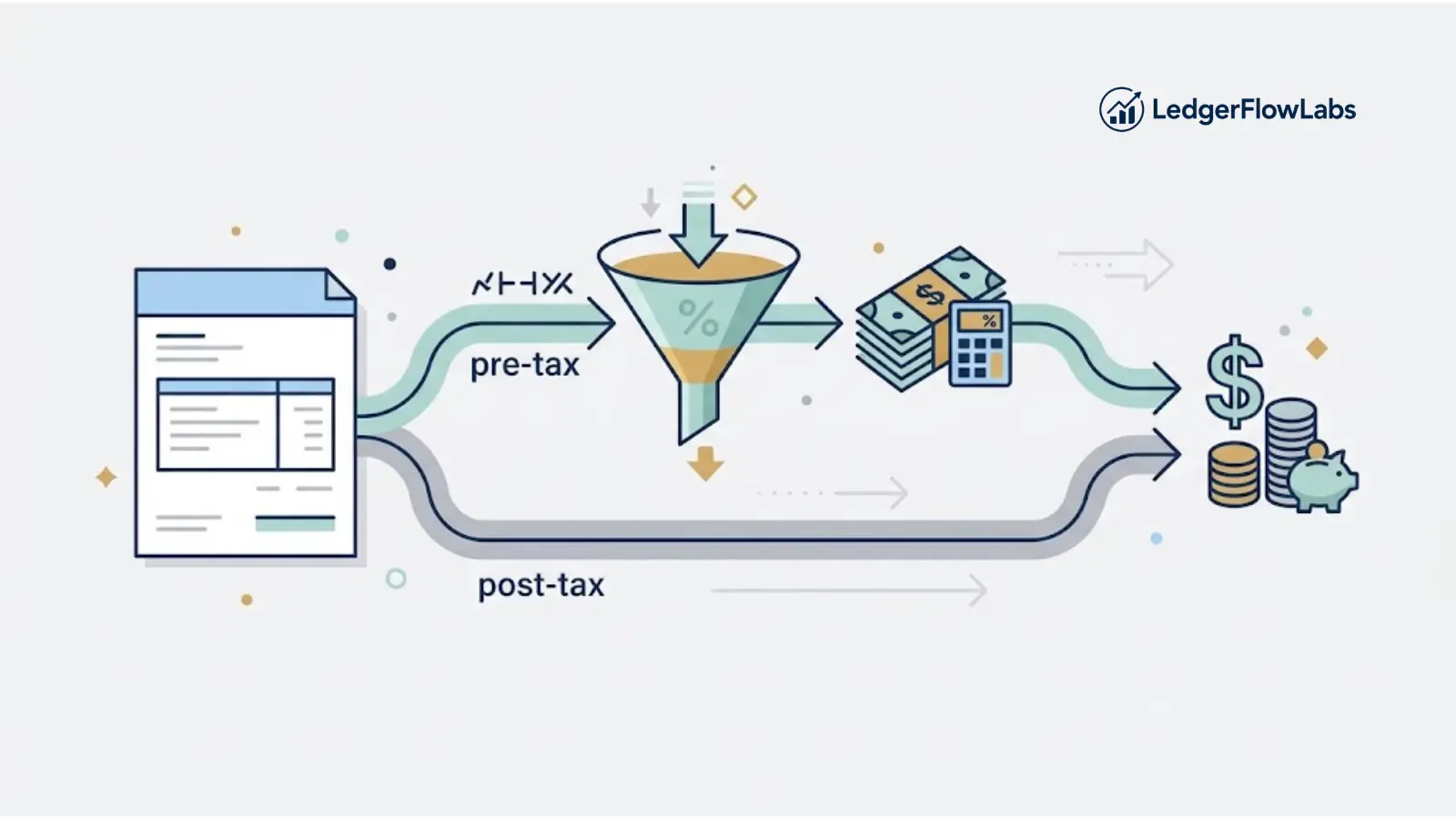
Short answer: payroll does not subtract your deductions all at once. It takes the pre-tax ones first, calculates tax withholding on what is left, then takes the post-tax ones. So a pre-tax deduction reduces your take-home pay by less than its own size, because the tax was worked out on a smaller figure, while a post-tax deduction reduces your take-home pay by its full size. Same amount on the stub, different effect on the deposit, purely because of where in the sequence it sits.
This is educational information, not tax advice and not financial advice. It explains how the two buckets behave. It does not tell you which benefits to elect, how to complete any form, or whether your own deductions are set up correctly.
Where this applies: the United States, on the pay stub of an employee who receives a Form W-2. The buckets, the taxes named and the forms behind them are US ones. Other countries divide payroll deductions differently and the terms do not translate, so a reader elsewhere will see lines that are not described here.
What "before tax" is actually before
A pre-tax deduction is taken out of your gross pay before certain taxes are calculated, so the figure those taxes are calculated on is smaller than your gross pay.
A post-tax deduction, also called an after-tax deduction, comes out further down, after the withholding has already been worked out. It has no effect on the tax calculation at all.
That is the entire difference, and everything else follows from it. Notice that this is a statement about your withholding this period and about your taxable wages, not a statement about the deduction being cheaper or better. It changes the size of a number, not the wisdom of a choice.
Which lines usually sit in which bucket
Where a specific line sits is determined by your employer's plan documents and by tax law, not by preference, so this table describes what is typical rather than what is guaranteed on your stub.
| Commonly pre-tax | Commonly post-tax |
|---|---|
| Health, dental and vision premiums offered through a Section 125 cafeteria plan | Roth 401(k) or Roth 403(b) contributions |
| Flexible spending account (FSA) contributions | Union dues |
| Health savings account (HSA) contributions made through payroll | Wage garnishments and court-ordered support |
| Traditional 401(k), 403(b) or 457 contributions | Disability or life insurance premiums, in many plan designs |
| Some commuter and parking benefits | Charitable giving through payroll |
| Certain group term life premiums up to the limits the IRS sets | Repayment of a payroll advance |
Two lines can carry almost the same name and sit in different buckets. A traditional 401(k) contribution and a Roth 401(k) contribution go to the same plan, often on adjacent lines of the same stub, and they are on opposite sides of this table.
The part almost nobody explains: pre-tax is not pre-every-tax
This is where the popular explanations get lossy, and it is worth knowing because it affects two different things on your stub.
"Pre-tax" describes which taxes a deduction is exempt from, and the answer is not the same for every pre-tax line.
Traditional retirement plan contributions are excluded from the wages your federal income tax withholding is calculated on, but they are still counted as wages for Social Security and Medicare. The Internal Revenue Service states this directly in its retirement plan FAQ on whether contributions are subject to withholding: elective deferrals are not treated as current income for federal income tax purposes, and they are still included as wages subject to Social Security, Medicare and federal unemployment taxes.
Benefits taken through a Section 125 cafeteria plan, which is how most employer health premiums and FSA contributions are handled, are generally excluded from federal income tax withholding and from Social Security and Medicare, as the IRS sets out in its guidance on cafeteria plans and in Publication 15-B.
So two lines both labeled pre-tax on the same stub can be exempt from different taxes. This is also why the wage figures in different boxes of your Form W-2 do not match each other at the end of the year: pre-tax contributions made under a salary reduction agreement are left out of the federal wages box while still appearing in the Social Security and Medicare wages boxes.
Why the order changes your take-home pay
Run the sequence in your head once and it stops being abstract.
- Payroll starts with gross pay for the period.
- It subtracts the pre-tax deductions.
- It calculates federal income tax withholding, and the state equivalent where one applies, on the reduced figure. Social Security and Medicare are calculated on their own wage figure, which as described above is not always the same one.
- It subtracts the post-tax deductions.
- What is left is net pay.
Because step 3 happens between steps 2 and 4, a dollar removed at step 2 also removes the withholding that would have been calculated on it. A dollar removed at step 4 does not. That is why the same amount on two different lines produces two different deposits, and it is the honest answer to "does it actually matter which bucket it comes out of."
How much less a pre-tax deduction costs your take-home pay depends on your own withholding, which depends on your Form W-4 information and your state. There is no universal fraction, and this page will not print one, because any figure would be wrong for most readers and out of date for the rest.
What the two buckets trade, later rather than now
Neither bucket is free. They differ in when tax applies, and the trade is worth stating plainly rather than being sold as a win.
Pre-tax retirement contributions are not taxed as income now. They are generally taxed when the money is withdrawn in retirement. The tax was postponed, not removed.
Roth contributions are made from money that has already been taxed, so they take a bigger bite from today's paycheck. Qualified withdrawals later are treated differently by the IRS as a result.
Cafeteria plan benefits are a genuine exclusion rather than a postponement, which is why the rules around them are narrower, including limits on when elections can be changed.
Which of these fits a particular household depends on facts this page does not have and cannot guess: your tax situation now, your expectation of it later, your plan's options and your other income. It is a decision for you, with your plan documents, and where the amounts are significant, with a tax professional. Contributing consistently rather than choosing a label is the part that most resembles ordinary money mechanics, and it is what our guide to paying yourself first is about.
How to tell which bucket a line on your stub is in
Three practical checks, none of which require any tax arithmetic.
Look at the position. Many stubs group deductions under headings such as "pre-tax deductions" and "after-tax deductions", or print them in calculation order, above and below the tax block.
Compare the wage figures. If your stub shows a taxable wages or taxable gross line beside your gross pay line, the difference between them is the total of your pre-tax deductions for that period.
Ask your benefits or payroll contact. They hold the plan documents that actually determine it, and it is an ordinary question. A stub abbreviation is not a reliable guide to tax treatment on its own.
If a deduction appears that you do not recognize at all, or an amount changes without an election on your side, that is a payroll question rather than a tax question, and payroll is where it goes first.
What this changes for a household budget, and what it does not
Both kinds of deduction leave your paycheck, so both reduce the money you can spend this month. For planning purposes the figure that matters is net pay, whatever bucket produced it, which is the argument set out in budgeting from gross or net income.
What the distinction does change is your reading of a stub that moved. Open enrollment, a plan change or a new election can shift a line from one bucket to the other, and the deposit will move by more or less than the line itself. If you review your own numbers on a regular cycle, as in reviewing your budget monthly, that is the moment to compare the stub before the change with the stub after it. A deposit that shrank without warning is also one of the ordinary causes of a short week, which we take apart in why you run out of money before payday.
FAQ
What is the difference between a pre-tax and a post-tax deduction? A pre-tax deduction comes out before withholding is calculated, so it reduces the wages the tax is worked out on. A post-tax deduction comes out after, and it does not change any tax figure.
Do pre-tax deductions reduce all of my taxes? Not always. The IRS states that traditional retirement plan contributions are excluded from federal income tax but are still wages for Social Security and Medicare, while benefits taken through a Section 125 cafeteria plan are generally excluded from both.
Is a Roth 401(k) contribution pre-tax or post-tax? Post-tax. It comes out of pay that has already had withholding calculated on it, which is why it reduces take-home pay by its full amount.
Why is my taxable wages figure lower than my gross pay? Because your pre-tax deductions have already been subtracted from it. The gap between the two lines is the total of those deductions for the period.
Which bucket is better? That depends on facts specific to you, and it is not a question a general article can answer. Your plan documents set out the options, and a tax professional can look at your own situation.
Sources: Internal Revenue Service, "Retirement plan FAQs regarding contributions: are retirement plan contributions subject to withholding for FICA, Medicare or federal income tax?", for elective deferrals being excluded from federal income tax while remaining subject to Social Security and Medicare, read 2026-09-07. Internal Revenue Service, Publication 15-B, "Employer's Tax Guide to Fringe Benefits", and the IRS guidance on cafeteria plans, for the general treatment of Section 125 benefits, read 2026-09-07. No tax rate, contribution limit, threshold or dollar figure appears on this page. Limits and rates change annually and the IRS publishes the current ones.