
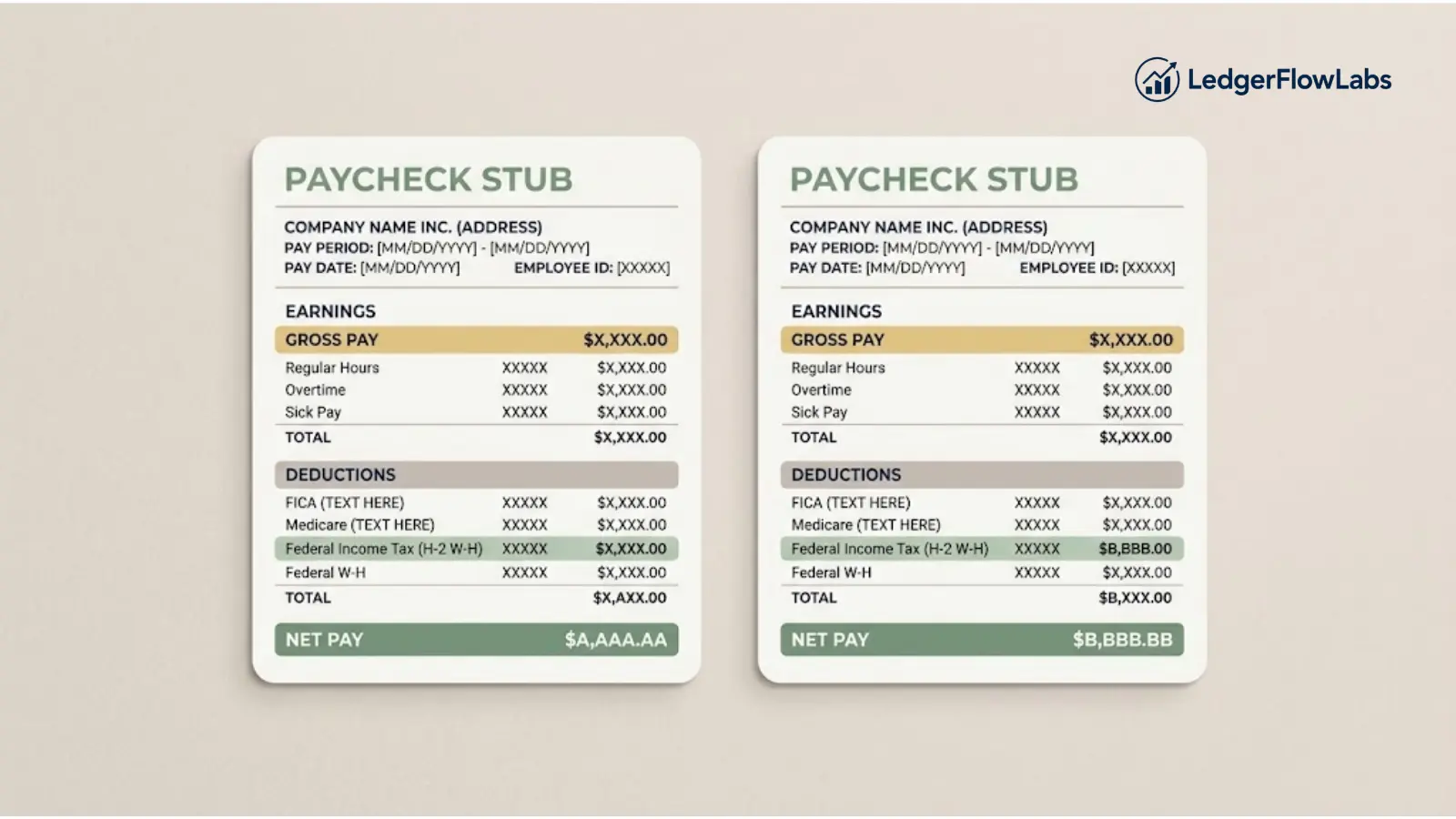
Short answer: withholding is your employer's running estimate of the income tax you will owe for the year, collected a little at a time from each paycheck instead of all at once when you file. The estimate is built from what you told your employer on your Form W-4 and from where you work. Two people on identical gross pay routinely take home different amounts because the W-4 information is different, the state is different, and the benefit elections sitting above the tax calculation are different. None of that means either stub is wrong. It means the estimate is personal.
This is educational information, not tax advice and not financial advice. It explains what withholding is trying to do. It does not tell you how to complete any form, what to claim, how much to have withheld, or whether your own employer has calculated it correctly.
Where this applies: the United States, and the pay stub of an employee who receives a Form W-2. The forms, the taxes and the agencies named below are US ones. Every country collects payroll tax differently. A Canadian reader, for example, deals with the Canada Revenue Agency and a TD1 form rather than the IRS and a W-4, and none of that is described here.
A note on numbers, deliberately: this page prints no tax rate, no bracket, no threshold, no standard deduction and no contribution limit. Those are set each year and change. The IRS publishes the current figures, and a page that reprints them is out of date the following January while still reading as fact. What follows is the mechanism, which does not change annually.
What withholding is actually approximating
The United States runs a pay as you go tax system. Rather than presenting employees with one bill after the year ends, tax is collected across the year from each paycheck.
Your employer is not deciding what you owe. It is running a calculation the IRS publishes, in Publication 15-T, which sets out the federal income tax withholding methods payroll systems use. The inputs are your pay for this period, your pay frequency, and the information on your Form W-4, which the IRS titles the Employee's Withholding Certificate.
Two consequences follow, and both explain a lot of confusion.
Withholding is not your tax bill. It is money paid toward a bill that is calculated later, on your return. If more was withheld than you owed, the difference comes back as a refund, which is a return of your own money rather than a payment from anyone. If less was withheld, the remainder is owed at filing.
The calculation assumes this period is typical. Payroll generally works out the withholding for a period as though your current pay continued at that rate for the rest of the year. That is why an unusual period, such as one containing a bonus or backdated pay, can be withheld against at a rate that feels wrong. It is an estimate reacting to an atypical input, not a penalty.
The variables that move it, from largest to smallest
Here is the inventory that answers the question in the title. Two coworkers with the same salary can differ on every line of this list.
1. What each person put on their Form W-4. The form asks for filing status, whether there are multiple jobs in the household, dependents, other income not from this job, expected deductions, and whether the employee wants an extra amount withheld each period. Every one of those changes the calculated result. A person whose spouse also works and who marked that on the form is withheld differently from a person on the same salary who did not.
2. Where the work happens. Some states levy an income tax and some do not. Some cities and localities levy their own. States that have an income tax generally have their own withholding certificate, separate from the federal W-4, and their own rules. Two people on identical federal figures can have completely different state lines on their stubs.
3. What sits above the tax calculation. Pre-tax deductions are subtracted before withholding is worked out, so the person contributing more to a traditional retirement plan or carrying a family health premium has a smaller figure being taxed. Their withholding line is smaller and so is their deposit, for two different reasons at once.
4. Pay frequency. Withholding is calculated per pay period against an annualized figure, so the same annual salary paid weekly, biweekly, semimonthly or monthly produces different per check numbers. It also produces a different number of checks per year, which is a planning question of its own, covered in weekly, biweekly and semimonthly pay.
5. Where each person is in the year. Some payroll taxes and plan contributions are governed by annual figures rather than per period ones, so somebody who started in July, or who received a large bonus in March, is at a different point in those annual totals than a colleague who has been paid steadily since January.
6. Everything after the tax lines. Union dues, a Roth contribution, a garnishment, a disability premium or a repayment all reduce take-home pay without touching the tax calculation at all. Two stubs can show identical withholding and still deposit different amounts.
Notice how many of these are not tax. "Take-home pay" is the end of a chain, and only part of the chain is the IRS.
Why "we earn the same" is rarely true in the way people mean
Two more things quietly break the comparison people make in the break room.
Gross pay is not always what it appears. Overtime, shift differential, paid leave used in a period, a commission, or a mid period rate change all move gross pay without moving anybody's salary. The comparison only holds if the same period, at the same length, is being compared.
A refund is not a measure of a better outcome. Two people with the same salary and the same tax result can land in very different places: one had more withheld across the year and receives a refund, the other had less withheld and keeps a slightly larger deposit each period. That is a difference in timing, not in what either person paid. Whether one arrangement suits a household better than the other is a personal decision, and not one this page will make.
Where to look on your own stub
The tax lines on a stub are readable without knowing any rates.
Find the tax block. It typically contains federal income tax withholding, Social Security and Medicare (often together as FICA, sometimes as OASDI and Med), and any state or local tax that applies where you work.
Then look at the taxable wages figure if your stub shows one, because it is usually not the same as gross pay. The difference between the two is your pre-tax deductions for the period. That number is the reason two people can be withheld differently on the same salary, and it is visible without any calculation at all.
Then look at the year to date column. A single period can be distorted by anything unusual inside it, and the running total is a fairer picture of what has been withheld so far.
If your take-home pay is what actually prompted the question, and a shortfall in the month is the real problem, that is a timing question rather than a tax one, and it is what our guides to why you run out of money before payday and building a one paycheck buffer deal with.
What to do with a withholding question, and who answers which part
This is the part where a page like this has to be honest about its limits.
Your employer's payroll department holds the W-4 information currently on file for you, your state form, your elections and your pay history. If you want to know what inputs produced your numbers, that is where the answer lives. It is a routine request.
The IRS publishes the withholding rules, the current year's figures, Form W-4 and its instructions, and a Tax Withholding Estimator that people use to check their own situation. USAGov also maintains a plain language page on checking and changing withholding that points at the same tools.
Your state revenue agency is the authority on state withholding, which the IRS does not administer.
A tax professional is the right place for a question about your own circumstances, particularly with more than one job in the household, self employment income alongside a salary, a mid year job change, or a large one off payment.
Whether to change what is on your W-4, and what to put on it, is your decision with those sources. It is not something this article, a coworker or a general guide can responsibly answer, because the correct entry depends on facts specific to your household. What is worth knowing is that the form can be updated with your employer when your circumstances change, rather than being fixed at the moment you were hired.
What withholding does not decide
It does not decide your tax. The return does.
It does not decide your take-home pay on its own, since benefit elections and post-tax deductions move the deposit independently.
And it does not decide whether your budget works. That runs on the amount actually landing in your account, which is the argument set out in budgeting from gross or net income, regardless of how the gap above it was composed.
FAQ
How does tax withholding work? Your employer estimates the income tax you will owe for the year using IRS methods and the information on your Form W-4, then collects a portion of it from each paycheck and sends it to the tax authorities on your behalf. The estimate is reconciled when you file.
Why is more withheld from my paycheck than my coworker's on the same salary? Most often because your W-4 information differs, because your benefit elections change the wages the tax is calculated on, or because state and local taxes differ for where each of you works.
Is my withholding the same as the tax I owe? No. Withholding is money paid toward a bill that is calculated on your tax return. The final figure can be higher or lower, which is why refunds and balances due both exist.
Why was my bonus withheld against so heavily? Payroll generally calculates a period as though that period's pay continued all year, so an unusually large period is treated as though it were typical. It is an estimate, corrected at filing.
Where do I check my own withholding? Your pay stub shows what was withheld, and your payroll department holds the information on file that produced it. The IRS publishes Form W-4 and a Tax Withholding Estimator, and a tax professional can look at your own situation.
Sources: Internal Revenue Service, Publication 15-T, "Federal Income Tax Withholding Methods", and Form W-4, "Employee's Withholding Certificate", named as the published methods and form behind the calculation, read 2026-09-07. USAGov, "How to check and change your tax withholding", read 2026-09-07. No rate, bracket, threshold, standard deduction or contribution limit appears anywhere on this page, by choice, because those are set annually and the IRS publishes the current versions.