
Short answer: interest on most credit cards is not charged on the balance you see at the end of the cycle. It is charged on a balance built from every day of the cycle, which is why a payment made on day 25 does much less than the same payment made on day 2. Regulation Z § 1026.14(d) describes the daily periodic rate approaches directly: a creditor may divide the total finance charge by “the average of the daily balances” and multiply by the number of billing cycles in a year, or divide by “the sum of the daily balances” and multiply by 365. And § 1026.7(b)(5) requires your own statement to show “the amount of the balance to which a periodic rate was applied and an explanation of how that balance was determined, using the term Balance Subject to Interest Rate.”
So the number is on your statement, with a label, and an explanation next to it.
Where this applies: the United States. Regulation Z is a US rule.
This is educational information, not financial advice. Nothing here tells you when or what to pay.
How the number is built
Take each day of the billing cycle. Write down the balance on that day. Add them all together. Divide by the number of days.
That is an average daily balance, and it means every day of the cycle has a vote. A day at a high balance pushes the average up; a day at a low balance pulls it down.
The consequence people find counter-intuitive: it does not matter only how much you owed, it matters how long you owed it. A large purchase on the last day of the cycle contributes one day to the average. The same purchase on the first day contributes thirty.
The arithmetic, with numbers that are not real
The figures below are invented for the arithmetic. They are not a rate anyone is offering, not a typical balance, and not a claim about any product.
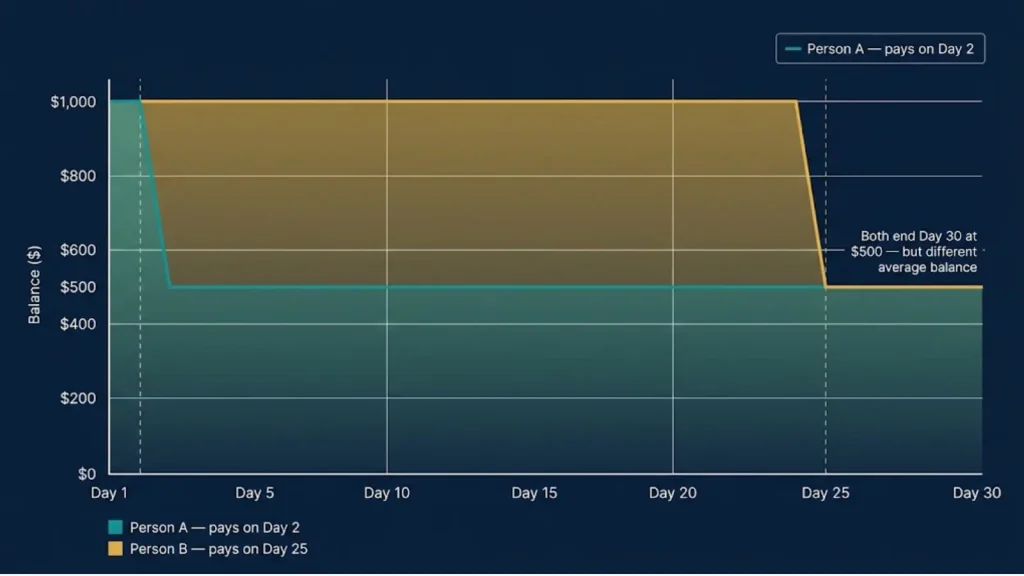
Two people, both starting a 30-day cycle at $1,000, both paying $500, both at an APR of 24%.
Person A pays on day 2.
- Days 1 to 2 at $1,000, days 3 to 30 at $500.
- Sum of daily balances: (2 × $1,000) + (28 × $500) = $2,000 + $14,000 = $16,000.
- Average daily balance: $16,000 ÷ 30 = $533.33.
Person B pays on day 25.
- Days 1 to 25 at $1,000, days 26 to 30 at $500.
- Sum of daily balances: (25 × $1,000) + (5 × $500) = $25,000 + $2,500 = $27,500.
- Average daily balance: $27,500 ÷ 30 = $916.67.
Now apply the rate. A 24% APR gives a daily periodic rate of 24 ÷ 365 = 0.0657% per day, which is the relationship Regulation Z § 1026.14(b) describes in reverse when it computes the APR by “multiplying each periodic rate by the number of periods in a year.”
- Person A: $533.33 × 0.000657 × 30 = about $10.51.
- Person B: $916.67 × 0.000657 × 30 = about $18.07.
Same balance, same payment, same rate, different day, roughly seven dollars and fifty cents apart on these invented figures. Scale the balance and the difference scales with it.
Why the closing balance misleads
Both people above end the cycle at $500. If you judged the cycle by its closing balance, you would expect the same charge.
The closing balance is one day’s vote out of thirty. It is the number your app shows and the number people quote to each other, and it is not the number the interest was computed on.
That is also why the “balance” question and the “available balance” question are different from each other. What your app displays as available money is a third thing again, and it is covered in why the balance in your banking app is not the money you have and pending vs posted transactions.
Which method your account actually uses
You do not have to assume. Two separate rules require it to be told to you.
On the periodic statement. § 1026.7(b)(5) requires the amount of the balance a periodic rate was applied to, labeled Balance Subject to Interest Rate, together with “an explanation of how that balance was determined.”
In the application or solicitation. § 1026.60(b)(6) requires “the name of the balance computation method listed in paragraph (g)” or “an explanation of the method used if it is not listed.”
Two documents, two disclosures, one answer. If a customer service explanation does not match those, the section numbers are how you point at the discrepancy.
The method that is prohibited
There used to be a version of this that reached backward into the previous cycle, and it is not allowed on credit cards.
Regulation Z § 1026.54(a)(1)(i) prohibits a card issuer from imposing finance charges based on “balances for days in billing cycles that precede the most recent billing cycle.” The official interpretation states that this “prohibits the card issuer from computing the finance charge using the two-cycle average daily balance computation method.”
So if you have read an older article describing two-cycle billing, that is history rather than current practice on cards, and it is worth knowing the citation because the description still circulates.
The other prohibition, which is the useful one
§ 1026.54(a)(1)(ii) prohibits a card issuer from imposing finance charges on “any portion of a balance subject to a grace period that was repaid prior to the expiration of the grace period.”
The same section describes how partial payment is handled: an issuer may comply by applying “the consumer’s payment to the balance subject to the grace period at the end of the preceding billing cycle” and then charging interest only on remaining unpaid amounts.
Which means the average daily balance arithmetic above is the case where a grace period does not apply. Where it does apply and the balance is repaid in full within it, the answer is zero and none of the daily arithmetic runs. The definition of a grace period is at § 1026.5(b)(2)(ii)(B)(3): “a period within which any credit extended may be repaid without incurring a finance charge due to a periodic interest rate.”
The three separate clocks around due dates, late fees and reporting are a different subject, and they are set out in grace period, late fee, credit reporting.
What this page will not do
It will not tell you when to pay. The arithmetic above is arithmetic. What you do with it is your decision, and it depends on when your money arrives, which is a different question covered elsewhere on this site.
It will not print a typical rate or a typical cycle length. Both are on your own statement, and § 1026.7(b)(4) requires the rate to be there.
It will not recommend a card. This site takes no affiliate or referral income from any financial product.
FAQ
What is the average daily balance method? A balance computed by taking the balance on each day of the billing cycle, summing them and dividing by the number of days. Regulation Z § 1026.14(d) describes the daily periodic rate approaches in those terms, using either the average of the daily balances or the sum of the daily balances.
I paid a lot off mid-month. Why did the interest barely change? Because interest was computed on the average across the whole cycle, not on the closing figure. A payment made late in the cycle only lowers the balance for the remaining days, so it moves the average very little.
Where do I find which method my card uses? Two places. § 1026.7(b)(5) requires the periodic statement to show the balance a periodic rate was applied to and to explain how it was determined. § 1026.60(b)(6) requires the application or solicitation to name the balance computation method or explain it.
Is two-cycle billing still allowed? Not on credit cards. § 1026.54(a)(1)(i) prohibits imposing finance charges based on balances for days in billing cycles preceding the most recent one, and the official interpretation states this prohibits the two-cycle average daily balance method.
Does this arithmetic apply if I pay in full every month? Generally not, because § 1026.54(a)(1)(ii) bars a card issuer from charging finance charges on a portion of a balance subject to a grace period that was repaid before the grace period expired. Whether a grace period applies to your account is a disclosure on your own documents.
Does the closing balance matter at all? It is one day of the cycle. It is the number most people look at and it is not the number the calculation uses.
Sources: Regulation Z, 12 CFR Part 1026, read on consumerfinance.gov 2026-08-28. § 1026.14(d) for the daily periodic rate approaches using the average of the daily balances or the sum of the daily balances; § 1026.14(b) for the annual percentage rate computed by multiplying each periodic rate by the number of periods in a year; § 1026.7(b)(5) for the balance subject to interest rate and the explanation of how it was determined; § 1026.7(b)(4) for the periodic rate disclosed as an annual percentage rate; § 1026.60(b)(6) for the balance computation method disclosure; § 1026.54(a)(1)(i) and its official interpretation for the prohibition on the two-cycle average daily balance method; § 1026.54(a)(1)(ii) for the prohibition on charging finance charges on a portion of a balance subject to a grace period repaid before it expired, and the partial payment application described there; § 1026.5(b)(2)(ii)(B)(3) for the definition of a grace period. The $1,000 balance, $500 payment, 24% APR and 30-day cycle in the worked example are invented for the arithmetic and are not a rate, a typical figure or a claim about any product.