
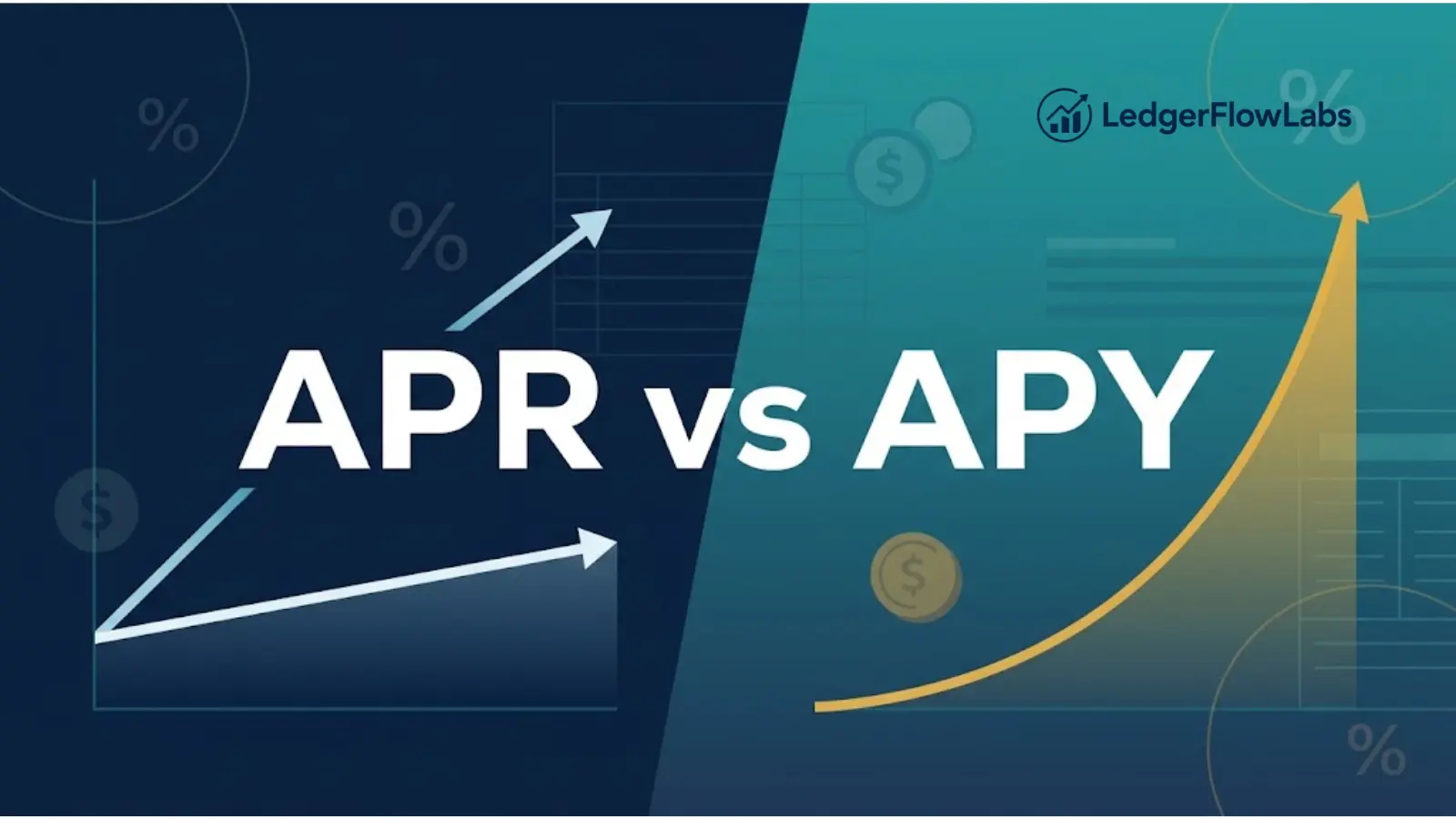
Short answer: they are defined in two different United States regulations, for two different purposes, and the difference is compounding. Annual percentage yield is defined in Regulation DD, 12 CFR § 1030.2(c), as "a percentage rate reflecting the total amount of interest paid on an account, based on the interest rate and the frequency of compounding for a 365-day period." Interest rate is defined in the same regulation, at § 1030.2(o), as "the annual rate of interest paid on an account which does not reflect compounding." And annual percentage rate, for open-end credit, is defined in Regulation Z at § 1026.14(a) as "a measure of the cost of credit, expressed as a yearly rate," computed under § 1026.14(b) by "multiplying each periodic rate by the number of periods in a year."
So APY includes compounding by definition, and a rate produced by multiplying a periodic rate by the number of periods in a year does not. That single sentence is the whole distinction, and it comes from the definitions rather than from a rule of thumb.
Where this applies: the United States. Regulation Z and Regulation DD are US rules and other countries define these terms differently.
This is educational information, not financial advice. No product is recommended anywhere on this site.
Two regulations, two jobs
Regulation Z, 12 CFR Part 1026, governs consumer credit. It is where APR lives, and its purpose is disclosure of the cost of borrowing.
Regulation DD, 12 CFR Part 1030, is the Truth in Savings rule and governs deposit accounts. It is where APY lives, and its purpose is comparability between deposit accounts.
That is why the two words look almost identical and behave differently: they were written by two different rules to answer two different questions.
The practical shorthand that follows: you will generally meet APR on things you borrow and APY on things you deposit. That is a convention produced by the regulations rather than a law of language, which is why it is worth knowing the definitions rather than the shorthand.
What each one includes
APY includes compounding. § 1030.2(c) says so directly: it reflects the total amount of interest paid "based on the interest rate and the frequency of compounding for a 365-day period." Two accounts with the same interest rate and different compounding frequencies have different APYs, which is exactly the comparison the rule was written to make possible.
Interest rate excludes compounding. § 1030.2(o) is explicit: it "does not reflect compounding."
APR, on open-end credit, is a periodic rate annualized. § 1026.14(b): "multiplying each periodic rate by the number of periods in a year." Multiplying is not compounding. A daily periodic rate multiplied by 365 gives an APR; the same daily rate compounded across 365 days gives a larger effective figure.
Which produces the point people find surprising: on a credit card where interest is charged daily on daily balances, the amount you actually pay over a year at a constant balance is not exactly the APR, because the APR is a multiplication and the charging is daily. That is not a hidden fee. It is what the definition of APR is.
The disclosure that makes this checkable
Both regulations put the numbers on documents you already have.
On a deposit account: § 1030.4(b)(1)(i) requires disclosure of "the 'annual percentage yield' and the 'interest rate,' using those terms, and for fixed-rate accounts the period of time the interest rate will be in effect." The official interpretation adds that "if the annual percentage yield is the same as the interest rate, institutions may disclose a single figure but must use both terms."
Read that last sentence carefully, because it tells you something useful: where APY and the interest rate are equal, compounding is not adding anything over the period, and the account is simple in the arithmetic sense.
On a credit account: § 1026.7(b)(4) requires the periodic statement to show "each periodic rate that may be used to compute the interest charge expressed as an annual percentage rate and using the term Annual Percentage Rate."
So both sides of this comparison are required to be printed, in named terms, on your own paperwork.
Comparing two savings accounts properly
This is where the distinction earns its keep.
Compare APY to APY. That is what the figure exists for. Comparing an interest rate on one product to an APY on another is comparing a number that excludes compounding to one that includes it.
Watch the compounding frequency only through the APY. § 1030.2(c) already folds frequency into the figure, so you do not need to do that arithmetic yourself. If two accounts show the same APY, the difference in compounding frequency has already been accounted for.
Note the period the rate applies for. § 1030.4(b)(1)(i) requires, for fixed-rate accounts, "the period of time the interest rate will be in effect." A high figure for a short period is a different proposition from the same figure indefinitely, and this site does not tell you which suits you.
Comparing two credit products properly
Also worth stating, and narrower than people expect.
APR is a cost measure, not a total. § 1026.14(a) calls it "a measure of the cost of credit, expressed as a yearly rate," and adds that an APR is considered accurate if it falls within one eighth of one percentage point of the calculated rate. It is a comparison tool with a tolerance built into it.
A card may have more than one. § 1026.7(b)(4) requires "each periodic rate that may be used," in the plural, because purchases, cash advances and balance transfers commonly carry different rates.
And what you actually pay depends on the balance, not only on the rate. That is because § 1026.7(b)(5) requires the statement to show the balance a periodic rate was applied to, and that balance is constructed from your activity across the cycle. It is why two people with the same APR can pay very different amounts.
The one-sentence test
If you are looking at a figure and cannot remember which is which:
Does compounding change it? If the figure would be different at daily compounding versus monthly compounding, you are looking at an APY under § 1030.2(c). If it is a periodic rate multiplied by the number of periods in a year, you are looking at an APR under § 1026.14(b).
FAQ
What is the difference between APR and APY? Compounding. Regulation DD § 1030.2(c) defines annual percentage yield as reflecting the total interest paid "based on the interest rate and the frequency of compounding for a 365-day period." Regulation Z § 1026.14(b) computes an annual percentage rate on open-end credit by multiplying each periodic rate by the number of periods in a year, which is a multiplication rather than a compounding.
Which one applies to a savings account? APY is the Truth in Savings figure and § 1030.4(b)(1)(i) requires both the annual percentage yield and the interest rate to be disclosed, using those terms.
Why are my account's APY and interest rate the same number? The official interpretation to Regulation DD notes that where the annual percentage yield is the same as the interest rate, institutions may disclose a single figure but must use both terms. In arithmetic terms, compounding is not adding anything over the period.
Does a credit card have an APY? Regulation Z's required disclosure is the annual percentage rate. Because card interest is commonly charged daily on daily balances, what you pay across a year at a constant balance is not exactly the APR, and that is a consequence of how APR is defined rather than a hidden charge.
Can one card have several APRs? Yes. § 1026.7(b)(4) refers to "each periodic rate that may be used," and purchases, cash advances and balance transfers commonly carry different rates.
Is a higher APY always better? This site does not rank products and does not tell you what to open. What the figure does is make two deposit accounts comparable on the same basis, which is the job Regulation DD gave it.
Sources: Regulation DD, 12 CFR Part 1030, read on consumerfinance.gov 2026-08-28. § 1030.2(c) for the definition of annual percentage yield; § 1030.2(o) for the definition of interest rate; § 1030.4(b)(1)(i) for the disclosure of both terms and, for fixed-rate accounts, the period the rate is in effect, together with the official interpretation on disclosing a single figure using both terms. Regulation Z, 12 CFR Part 1026, read the same day. § 1026.14(a) for the definition of annual percentage rate on open-end credit and the one eighth of one percentage point accuracy tolerance; § 1026.14(b) for the computation by multiplying each periodic rate by the number of periods in a year; § 1026.7(b)(4) for the periodic statement disclosure. No rate figure of any kind appears on this page.