

Short answer: you do not have to estimate this and you do not have to trust a calculator on a website, because in the United States the answer for your own account is printed on your own statement. Regulation Z § 1026.7(b)(12) requires a periodic statement to carry the Minimum Payment Warning: “If you make only the minimum payment each period, you will pay more in interest and it will take you longer to pay off your balance,” together with minimum payment repayment estimates, total cost estimates, and credit counseling service information.
That is a personalized figure, produced by the lender, using your actual balance and rate. It beats every general explanation of the trap, including this one.
Where this applies: the United States. Regulation Z is a US rule.
This is educational information, not financial advice. This site does not tell you what to pay or which debt to pay first.
Why a minimum payment behaves the way it does
A minimum payment is typically set as a small percentage of the balance plus interest and fees, or a small flat floor, whichever is greater. The exact formula is the issuer’s, and Regulation Z governs what must be disclosed about it rather than setting the formula.
Two consequences follow from that shape, and they are the whole of the “trap.”
The payment shrinks as the balance does. A percentage of a smaller number is a smaller payment. So the amount going to principal falls just as the balance is falling, which stretches the tail of the repayment out.
Interest is charged on the balance, not on the payment. Whatever is not repaid keeps accruing at the daily periodic rate, so the portion of each payment that clears principal is the payment minus that cycle’s interest. When the interest charge is a large share of the minimum, very little principal moves.
Neither of those is a trick. Both are arithmetic, and both are visible in the numbers on your statement.
The arithmetic, with numbers that are not real
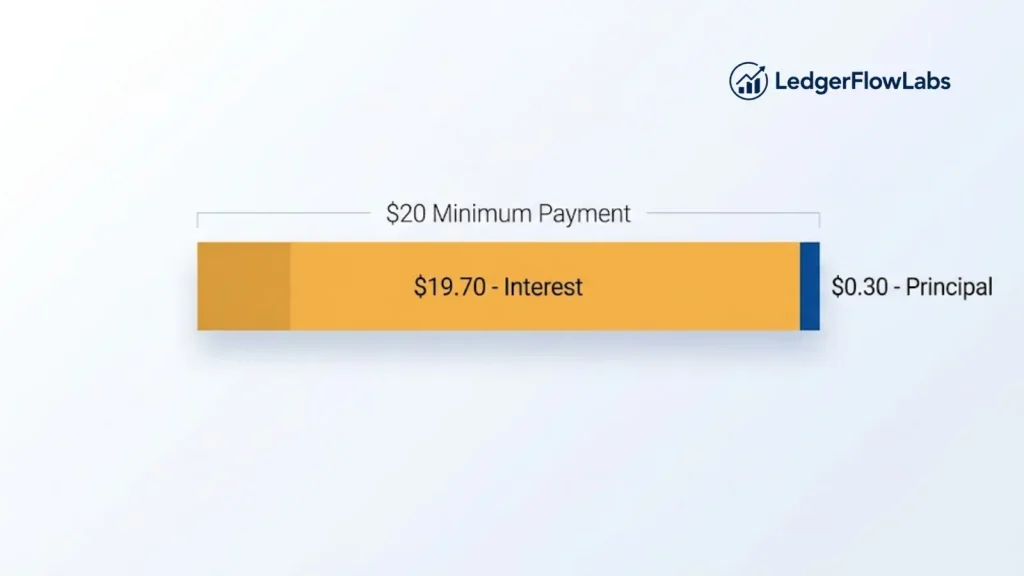
The figures below are invented for the arithmetic. They are not a rate anybody is offering, not a typical balance, and not a claim about any product. Use your own statement’s figures.
Take a balance of $1,000 at an APR of 24%, with the minimum payment set at 2% of the balance.
The daily periodic rate: 24% ÷ 365 = 0.0657% per day. Over a 30-day cycle that is roughly 1.97% of the balance.
The interest for the cycle: $1,000 × 1.97% = about $19.70.
The minimum payment: 2% of $1,000 = $20.
What clears the principal: $20 − $19.70 = about $0.30.
That is the illustration in one line: on these invented numbers, a $20 payment moves the balance by thirty cents.
Change any input and the picture changes completely. At half the rate, the same payment clears roughly ten dollars of principal instead of thirty cents. That is why the useful number is not a rule of thumb, it is the one on your statement.
The arithmetic underneath this is a daily periodic rate applied to a daily balance and summed across the cycle. Regulation Z § 1026.14(b) gives the relationship: the annual percentage rate is computed by “multiplying each periodic rate by the number of periods in a year,” so dividing your APR by 365 gives the daily figure.
Reading the box on your own statement
This is the part worth doing once, with the statement in front of you.
Find the Minimum Payment Warning. § 1026.7(b)(12) requires it, along with repayment estimates and total cost estimates. It typically shows what happens if you pay only the minimum, and what a larger fixed payment would do instead.
Find the Balance Subject to Interest Rate. § 1026.7(b)(5) requires the statement to show “the amount of the balance to which a periodic rate was applied and an explanation of how that balance was determined.” That is the number interest was actually charged on.
Find the rate. § 1026.7(b)(4) requires each periodic rate that may be used to compute the interest charge to be shown as an annual percentage rate.
Find the interest charged this cycle. Compare it to the minimum payment. The difference between the two is what actually came off the balance.
That last comparison is the entire subject, and it takes about a minute once you know which lines to look at.
The credit counseling line, and why it is there
§ 1026.7(b)(12) requires the repayment disclosures to include credit counseling service information. That is not decoration; the rule puts a route to free help on the same page as the number.
The Consumer Financial Protection Bureau describes credit counseling organizations as usually non-profit, with counselors “certified and trained in the areas of consumer credit, money and debt management, and budgeting,” and names the Financial Counseling Association of America and the National Foundation for Credit Counseling as places to find one, along with the US Department of Justice’s list of approved credit counselors (CFPB, “What is credit counseling?”, last reviewed August 2, 2023).
It also warns. The CFPB advises avoiding organizations that charge for information or will not help if you cannot pay, and states that “some organizations that offer debt management plans have defrauded people.”
What this page will not do
It will not tell you to pay more than the minimum. That is advice about your own money. What it will say is that the statement is required to show you what each choice does, in your own numbers.
It will not compare payoff methods. Snowball, avalanche and any other ordering of debts is payoff-plan execution, which this site does not cover, and choosing between them is a decision about your own creditors.
It will not recommend a balance transfer, a consolidation loan, or any product. LedgerFlow Labs takes no affiliate or referral income from any financial product. On this question in particular that matters, because much of what ranks for it is written by companies that are paid when a reader signs up.
It will not print a typical rate or a typical minimum percentage. Both vary by issuer and by account, and yours are on your own documents.
The one thing worth checking that nobody mentions
Where a payment lands in the cycle changes what it does, because interest on most cards is charged on daily balances rather than on the closing figure.
A payment made early in a cycle reduces the balance for more days than the same payment made on the due date. That is not a reason to change what you pay; it is a reason to know that “the same payment” is not always the same in effect, and it is the mechanism behind the average daily balance method.
Whether that method applies to your account is a disclosure rather than a guess: § 1026.60(b)(6) requires an application or solicitation to give “the name of the balance computation method listed in paragraph (g)” or an explanation where it is not listed.
FAQ
If I only pay the minimum, how long will it take? Your own statement is required to tell you. Regulation Z § 1026.7(b)(12) requires the Minimum Payment Warning together with minimum payment repayment estimates and total cost estimates, calculated on your actual account.
Why does my balance barely move when I pay the minimum? Because interest for the cycle is deducted from the payment before anything clears principal. If the interest charged is close to the size of the minimum payment, very little principal moves.
Why does the minimum payment get smaller? Because it is typically set as a percentage of the balance, so as the balance falls the payment falls with it. That is what stretches the tail of the repayment.
Where is the warning on my statement? It is a required disclosure under § 1026.7(b)(12), and it includes the Minimum Payment Warning text, repayment and total cost estimates, and credit counseling service information.
Should I pay more than the minimum? That is your decision and this site does not make it. The statement disclosure exists so you can see what each option does in your own numbers.
Where can I get free help if the balance is not moving? The CFPB describes credit counseling organizations as usually non-profit with certified counselors, and names the Financial Counseling Association of America, the National Foundation for Credit Counseling and the US Department of Justice’s approved list. It also warns against organizations that charge for information or will not help those who cannot pay.
Sources: Regulation Z, 12 CFR Part 1026, read on consumerfinance.gov 2026-08-28. § 1026.7(b)(12) for the Minimum Payment Warning text, the repayment and total cost estimates and the credit counseling service information; § 1026.7(b)(5) for the balance subject to interest rate and the explanation of how it was determined; § 1026.7(b)(4) for the periodic rate disclosed as an annual percentage rate; § 1026.60(b)(6) for the balance computation method disclosure. Consumer Financial Protection Bureau, “What is credit counseling?”, last reviewed August 2, 2023, read 2026-08-28, for the description of credit counseling organizations, the named routes to find one and the warnings. The 24% APR, $1,000 balance, 2% minimum and 30-day cycle in the worked example are invented for the arithmetic and are not a rate, a typical figure or a claim about any product.