
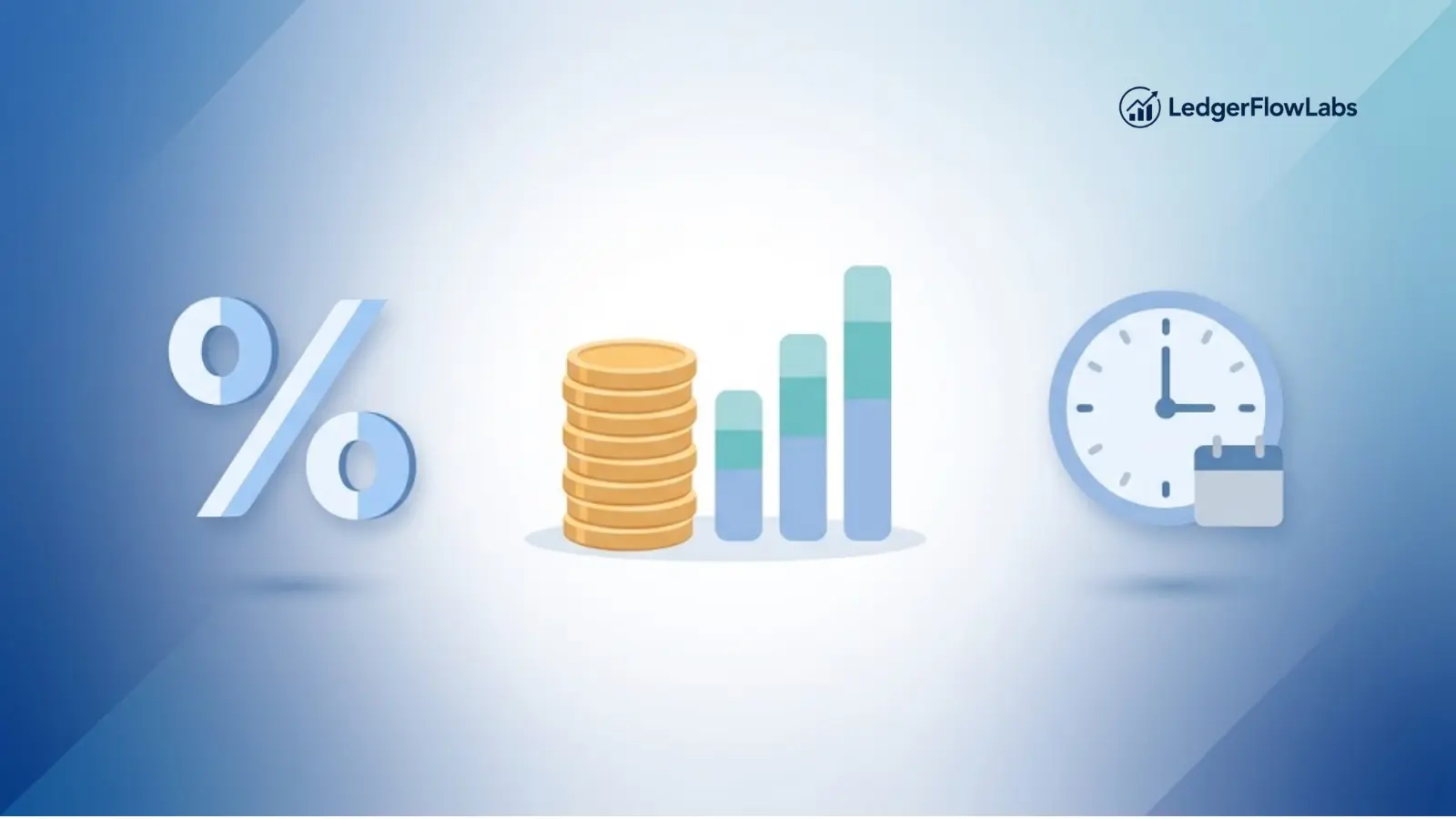
Short answer: interest is a rate, applied to a balance, over a period of time. Every complication in the subject comes from the second of those three. The rate is printed on your statement, the period is your billing cycle, and the balance is a number the lender constructs rather than one you can see on any screen. In the United States, Regulation Z requires the statement itself to show you both: § 1026.7(b)(4) requires “each periodic rate that may be used to compute the interest charge expressed as an annual percentage rate and using the term Annual Percentage Rate,” and § 1026.7(b)(5) requires “the amount of the balance to which a periodic rate was applied and an explanation of how that balance was determined, using the term Balance Subject to Interest Rate.”
Once you know those two lines exist, you can check the sum yourself.
Where this applies: the United States. Regulation Z is a US rule and other countries have their own.
This is educational information, not financial advice. Nothing here tells you what to do about your own account.
The three inputs
The rate. Expressed as an annual percentage rate, and applied per period as a periodic rate. Regulation Z § 1026.14(b) states that the annual percentage rate is computed by “multiplying each periodic rate by the number of periods in a year,” which means the relationship runs both ways: divide the APR by the number of periods and you have the periodic rate.
The balance. Not your balance today, and usually not your balance on the statement date. This is the constructed number, and § 1026.7(b)(5) requires the statement to name it and explain how it was determined.
The time. One billing cycle, which is not a calendar month and often does not start on the 1st. Why that matters for everything else is set out in statement cycle vs calendar month.
The arithmetic, with numbers that are not real
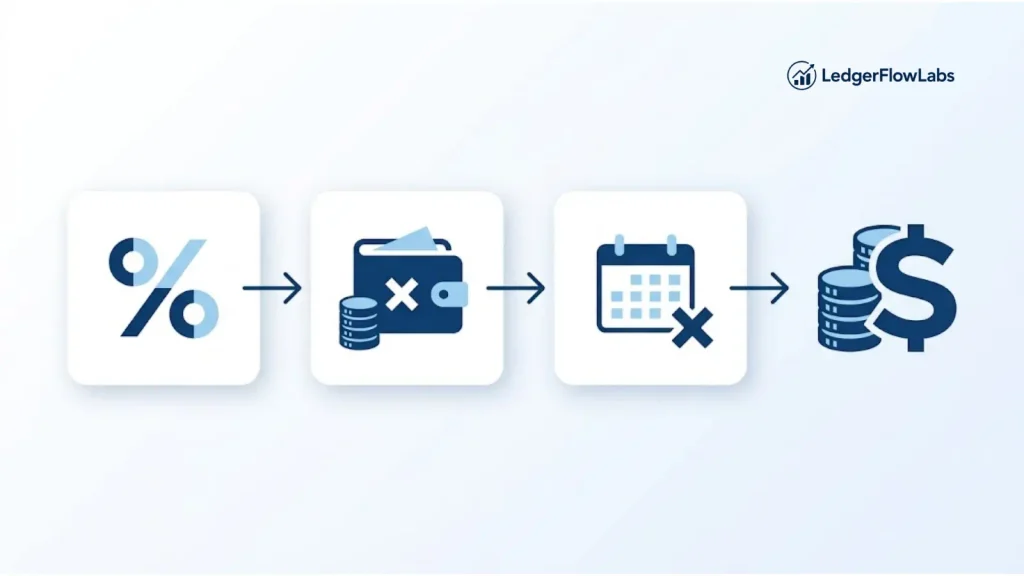
The figures below are invented for the arithmetic. They are not a rate anybody is offering and they are not a claim about typical rates. Use your own statement’s figures when you do this for yourself.
Suppose an APR of 24% and a balance subject to interest rate of $1,000, over a cycle of 30 days.
Step 1: get the daily periodic rate. 24% divided by 365 = 0.0657% per day, or 0.000657 as a decimal.
Step 2: apply it to the balance, per day. $1,000 × 0.000657 = $0.657 per day.
Step 3: multiply by the days in the cycle. $0.657 × 30 = $19.71.
That is the whole calculation. There is nothing hidden in it, and the reason so many people find their interest charge surprising is not the arithmetic. It is step 2, because the $1,000 is not the number they think it is.
Regulation Z § 1026.14(d) describes the daily periodic rate approach in the same terms, allowing a creditor to divide the total finance charge by “the average of the daily balances” and multiply by the billing cycles in a year, or by “the sum of the daily balances” and multiply by 365.
Why the balance is the whole story
Your balance is not one number over a cycle. It changes with every purchase and every payment, and interest is charged for each day at the balance on that day.
That is why paying $200 off on day 25 of a 30-day cycle helps far less than paying the same $200 on day 2. It is also why the average of the daily balances is the number most commonly used, and why it is worth understanding on its own.
The statement is required to tell you which method was used. § 1026.7(b)(5) requires “an explanation of how that balance was determined,” and for card applications and solicitations § 1026.60(b)(6) requires “the name of the balance computation method listed in paragraph (g)” or “an explanation of the method used if it is not listed.”
So “how is my balance calculated” is not a mystery to be guessed at. It is a disclosure the lender is required to make, in two separate places.
The condition that makes the answer zero
For purchases on a credit card there is a case where all of the above produces nothing at all, and it is the one people most often misunderstand.
Regulation Z § 1026.5(b)(2)(ii)(B)(3) defines a grace period as “a period within which any credit extended may be repaid without incurring a finance charge due to a periodic interest rate.” § 1026.54(a)(1)(ii) then prohibits a card issuer from imposing finance charges on “any portion of a balance subject to a grace period that was repaid prior to the expiration of the grace period.”
Read those together and the condition is repayment, not timing alone. A grace period is not “a few days after the due date.” It is a window in which repaying means no periodic-rate finance charge, and it is a feature of purchases on a card rather than of every product. Whether one applies to you, and what breaks it, is a subject of its own.
The related question of what “late” means, and why there are three separate clocks rather than one, is in grace period, late fee, credit reporting.
Where each input sits on your statement
This is what makes the whole subject checkable rather than theoretical.
| What you need | Where it is required to be | The rule |
|---|---|---|
| The rate, as an APR | On the periodic statement | § 1026.7(b)(4) |
| The balance interest was charged on | On the periodic statement, labeled Balance Subject to Interest Rate | § 1026.7(b)(5) |
| How that balance was determined | On the periodic statement, as an explanation | § 1026.7(b)(5) |
| The name of the balance computation method | In the application or solicitation disclosures | § 1026.60(b)(6) |
| The due date and the late payment cost | On the periodic statement | § 1026.7(b)(11) |
Nothing on that list is something you have to ask for. It is on documents you already have, and the section numbers are there so you can point at them if a customer service answer does not match.
Two things this page will not do
It will not tell you what to pay off first. That is a decision about your own money, and this site does not rank a reader’s debts.
It will not print a typical rate. Rates vary by product, by lender and by borrower, and a figure here would be a guess dressed up as information. Your own statement carries yours, under § 1026.7(b)(4).
What comes next
This page is the arithmetic. Four things sit underneath it and each changes one of the three inputs.
- The balance input is decided by the balance computation method, and the average daily balance version is the one most people are on.
- The rate input is a daily figure derived from the APR, and how to work yours out has its own page.
- The time input changes with compounding frequency, which is a separate question from the rate.
- And the same arithmetic runs in your favor on a savings account, where the vocabulary changes but the sum does not.
If you are here because a statement charge did not match what you expected, the first thing to check is not the arithmetic. It is whether the balance you assumed was the balance the lender used.
FAQ
How is interest actually calculated? A rate applied to a balance over a period. On a credit card the usual form is a daily periodic rate applied to a daily balance and summed across the cycle. Regulation Z § 1026.14(b) states the annual percentage rate is computed by multiplying each periodic rate by the number of periods in a year.
Why is my interest charge higher than my own calculation? Almost always because the balance used is not the balance you assumed. § 1026.7(b)(5) requires your statement to show the balance interest was applied to, labeled Balance Subject to Interest Rate, along with an explanation of how it was determined.
Where do I find my rate? On the periodic statement. § 1026.7(b)(4) requires each periodic rate that may be used to compute the interest charge to be shown as an annual percentage rate, using the term Annual Percentage Rate.
Does paying part of the balance mid-cycle help? It changes the daily balances from that day forward, which changes the sum. How much it helps depends on when in the cycle you pay, which is why the average daily balance method matters.
What is a grace period, exactly? Under § 1026.5(b)(2)(ii)(B)(3) it is a period within which credit extended may be repaid without incurring a finance charge due to a periodic interest rate. § 1026.54(a)(1)(ii) bars a card issuer from charging finance charges on a portion of a balance subject to a grace period that was repaid before the grace period expired.
Can I check my lender’s arithmetic? Yes, and the disclosure rules exist so that you can. You need the rate, the balance subject to interest rate, the method used and the days in the cycle, and all four are on documents you already have.
Sources: Regulation Z, 12 CFR Part 1026, read on consumerfinance.gov 2026-08-28. § 1026.7(b)(4) for the periodic rate disclosure as an annual percentage rate; § 1026.7(b)(5) for the balance subject to interest rate and the explanation of how it was determined; § 1026.7(b)(11) for the due date and late payment cost; § 1026.14(b) for the annual percentage rate computed by multiplying each periodic rate by the number of periods in a year; § 1026.14(d) for the daily periodic rate approaches using the average of the daily balances or the sum of the daily balances; § 1026.5(b)(2)(ii)(B)(3) for the definition of a grace period; § 1026.54(a)(1)(ii) for the prohibition on charging finance charges on a portion of a balance subject to a grace period repaid before it expired; § 1026.60(b)(6) for the balance computation method disclosure in applications and solicitations. The 24% APR, $1,000 balance and 30-day cycle in the worked example are invented for the arithmetic and are not a rate, a typical figure or a claim about any product.