
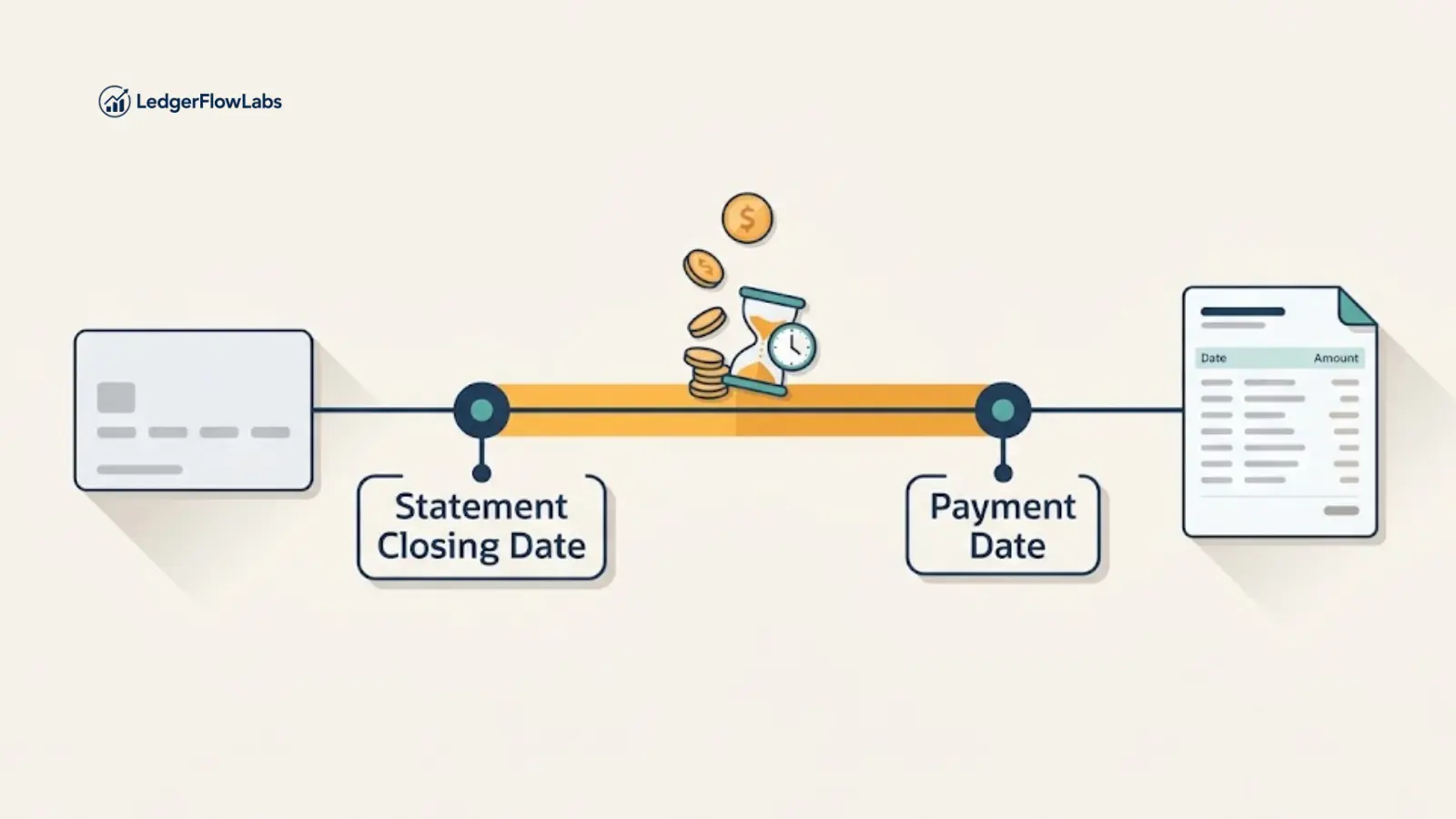
A trailing interest credit card charge is interest that built up between the day a statement closed and the day the payment arrived, on a card that had no grace period because a balance was carried from an earlier month. The statement balance could not include it, because those days had not happened yet when the statement was produced. So after that statement balance is paid in full, the next statement still shows a small interest charge. Issuers also call it residual interest. It is ordinary arithmetic, not a billing mistake.
Where this applies: consumer credit cards in the United States, where card billing is governed by the federal Truth in Lending Act and its Regulation Z. Each issuer's cardholder agreement sets the exact interest method, so that document is the final word for a specific card.
This article explains how card interest works. It is general information, not financial advice.
Why the statement balance could not include it
Start with the timeline, because trailing interest is a timing problem more than a math problem.
A statement closes on a set date. Everything up to that moment, including interest charged for the cycle, is added up into the statement balance. The payment due date comes weeks later. The Consumer Financial Protection Bureau's page on what a grace period is for a credit card, read on September 24, 2026 (last reviewed by the CFPB on September 23, 2024), says card companies "must establish procedures to assure that their bills are mailed or delivered to you at least 21 days before the payment is due."
The balance does not stand still during that gap. The CFPB's answer to whether a card company can charge interest after a balance is paid when due, read on September 24, 2026 (last reviewed October 19, 2023), puts it plainly: "When you carry a balance on your credit card, most card companies charge you interest from your billing date until the time they receive your payment."
So there are two pieces of interest. One covers the days inside the closed cycle, and it is already on the statement. The other covers the days from the closing date to the payment date. That second piece is trailing interest, and it lands on the next statement.
Card cycles rarely line up with the calendar month, which makes these dates harder to see at a glance. The reason is explained in statement cycle vs calendar month.
The condition that creates it: no grace period
Trailing interest on purchases only appears when the card has no grace period at that moment. The same CFPB grace period page defines the term as "the period between the end of a billing cycle and the date your payment is due," and notes that "credit card companies are not required to give a grace period. However, most credit cards provide a grace period on purchases."
When the grace period is in place and the full statement balance is paid by the due date, purchases do not collect interest during that window. The grace period is lost when a balance is not paid in full. In the CFPB's words, "you will be charged interest on the unpaid portion of the balance," and "you will also be charged interest on purchases in the new billing cycle starting on the date each purchase is made."
That is the trap in plain terms. A month of carrying a balance switches off the grace period. The next month, the statement balance gets paid in full, but interest has been running every day since the closing date, and the statement could not show it.
Some balances never had a grace period at all. The CFPB page adds that for a cash advance or a check from the card issuer, "generally you must start paying interest as of the date of the transaction." That is why cash advances can leave trailing interest even on a card that is otherwise paid in full every month, as covered in why cash advances have no grace period.
Trailing interest credit card math, with the arithmetic shown
Here is an illustration with invented, round assumptions. The 20% APR is chosen only because it divides cleanly. It is not a typical or quoted rate.
- Balance carried after the statement closed: $1,000.00
- APR: 20%
- No grace period, because a balance was carried the month before
- No new purchases
- Payment of the full $1,000.00 statement balance arrives 24 days after the closing date
Step 1: the daily rate. 20% divided by 365 days is about 0.0548% per day, or 0.000548 as a decimal.
Step 2: one day of interest. $1,000.00 times the daily rate is about $0.548.
Step 3: the trailing days. That daily figure times 24 days comes to about $13.15.
The $1,000.00 payment clears the statement balance exactly, but about $13.15 of interest accrued while the payment was on its way, and it arrives on the next statement. An issuer that compounds daily would land slightly higher, because each day's interest joins the balance for the next day. Many issuers apply the daily rate to an average daily balance rather than a single fixed figure, the method walked through in how the average daily balance is calculated.
Two levers move the result: the size of the balance and the number of days between closing and payment. The APR is set by the card agreement. The days are set by when the payment posts.
Where it shows up on the next statement
On the next statement, trailing interest usually appears in the interest charges section, under the balance type it came from, such as purchases or cash advances. The new balance can look strange: a card that was "paid off" now shows a small amount owed, often with a minimum payment and a due date of its own.
That small balance is an ordinary balance. It has a due date like any other, and the cardholder agreement's usual terms for late or missed payments apply to it. What counts as late, and the separate clocks that decide it, are covered in when a payment is actually late.
Trailing interest is not double-cycle billing
Surprise interest after a payoff can feel like being charged twice for the same month. Federal rules separate the two cases.
Regulation Z, section 1026.54, as published by the CFPB and read on September 24, 2026, bars card issuers from imposing finance charges, as a result of losing a grace period, based on "balances for days in billing cycles that precede the most recent billing cycle," or on "any portion of a balance subject to a grace period that was repaid prior to the expiration of the grace period." The first of those is the practice known as double-cycle billing, where interest was charged for days in an earlier, already-billed cycle.
Trailing interest is charged for different days: the days after the most recent closing date, before the payment arrived. Those days were never billed before. The official interpretation of the same section even uses the phrase "trailing or residual interest" in one of its worked examples. So a trailing interest charge is not, by itself, a sign of the banned practice. A charge that seems to cover days that were already billed is a different matter, and one the issuer can be asked to explain line by line.
How the leftover interest ends
There is no single required method, so here is what each route does, rather than which one to choose.
| Route | What happens |
|---|---|
| Paying the trailing interest balance when the next statement arrives | Clears the leftover amount. Whether any further small charge follows depends on how the issuer treats interest-only balances and when it restores the grace period |
| Asking the issuer for a payoff amount | Bank of America's Better Money Habits guide on residual interest, read on September 24, 2026, says a cardholder "may be able to call your bank and ask for a payment amount which will cover any residual interest to be billed in future statements" |
| Paying the current balance rather than the statement balance | Shrinks the number of days that interest can run, because the payment also covers activity after the closing date |
How and when a lost grace period comes back varies by issuer, and the cardholder agreement is where that rule is written. If card balances have become hard to manage more generally, the CFPB's consumer resources are free, and nonprofit credit counseling agencies such as those affiliated with the National Foundation for Credit Counseling are a starting point that comes before any commercial product.
Frequently asked questions
Is trailing interest the same as residual interest?
Yes. Issuers use both names, and some statements simply show it as part of the interest charge. Bank of America's guide describes it as "residual interest, aka trailing interest" that "builds up daily between the time your new statement is issued and the day your payment posts."
Why is interest charged after the statement balance was paid in full?
Because the statement balance was fixed on the closing date. If the card had no grace period, interest kept accruing from that date until the payment arrived, and that interest could only appear on the following statement.
Does trailing interest happen on a card paid in full every month?
Not on purchases, if the card offers a grace period and the full statement balance has been paid by each due date. Cash advances are different, since the CFPB notes interest on them generally starts on the transaction date.
Is trailing interest allowed?
Federal rules ban charging interest for days in earlier billing cycles that were already billed. Trailing interest covers days after the most recent closing date, and the CFPB says most card companies charge interest from the billing date until the payment is received when a balance is carried. The exact method for a given card is in its cardholder agreement.