
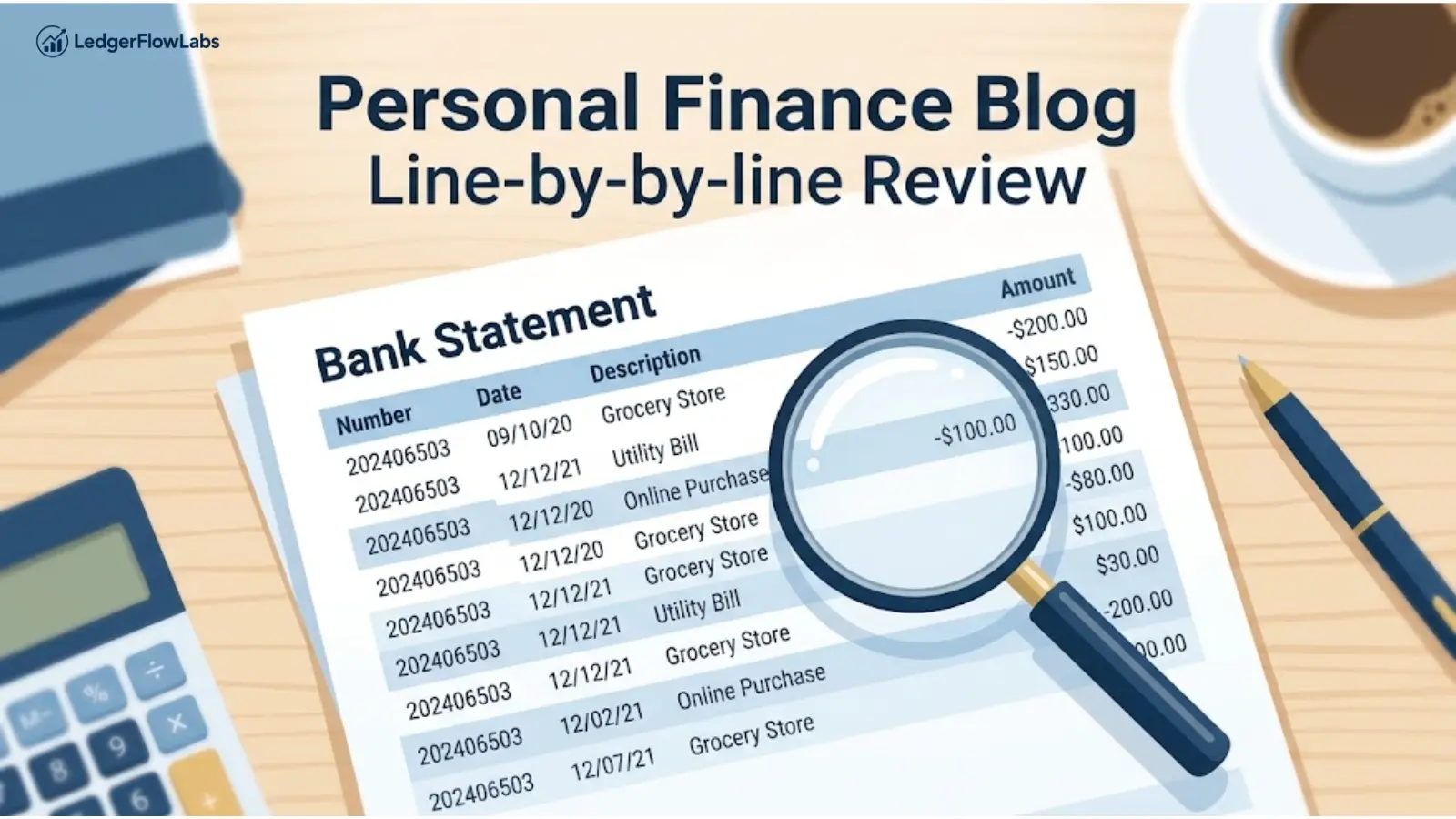
Short answer: how to read a bank statement, in order: check the summary at the top first (opening balance, closing balance, statement period), scan the deposits, then go through every withdrawal line by line asking whether the merchant, amount and date look right, find the fees section, check any interest earned, and finish by confirming opening balance plus deposits minus withdrawals equals the closing balance. If that arithmetic does not work out, or a line does not look familiar, that is the signal to look closer before assuming it will sort itself out.
This is educational information, not financial advice. It explains what the sections of a bank statement are and how to check them. It does not tell you what to do about any specific transaction.
Where this applies: the United States. A statement's exact layout differs by bank, but the sections below appear on nearly every US checking or savings account statement.
How to read a bank statement: what each section shows
A bank statement is a record of one account over one period, usually a calendar month. Every version has the same skeleton even when the layout looks different: a header identifying the account and the dates covered, an account summary with the opening and closing balance, a list of every transaction in between, and usually a fees section.
The account summary is the fastest-to-read and easiest-to-skip part of the statement. It compresses the whole period into four numbers: the balance the period started with, total money in, total money out, and the balance it ended with. Those four numbers should relate to each other in a fixed way, which is the first thing worth checking.
Step 1: Check the summary before you check anything else
Start at the top. Confirm this is the right account and the right month, then look at the opening balance. It should match last month's closing balance exactly. If it does not, something posted between the two statements that is worth tracing, because a mismatch here means the two documents are not describing a continuous period.
Then look at the two totals: money in and money out for the period. These are rough sanity checks, not proof of anything. If the deposit total looks far higher or lower than the paychecks and transfers a reader expects, or the withdrawal total looks far off from what was actually spent, that is a reason to read the transaction list more carefully rather than a reason to stop.
Step 2: Read the transaction list, line by line
This is the longest part of the statement and the one worth the most attention. Every transaction from the period appears here, usually in date order, with a date, a short description or merchant code, a debit or credit amount, and often a running balance after that line.
For each line, the question is the same: does this merchant, this amount and roughly this date look familiar? Most lines will pass instantly. The ones that make a reader pause are the ones worth a closer look, whether that means checking a receipt, checking budget notes, or checking with the bank.
Bank statements shorten transaction descriptions into codes that are not always self-explanatory. A short decoder helps:
| Code or term | What it usually means |
|---|---|
| ACH | An electronic transfer between banks, common for payroll deposits and bill payments |
| POS | A point-of-sale purchase, typically a debit card swipe or tap |
| ATM | A withdrawal or deposit at an automated teller machine |
| NSF | Non-sufficient funds, meaning a payment was declined or reversed for lack of money in the account |
| PMT | Shorthand for "payment," often attached to a loan or card payment |
| INT | Interest paid to the account, or occasionally interest charged, depending on the account type |
An unfamiliar code is not automatically a problem. It is a prompt to match the line against something recognizable, such as a subscription, a recurring bill or a purchase.
Step 3: Find the fees section
Fees do not always sit in the same place. Some banks list every fee inside the regular transaction list, mixed in with deposits and purchases. Others break fees into their own section near the bottom of the statement. Where a bank uses a separate section, read it alongside the transaction list rather than instead of it, since either can hide the full picture on its own.
Common fee lines include monthly maintenance fees, overdraft fees, out-of-network ATM fees and wire transfer fees. A fee that repeats every month is worth understanding, since some are waived under conditions such as a minimum balance or a set number of direct deposits, and those conditions are set by the account agreement rather than by the statement itself.
Step 4: Check interest earned, if the account pays it
Savings accounts, money market accounts and some checking accounts pay interest, and the statement usually shows two figures for it: interest earned this period, and interest earned year to date. It is worth confirming the period figure looks consistent with the account's balance and its stated rate.
One distinction worth knowing here is the difference between the rate advertised on an account and the rate actually reflected in what was earned, which comes down to how often interest compounds. That difference is explained in APR vs APY, which describes borrowing and which describes earning. A separate wrinkle applies to accounts that calculate interest, or in the case of credit balances, charges, using the balance from every single day of the period rather than the balance on any one day, covered in the average daily balance method.
Step 5: Reconcile the totals
This is the arithmetic check that ties the whole statement together: opening balance, plus total deposits, minus total withdrawals and fees, should equal the closing balance. Banks rarely get this wrong, since it is generated by the same system that produced every line above it, but the check still catches two things: a transaction that got missed while scanning, or a period boundary that got confused with a different month.
If the numbers genuinely will not reconcile after a careful recount, that is worth raising with the bank directly rather than assuming a typo. The same instinct, checking that the parts add up to the whole before assuming a number is simply wrong, is the habit behind what to do when a budget doesn't balance.
Match deposits against a pay schedule
For anyone paid by direct deposit, the deposit line should match the amount, and roughly the date, expected each pay period. A deposit that lands a day early or late is usually a processing timing difference rather than an error. A deposit that is smaller than expected, or missing entirely, is worth checking against a pay stub before assuming the bank made a mistake.
This matters more for anyone paid every two weeks, since two months a year bring a third paycheck and a bill calendar built around a "two paychecks a month" assumption can fall out of step. Matching each deposit to what is expected that period is one part of splitting monthly bills across two paychecks without a surprise gap.
What to do if a transaction looks wrong
Most unfamiliar lines turn out to have an ordinary explanation: a subscription renewed under a business name that does not match the product, a pending charge that posted for a slightly different amount than the receipt, or a transfer that was simply forgotten. Before contacting the bank, check the exact date, amount and any reference number against receipts or personal records.
If a transaction genuinely was not authorized by the account holder, timing matters. According to the Consumer Financial Protection Bureau, read 2026-09-18, a bank must be notified within 60 days after it sends the statement showing the unauthorized transaction in order to preserve full protection, and reporting sooner limits liability further under Regulation E's tiered structure. The CFPB explains the process in how to get your money back after an unauthorized transaction, and the liability tiers themselves are set out in Regulation E, section 1005.6. Waiting past that window does not eliminate every option, but it can shift what a bank is required to reimburse.
What a bank statement cannot tell you
A statement is a record of what already happened. It will not say whether a recurring charge is a good use of money, whether a balance is enough to cover next week's bills, or why a merchant billed the amount it did. Those are separate questions that a statement's numbers can inform but not answer by themselves.
A statement also will not flag a scam or an error on its own. It lists what posted; recognizing whether each line belongs to the account holder is still a human judgment, which is exactly why the line-by-line read matters more than a glance at the ending balance.
This site takes no affiliate or referral income from any financial product. Nothing above recommends a bank, account or product.
FAQ
How often should a bank statement be checked? Once a month, when the new statement is available, is enough for most people. Reading it the same week it arrives makes it easier to remember whether a given transaction is recognizable.
What if the opening balance does not match last month's closing balance? That mismatch means something posted between the two statement periods, or the account had activity a system glitch has not reflected yet. Contact the bank with both statements in hand rather than assuming either number is correct.
What is the difference between the balance shown on each line and the actual available money? The running balance next to a transaction reflects what has posted as of that line. Pending transactions, holds and, for interest-bearing accounts, the average daily balance calculation can all differ from that single number, which is why apps sometimes show a different "available" figure than the statement's running total.
Why do some banks list fees separately from other transactions? Some banks group all fees into one section for clarity; others list each fee inline with the transaction it relates to. Either way, the fee still reduces the closing balance, so checking that section is part of reading a bank statement completely.
How long is there to report an error or unauthorized charge? The Consumer Financial Protection Bureau states that a bank must be notified within 60 days of the statement showing the unauthorized transaction to preserve full protection under Regulation E. Reporting as soon as a problem is noticed is always the safer choice.
Sources: Consumer Financial Protection Bureau, "How do I get my money back after I discover an unauthorized transaction or money missing from my bank account?", read 2026-09-18. Consumer Financial Protection Bureau, Regulation E, 12 CFR § 1005.6, "Liability of consumer for unauthorized transfers," read 2026-09-18. No fee amount, interest rate or dollar figure specific to any bank or product appears on this page.