
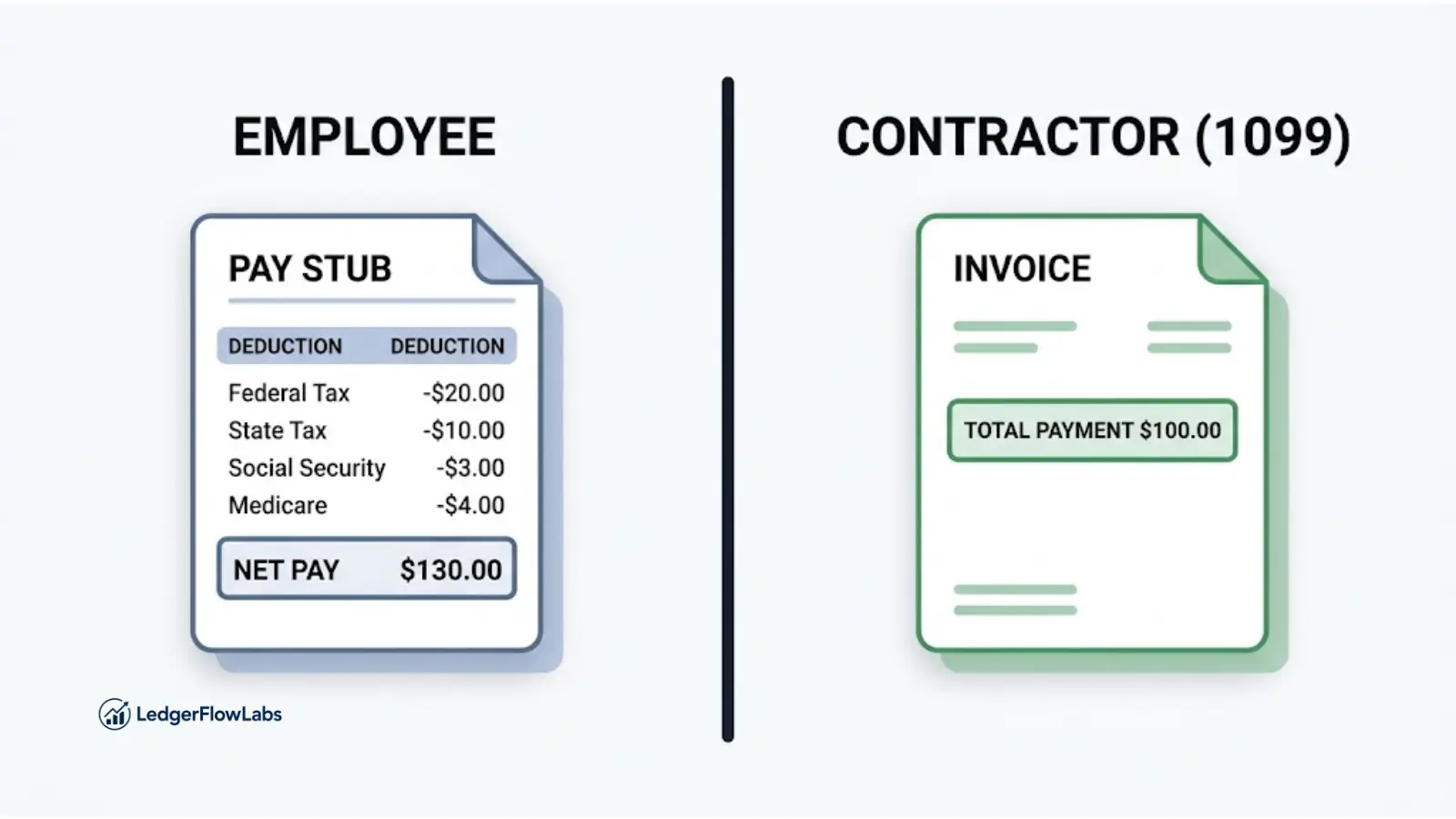
Short answer: the contractor vs employee paycheck difference comes down to one line. An employee's pay stub shows federal income tax, Social Security, Medicare, and often state tax already subtracted before the money lands in the bank. A contractor's payment shows the full agreed amount with nothing subtracted at all. That is not a bonus, and it is not a mistake by whoever is paying. The IRS does not require a business to withhold anything from a payment to an independent contractor, because a contractor is legally self-employed rather than an employee of the business paying them. The money still owes tax; it is just the contractor's own job to set it aside and send it in, not the payer's.
That single fact explains almost every other difference people notice when they move between the two kinds of pay.
What Actually Shows Up on Each Type of Paycheck
An employee pay stub is built around deductions, because the employer is required to make them. A typical stub lists gross pay, then federal income tax withheld, then Social Security and Medicare tax, commonly grouped together as FICA, then any state or local tax, then pre-tax items like a 401(k) contribution or health insurance premium, and finally net pay, the amount that actually reaches the account. If a raise or a bonus does not seem to change net pay by as much as expected, the reason usually lives in that stack of deductions rather than anywhere else, a pattern covered in more detail in why a raise sometimes does not show up in your bank account.
A contractor's payment has almost none of that structure. It is usually just the agreed amount for the work, paid by check, direct deposit, or a payment platform, with no withholding line at all. Two people can do similar work for the same company and see a completely different-looking piece of paper for it, and the difference is not the amount of work. It is which tax rules apply to the person doing it.
What Causes the Contractor vs Employee Paycheck Difference
The legal distinction sits underneath the paycheck, not on it. According to the IRS, whether someone is an employee or an independent contractor depends on the degree of control and independence in the working relationship, evaluated across three areas: behavioral control (does the business direct how the work gets done, not just what the result should be), financial control (who provides tools, who can profit or lose money on the arrangement, how expenses are handled), and the type of relationship (is there a written contract, are there employee-type benefits, is the work expected to continue indefinitely), according to the IRS's guidance on worker classification, read 2026-09-18. No single factor decides it; the IRS looks at the whole relationship.
That classification decides the paperwork on both ends. An employer withholds and deposits income tax, Social Security, and Medicare for an employee and reports the year's wages on a Form W-2. A business paying a contractor for services reports the payment on a Form 1099-NEC instead once it crosses the IRS's reporting threshold, which the IRS raised to $2,000 for payments made in 2026 (it was $600 for payments made before 2026), per the IRS's own 1099 filing guidance read 2026-09-19. Either way, the form itself carries no withholding, because none was taken.
What "You Handle Your Own Taxes" Actually Means
An employee's FICA withholding is only half the bill. The employer pays a matching share of Social Security and Medicare on top of what comes out of the paycheck, separately, without it ever touching the employee's stub. A contractor has no employer to split that cost with, so the self-employment tax covers both halves at once: 12.4% for Social Security and 2.9% for Medicare, a combined 15.3% of net self-employment earnings, according to the IRS page on self-employment tax, read 2026-09-18. That is on top of ordinary federal income tax, which a contractor also owes but which nobody withholds along the way.
Because nothing is withheld, the IRS generally expects a self-employed person to send in estimated tax payments during the year rather than settling everything in one lump sum the following spring. The exact schedule and thresholds are set by the IRS and can change, so the current rules on its own estimated tax pages are the source to check rather than a number repeated here.
Budgeting Without Automatic Withholding
The practical effect of no withholding is that the responsibility for setting money aside moves from the employer's payroll system to the contractor's own budget. A paycheck that looks larger because nothing was taken out of it is not the same as a paycheck that is larger; a portion of it is already owed, it just has not been removed yet. Treating the tax portion the same way as any large, foreseeable, irregular cost, something covered in general terms in how to plan for seasonal expenses in your own budget, is one way to avoid the funds being spent before the tax bill arrives.
Contractor income is also often irregular in timing as well as amount, since it depends on invoices and contracts rather than a fixed pay schedule. When a budget stops balancing because the money is arriving on a different rhythm than the bills, what to do when a budget does not balance walks through the adjustment step by step, and the same logic used to manage splitting monthly bills across two paychecks applies just as well to spacing bills against invoices that land on their own schedule instead of every two weeks.
Why Payday Itself Can Look Different Too
The paycheck difference is not only about what is subtracted. It can also be about when the money shows up. Employee pay frequency, and rules about how quickly a final paycheck must be issued after someone leaves a job, are set at the state level in the United States, not by one national rule. What counts as timely, and what happens if it is not, depends on the state the work is performed in, so the accurate answer to "how fast does this have to be paid" is to check your own state's labor department rather than assume a rule you read applies everywhere.
A contractor is not covered by those employee pay-frequency rules at all. Payment timing for a contractor is whatever the contract between the contractor and the business says, which is one more reason two people who feel like they are doing comparable work can experience very different rhythms in when their money actually arrives.
If You Think You Were Actually Misclassified
Sometimes the missing deductions are not because someone is a genuine independent contractor. They are because a worker who behaves like an employee, being told when, where, and how to do the job, using the company's equipment, working exclusively for one business indefinitely, has been labeled a contractor on paper. That is a classification question, not a preference, and it is decided by the same control test described above, not by what the paperwork says. A worker who believes they have been misclassified can raise the question with their state's labor department or file IRS Form SS-8 to request an official determination. This is a factual question to check, not a decision this page can make for any individual situation.
FAQ
Why does my 1099 pay not have any taxes taken out of it? Because the IRS does not require a business to withhold tax from payments to an independent contractor. Withholding is an employer obligation tied to a W-2 employment relationship; a contractor is treated as self-employed and is responsible for calculating and paying their own tax.
How much should a contractor set aside for taxes? There is no single figure that applies to everyone, since it depends on total income, filing status, and deductions. What is fixed is the self-employment tax rate itself, 15.3% of net self-employment earnings, on top of ordinary income tax. Many contractors set aside a portion of each payment specifically to cover both.
Do independent contractors pay more in taxes overall than employees? Not necessarily more in total, but they pay the full 15.3% self-employment tax themselves, where an employee and employer each cover half of the equivalent Social Security and Medicare tax. A contractor can also deduct business expenses an employee cannot, which affects the net comparison.
Why did my pay schedule change when I moved from employee to contractor status? Employee pay frequency is often set by state law. A contractor's payment timing is set by the contract instead, so it is common for the rhythm of payments to change even if the total amount of work is similar.
What should I do if I think I have been misclassified as a contractor? Compare the actual working relationship against the IRS's behavioral control, financial control, and relationship-type factors, or ask your state's labor department to look at it. IRS Form SS-8 exists specifically to request an official worker-classification determination.
Sources: IRS, "Independent Contractor (Self-Employed) or Employee?", read 2026-09-18. IRS, "Self-Employment Tax (Social Security and Medicare Taxes)", read 2026-09-18. IRS 1099 filing guidance on the Form 1099-NEC reporting threshold ($2,000 for 2026 payments, $600 before 2026), read 2026-09-19. Pay-frequency and final-paycheck timing rules are set by each US state; check your own state's labor department for the current rule where you work. No dollar figure or withholding percentage other than the IRS figures cited above appears in this article.