
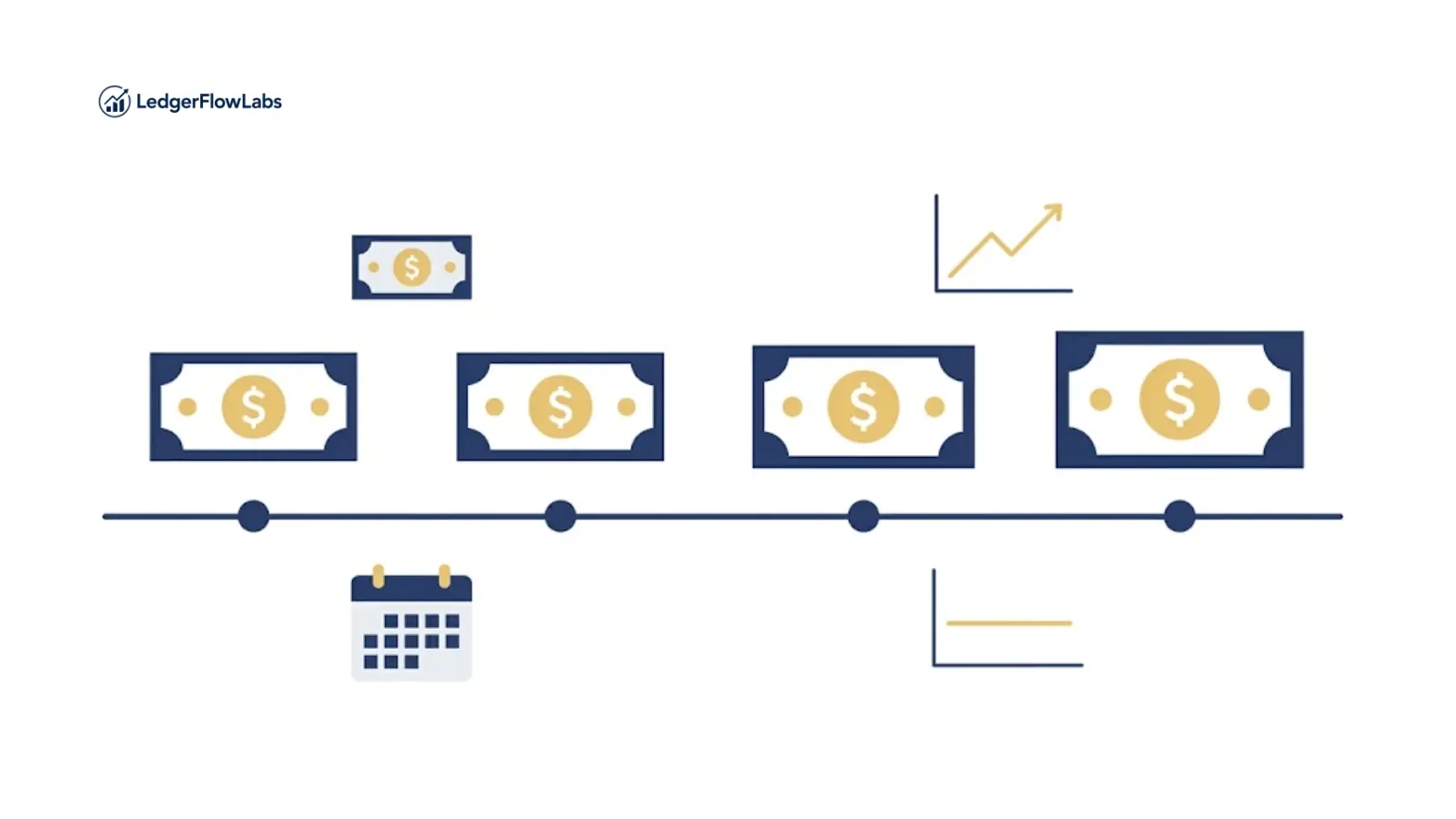
Pay frequency, how often an employer issues a paycheck, does not change the total amount earned in a year. It does change how large each paycheck looks, how tax withholding is calculated period by period, and how a budget has to line up with paydays. How pay frequency affects a paycheck comes down to three things: the number of checks issued (weekly, biweekly, semimonthly, or monthly), the math used to split the same annual pay across those checks, and the pattern of "big" and "light" months that follows from the schedule. The rest of this guide walks through each piece with plain arithmetic, not guesswork.
The Four Common Pay Frequencies
Employers in the United States generally settle on one of four schedules:
- Weekly: a paycheck every week, 52 per year. Common for hourly and construction-adjacent work because it keeps cash flow tight between wages earned and wages received.
- Biweekly: a paycheck every two weeks, 26 per year. Because 26 does not divide evenly into 12 months, two months a year land three paychecks instead of two.
- Semimonthly: two fixed paydays a month, such as the 15th and the last business day, for 24 checks a year. The dates are fixed, but the number of days between them is not: it can run anywhere from 13 to 16 days depending on the month.
- Monthly: one paycheck a month, 12 per year. It is the least common option for non-exempt hourly staff, partly because several states restrict how infrequently a worker can be paid.
The schedule an employer uses is usually fixed company-wide rather than chosen per employee, and switching frequency generally requires the employer to change payroll setup, not something an individual worker requests case by case.
How Pay Frequency Affects Paycheck Size
This is the part that surprises people the first time they compare paychecks with a coworker. Take a round, illustrative salary of $52,000 a year, used here only to show the arithmetic, not as a real offer. Divide it by the number of pay periods in each schedule:
- Weekly: $52,000 ÷ 52 = $1,000 per check
- Biweekly: $52,000 ÷ 26 = $2,000 per check
- Semimonthly: $52,000 ÷ 24 ≈ $2,166.67 per check
- Monthly: $52,000 ÷ 12 ≈ $4,333.33 per check
Notice that biweekly and semimonthly are easy to confuse but are not the same schedule. Biweekly always produces 26 checks and, in most years, two months where three checks land instead of two. Semimonthly always produces 24 checks on fixed calendar dates and never has a three-check month, because the dates are anchored to the calendar rather than to a two-week cycle. A worker moving from a biweekly job to a semimonthly one at the identical salary will see a larger number on each check, even though the yearly total has not moved at all.
How Withholding Changes With Pay Frequency
Pay frequency also changes how federal income tax withholding is calculated on each check, though not how much tax is owed for the year. Payroll systems follow the methods in IRS Publication 15-T (read 2026-09-18), which converts the wages on a given paycheck into an annualized figure based on the number of pay periods in the year, calculates the tax on that annualized amount, and then divides the result back down to a per-paycheck withholding amount. Because the annualizing multiplier is different for weekly (52), biweekly (26), semimonthly (24), and monthly (12) pay, the same gross wages can produce a slightly different withholding percentage depending on which schedule generated the check. This does not change what is owed on the annual tax return; it only changes how the withholding is spread across the year. Anyone who wants the current dollar brackets should read the current Publication 15-T rather than rely on a figure quoted from an older year, since the IRS updates the tables annually.
Pay Frequency Is a State Rule, Not a Free Choice
There is no single federal law that sets how often a paycheck has to arrive. The Fair Labor Standards Act governs minimum wage and overtime, but pay frequency itself is set state by state, and the requirements genuinely differ: some states require weekly pay for manual workers, most require at least semimonthly or biweekly pay, and a handful, including Alabama, Florida, and South Carolina, have no statewide frequency rule at all. According to the U.S. Department of Labor's State Payday Requirements page (read 2026-09-18), an employer can generally pay more often than the state minimum requires but cannot pay less often, and the page notes the table should be checked against the relevant state labor office for current, official detail.
The same state-level variation applies to final paychecks after a job ends. Some states require the final check on the last day worked, others allow it to wait until the next regular payday, and the rule can even depend on whether the employee quit or was let go. Because these deadlines are set state by state and do change, this article does not state a single deadline as universal: check the labor department for the specific state in question before assuming a timeline.
Budgeting Around Three-Paycheck Months and Fixed Dates
The practical effect of pay frequency shows up at budgeting time, not at tax time. A biweekly schedule means most months carry two paychecks, but two months a year carry three, and that extra check is easy to treat as normal spending money rather than what it actually is: the same annual pay, arriving in a different pattern. Recognizing which months are "three-check" months ahead of time turns that check into a planning tool instead of a surprise, which is the same logic covered in how to plan for seasonal expenses in a budget.
Semimonthly pay creates a different challenge. Because the dates are fixed but the days between them are not, a rent or mortgage due date that sits close to a payday in a 28-day month can land just before payday in a 31-day month. Lining up recurring bills against two fixed paydays, rather than against a single monthly due date, is the approach covered in splitting monthly bills between two paychecks, and it applies to biweekly and semimonthly schedules alike.
Comparing Job Offers Across Different Pay Schedules
Pay frequency also matters when comparing two job offers, or comparing a new employer's schedule with a previous one. A biweekly offer that lists a per-check amount and a semimonthly offer that lists a different per-check amount can look uneven at first glance, even when the underlying annual salary is the same or close to it. Multiplying a weekly rate by 52, a biweekly rate by 26, a semimonthly rate by 24, or a monthly rate by 12 turns any of the four into a comparable annual figure, which is the number that actually reflects total pay. The per-check number on its own says more about the schedule than about the offer.
When a Raise or a Switch Doesn't Feel Like More Money
Two situations confuse people who otherwise understand their pay frequency. The first is a raise that doesn't seem to move the number on the check, which usually has more to do with withholding, benefit deductions, or a mid-year bracket effect than with the raise itself; that mechanism is broken down in why a raise sometimes does not show up in a bank account. The second is starting a new job on a different pay frequency, which can make a budget appear broken for a month or two even though nothing is actually wrong; working through that mismatch is covered in what to do when a budget does not balance. In both cases, the paycheck total for the year is not the problem. The pattern it arrives in is.
Frequently Asked Questions
Does pay frequency change how much is earned in a year? No. Pay frequency changes how the same annual pay is split into checks and how often those checks arrive. It does not change gross annual pay or the tax owed for the year.
Why is a biweekly paycheck smaller than a semimonthly one at the same salary? Biweekly pay divides annual salary by 26 pay periods; semimonthly divides it by 24. Fewer, larger divisions mean a bigger number on each semimonthly check, even though the yearly total is identical.
Can an employer choose any pay frequency it wants? Not entirely. The state sets a minimum frequency, and an employer can pay more often than that minimum but generally cannot pay less often. The specific rule depends on the state and sometimes the type of work, per the Department of Labor's state payday table.
Does switching pay frequency change how much tax is withheld overall? It can change how withholding is spread across the year's paychecks, because payroll systems annualize each check differently depending on the pay period count, but it does not change the total tax owed for the year once the return is filed.
When is a final paycheck due after leaving a job? That depends on the state and, in many states, on whether the employee resigned or was terminated. There is no single national deadline, so the accurate answer is to check that state's labor department rather than assume a timeline from a different state.