
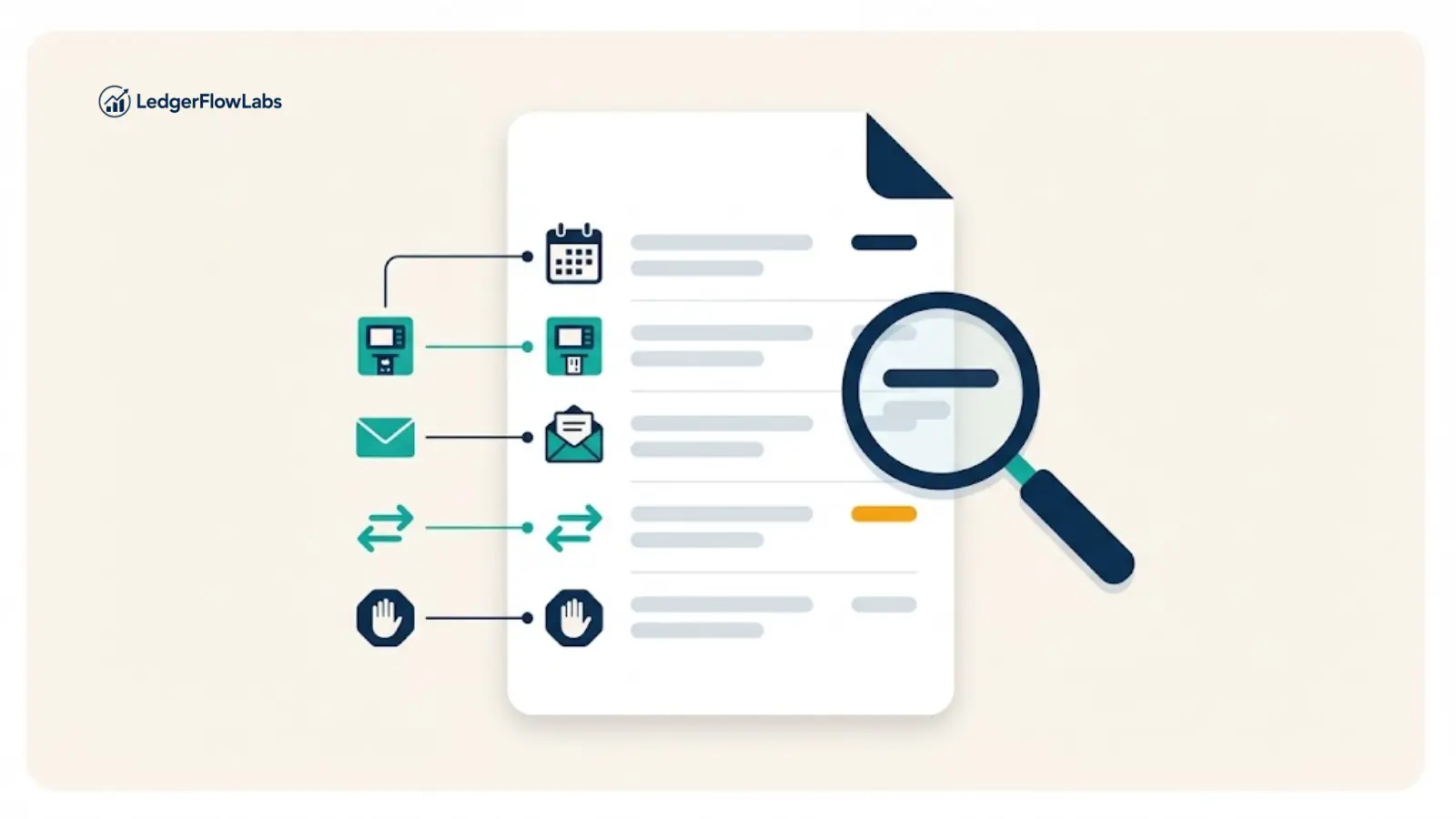
Every bank account fee is set off by a specific event: a statement cycle closing without the waiver conditions met, a payment the account could not cover, an ATM outside the bank's network, a mailed statement, a wire, a stop-payment request. Understanding bank account fees comes down to two matches. First, match each fee on the statement to the event that triggered it. Then find that fee in the account's fee schedule, where US federal rules require the bank to state both the amount and the conditions under which it applies.
Where this applies: checking and savings accounts at US banks. The federal disclosure rules quoted here come from Regulation DD (the Truth in Savings Act rule) and Regulation E (the electronic transfer rule). The fees themselves are set by each bank, account by account, and some related rules are set by each state. That is why this article gives no dollar amounts: the only figure that applies is the one in your own bank's current fee schedule.
This article explains how bank fees work. It is general information, not financial advice.
Where a bank's fees are actually written down
Before looking at any single fee, it helps to know which document holds the answer, because the statement only shows that a fee happened. The rules behind it live in the account disclosures, often called the fee schedule or schedule of charges.
The CFPB's published text of Regulation DD, section 1030.4, read on September 24, 2026, says these disclosures must include "the amount of any fee that may be imposed in connection with the account (or an explanation of how the fee will be determined) and the conditions under which the fee may be imposed." The same section requires the bank to disclose "any minimum balance required to" avoid a fee, and to explain how that balance is determined.
Two details in that section matter in practice. The bank has to provide the disclosures before the account is opened, and it has to provide them "upon request." So the current fee schedule for an existing account is something the bank must hand over when asked. The phrase "the conditions under which the fee may be imposed" is the trigger this article is about. Every fee below has one, and the fee schedule is where it is written.
Understanding bank account fees on the statement itself
The statement is the second document, and it records every fee that actually posted. Under Regulation E, section 1005.9, as published by the CFPB and read on September 24, 2026, a periodic statement for an account with electronic transfers must show "the amount of any fees assessed against the account during the statement period for electronic fund transfers, the right to make transfers, or account maintenance."
Two fees get special treatment. The CFPB's text of Regulation DD, section 1030.11, read on September 24, 2026, requires each periodic statement to show "the total dollar amount for all fees or charges imposed on the account for paying checks or other items when there are insufficient or unavailable funds and the account becomes overdrawn, using the term 'Total Overdraft Fees,'" plus the total for "returning items unpaid." Both totals appear for the statement period and for the calendar year to date.
That year-to-date line is easy to miss and useful. It answers "how much has this account paid in overdraft and returned-item fees this year?" without adding up twelve statements. The descriptions on individual fee lines, by contrast, are the bank's own wording and vary widely from bank to bank.
Fees triggered by time passing
These fees need no action at all. The trigger is the calendar, combined with a condition the account did or did not meet.
Monthly maintenance or service fee
Trigger: the statement cycle ends and the account did not meet the waiver conditions in its fee schedule. Waiver conditions differ by account; typical examples are keeping a minimum balance or receiving a direct deposit of a set size. The fee tends to post around the end of the cycle, which is why it can appear even in a month with no unusual activity.
Minimum balance fee
Trigger: the account's balance falls below a required level. Some banks fold this into the maintenance fee; others list it on its own. What matters is how "balance" is measured. A daily minimum is broken by one low day. An average balance is broken only if the whole cycle averages below the line, using the same arithmetic explained in how an average daily balance is calculated. Regulation DD requires the disclosures to explain how the balance is determined.
Paper statement fee
Trigger: receiving mailed statements on an account that charges for them. The fee schedule states whether the account charges for paper statements at all, and the delivery setting decides whether the trigger is met.
Inactivity or dormant account fee
Trigger: no customer-initiated activity for the period the fee schedule defines. Separately, state unclaimed property laws can eventually move the balance of a long-untouched account into the state's custody. The waiting period is set by each state, not federally, so the state's unclaimed property office is the place to check the rule that applies.
Fees triggered by money leaving without enough to cover it
This group is where most fee surprises start, because the trigger is a transaction meeting a balance that was lower than expected.
Overdraft fee
Trigger: the bank pays a transaction even though the account does not have enough to cover it, and the balance goes negative. Which balance the bank measures against, and the order it processes items in, are set out in the account agreement. The gap between the two balances a bank can use is explained in available balance vs actual balance, and scheduled payments that land on a thin day are a common route into this fee, as covered in autopay overdraft risk.
Nonsufficient funds (NSF) or returned item fee
Trigger: the bank declines to pay a check or electronic payment and returns it unpaid. The payment does not go through, but the fee can still post. The company that was meant to receive the payment may charge its own returned-payment fee as well, and that charge arrives on its bill, not on the bank statement.
Overdraft transfer fee
Trigger: the bank moves money from a linked savings account or credit line to cover a shortfall. This applies only where the account has that service set up, and the fee schedule states whether each transfer carries a charge.
Stop payment fee
Trigger: asking the bank to stop a check or a payment before it is paid. The request itself is the event that sets off the charge.
Wire transfer and official check fees
Trigger: sending a wire (domestic and international wires are often priced separately), and at some banks receiving one. Buying a cashier's check or other official check is often a separately listed fee too.
Fees triggered by where and how the card is used
Out-of-network ATM fees: two charges, two disclosures
An ATM outside your bank's network can produce two separate fees. The first belongs to the machine's owner. Under Regulation E, section 1005.16, as published by the CFPB and read on September 24, 2026, an ATM operator that charges a fee must disclose the fee and its amount "either by showing it on the screen of the automated teller machine or by providing it on paper, before the consumer is committed to paying a fee." That rule defines the operator as a party that "does not hold the account," so it does not cover your own bank.
The second fee, if there is one, is your own bank's charge for using an outside machine. It never appears on the ATM screen. It is disclosed in your account's fee schedule and usually shows as its own line on the statement.
Foreign transaction fee
Trigger: a debit card purchase or withdrawal processed in a foreign currency or through a foreign bank. It can apply to an online purchase from a merchant based abroad, even when the cardholder never left home.
Card replacement or rush delivery fee
Trigger: requesting a replacement card, or faster shipping than standard. Many fee schedules list these separately.
Fees triggered by a deposit or a request
Returned deposited item fee
Trigger: a check someone else wrote, which was deposited into the account, bounces. The bank reverses the deposit and may add a fee, even though the account holder did nothing wrong. This is different from the NSF fee above, which applies to items drawn on your own account.
Service request fees
Trigger: asking the bank to do something outside routine account use. Examples that appear on many fee schedules include copies of old statements, account research, check printing, and closing an account soon after opening it.
Tracing an unfamiliar fee back to its trigger
When a fee line shows up and the reason is not obvious, the same four steps work for almost every item above:
- Read the date and description on the statement. The description is the bank's wording, and the date tells you where to look.
- Look at the days just before it. A balance dip, an ATM visit, a returned payment or the end of the statement cycle usually sits right there.
- Find the fee by name in the current fee schedule. Read its conditions, since the conditions are the trigger.
- Compare the two. If the condition was met, the fee is explained. If it was not, or if no listed fee matches, that is a question for the bank, and the account agreement explains how to raise it.
Doing this once for each fee on a statement also shows which triggers repeat. A fee that appears every cycle is usually a waiver condition that is not being met; a fee that appears once is usually a single event.
Frequently asked questions
Why does a monthly fee appear when nothing changed on the account?
A maintenance fee is triggered by the statement cycle itself, combined with a waiver condition the account did not meet that cycle. If the waiver depends on a minimum balance or a qualifying deposit, one low balance or one missed deposit can be enough, even in an otherwise quiet month.
Can a bank charge a fee that is not in its fee schedule?
Regulation DD requires a bank's account disclosures to list the amount of any fee that may be imposed and the conditions under which it may be imposed. A charge that does not match anything in the current fee schedule is worth raising with the bank directly.
Where is the total of overdraft fees for the year shown?
On the periodic statement. Regulation DD requires a "Total Overdraft Fees" figure, and a total for returned-item fees, for both the statement period and the calendar year to date.
Is an ATM owner's fee the same as a bank's out-of-network fee?
No. The ATM owner's fee must be disclosed on the machine's screen or on paper before the transaction is completed. The account holder's own bank may add a separate out-of-network fee, which appears in its fee schedule and on the statement instead.
Are bank fees the same in every state?
No. Each bank sets its own fees, account by account. The federal disclosure rules in Regulations DD and E apply across the US, while some related matters, such as when a dormant account becomes unclaimed property, are set by each state.