
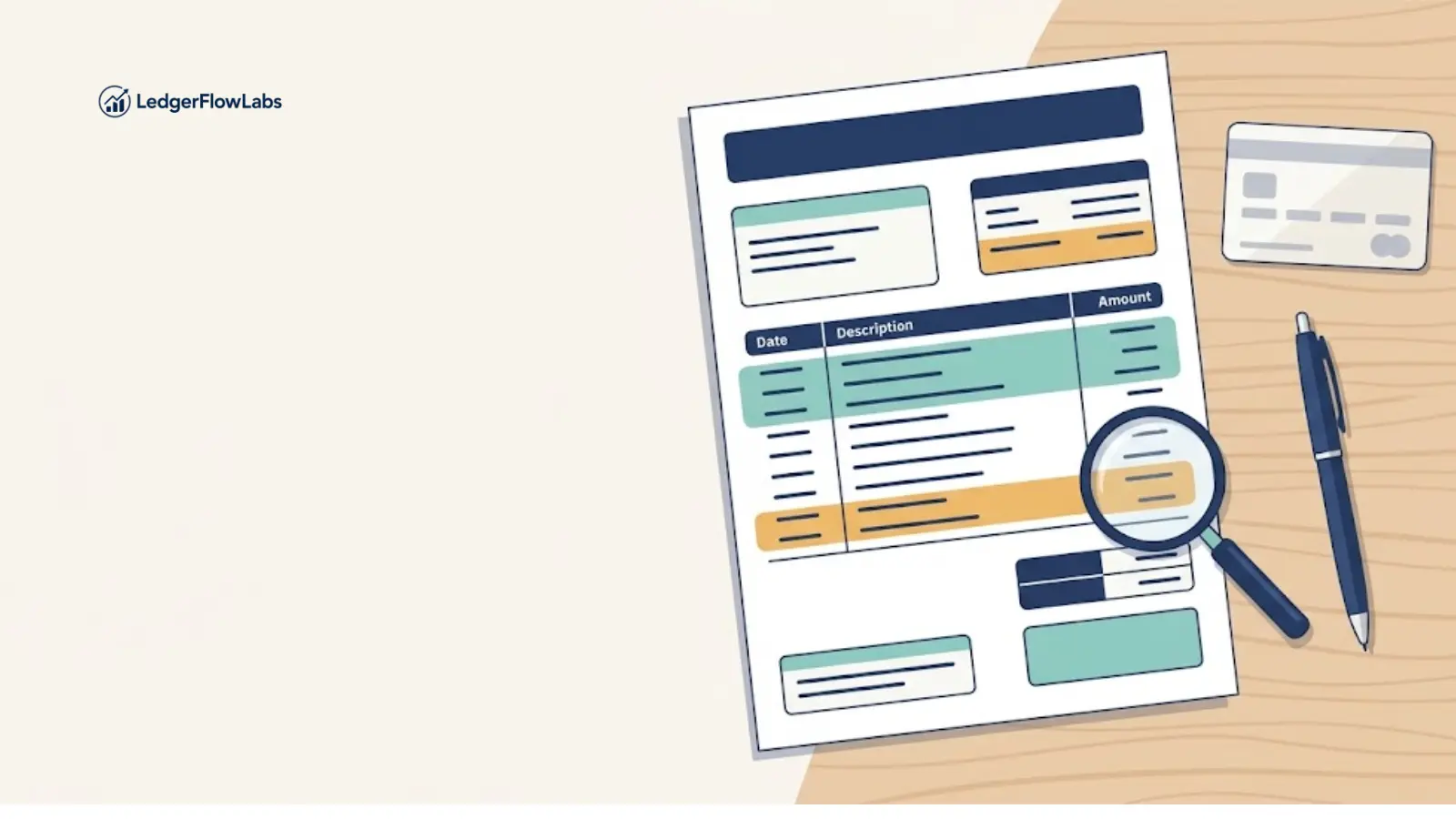
Short answer: learning how to read a credit card statement means checking five blocks in order: the account summary (previous balance, payments, new balance), the transaction list, the interest charged section, the fees section, and the payment information box with the minimum payment and due date. Each block answers one question. Read them in that order and the whole page takes about five minutes, and it is the fastest way to catch an error or an unauthorized charge before it costs you anything.
Where this applies: the United States. Card statement content is set by federal Regulation Z, so a statement issued by a US card company follows the same required layout regardless of which bank issued the card.
This is educational information, not financial advice. This site does not tell you what to pay or which balance to carry.
The account summary box on a credit card statement
Near the top of every statement is a summary box with a small set of numbers that anchor everything below it: the previous balance (what you owed when the last cycle closed), payments and credits since then, new charges, any fees or interest added this cycle, and the new balance, which is the total the current cycle ends with. The box also repeats your credit limit and the credit still available against it.
Those numbers should add up on their own: previous balance, minus payments and credits, plus new charges, plus fees, plus interest, equals the new balance. If it does not, something on the statement needs a closer look before you assume the total is right.
Statement balance, current balance, and minimum payment are three different numbers
These get confused constantly, and the confusion is expensive.
| Number | What it means | When it was fixed |
|---|---|---|
| Statement balance | What you owed on the closing date this statement covers | Frozen on the closing date |
| Current balance | What your account shows right now, online or in the app | Changes as new activity posts |
| Minimum payment | The smallest amount the issuer accepts without treating the account as late | Recalculated each cycle from the new statement balance |
Statement balance is what you owed on the closing date the statement covers. It is frozen. Anything you charge after that date shows up on the next statement, not this one.
Current balance is whatever your account shows right now, in the app or online, and it includes activity that happened after the statement closed.
Minimum payment is the smallest amount the issuer will accept without treating the account as late. It is not related to what you owe in any simple way, because it is typically set as a small percentage of the balance, or a flat floor, whichever is larger, and how little of that payment reaches principal instead of interest is its own piece of arithmetic worth walking through separately in the minimum payment trap.
Paying the statement balance in full, by the due date, is the one action tied to keeping a grace period on new purchases.
The transaction list: two dates, not one
Each line in the transaction list usually carries two dates: the date you made the purchase, and the date it posted to the account. They can be days apart, especially over a weekend or when a merchant batches transactions. A purchase made the day after the closing date will not appear on this statement at all; it waits for the next cycle, which is why a charge you remember making does not always show up where you expect it.
Reading down this list is also the fastest fraud check you have: a charge you do not recognize, a duplicate charge, or a refund that never appeared are all things this list will show before anything else on the account does. If someone else is authorized on the card, their transactions typically appear in this same list, sometimes under a separate name heading. Reviewing that section line by line each month is worth the two or three minutes it takes.
Interest charged: grouped by what kind of balance it came from
Regulation Z requires the interest section to group finance charges under a heading called Interest Charged, itemized and totaled by the type of transaction, such as purchases, cash advances, or balance transfers, with a subtotal for the statement period and a running Total Interest for the calendar year to date. That requirement is set out at 12 CFR 1026.7(b)(6) on the Consumer Financial Protection Bureau's regulations page, read September 18, 2026.
That year-to-date figure is the one most people never look at, and it is worth finding. It answers a question the monthly number cannot: how much has this account actually cost in interest since January, in one line.
Purchases and cash advances are not charged the same way. Cash advances almost never carry the grace period that purchases get, so interest on a cash advance can start accruing from the day of the transaction rather than after a billing cycle, a distinction worked through in full in why cash advances carry no grace period. The exact dollar figure in the interest section also depends on how the issuer calculates the balance interest applies to across the cycle, which is set out in the average daily balance method.
The APR box, and which rate applied to which balance
Below the interest section is a box listing each annual percentage rate that can apply to the account, one row per rate: a rate for purchases, often a separate and higher rate for cash advances, and sometimes an introductory or penalty rate. The APR is the yearly cost of borrowing expressed as a rate, and it is not the same figure a savings account quotes when it advertises a yield, a distinction that matters more than it looks and is covered in APR vs APY.
Next to each APR, statements typically show the balance that rate was actually applied to for the cycle. That balance figure, not the APR alone, is what the interest charge in the section above was calculated from.
The due date, the grace period, and when interest actually starts
The payment information box states the amount due and the due date. Sitting behind that date is the grace period, which the Consumer Financial Protection Bureau's guide, "What is a grace period for a credit card?" (read September 18, 2026), defines as the window during which credit extended can be repaid without a finance charge from a periodic interest rate. Card issuers are not required to offer one, though most do on purchases, and paying the full statement balance by the due date each month is what keeps it in place. Miss it once and new purchases in the following cycle can start accruing interest from the date of purchase instead.
The fees section, itemized the same way as interest
Fees are grouped separately from interest, under their own heading, identified by type (late fee, annual fee, foreign transaction fee, and so on), itemized, and totaled for the statement period and for the calendar year to date, under the same Regulation Z requirement that governs the interest section (12 CFR 1026.7(b)(6)). Checking this box against what you actually did that month, a late payment, a purchase abroad, is the way to catch a fee you were not expecting before it happens again next cycle.
The rewards or cash-back summary, if the card has one
Many statements carry a separate small box for points, miles, or cash back: what was earned this cycle, what was redeemed, and a running balance. This box is not part of the required Regulation Z disclosures covered above; it is the issuer's own program summary, and its layout varies far more from card to card than anything else on the page.
Two things are worth checking here regardless of the program: whether a redemption you made actually posted, and whether a return or refund pulled back rewards you had already earned on that purchase. Both are common enough to be worth the ten seconds it takes to look.
How to read a credit card statement in five minutes
Working through a statement in this order covers every required disclosure without doubling back:
- Check the account summary box: does previous balance plus new charges minus payments equal the new balance?
- Scan the transaction list line by line for anything you do not recognize.
- Read the interest charged section and note the calendar year-to-date total.
- Check the fees section against what you know happened this cycle.
- Confirm the due date and the minimum payment, and decide separately from this checklist what you intend to pay.
What this page will not do
It will not tell you how much of your balance to pay. That decision depends on your own income, your other obligations, and your own account terms, and it belongs to you.
It will not estimate a typical interest rate or fee for any card, because both vary by issuer and by account and yours are printed on your own statement.
LedgerFlow Labs takes no affiliate or referral income from any card issuer or financial product, on this page or elsewhere on this site.
FAQ
What is the first thing I should check on a credit card statement? Start with the account summary box and confirm the arithmetic: previous balance, minus payments and credits, plus new charges, plus fees, plus interest, should equal the new balance printed as the new balance.
Why is my current balance different from my statement balance? The statement balance was frozen on the closing date. The current balance includes anything charged or paid since then, so the two numbers are answering different questions about different moments.
Where does interest actually show up on the statement? Under a heading called Interest Charged, grouped and itemized by the type of transaction (purchases, cash advances, balance transfers), with a total for the statement period and a running total for the calendar year to date, as required by Regulation Z, 12 CFR 1026.7(b)(6).
Does the grace period apply to everything on the card? No. It typically applies to purchases, not to cash advances, which generally start accruing interest from the date of the transaction rather than after a grace period.
How can I tell if a charge on my statement is a mistake? Read the transaction list line by line against your own memory of the cycle. A charge you do not recognize, a duplicate line, or a refund that never posted are the three most common errors, and catching them early is easier while the statement is still current.
Sources: Consumer Financial Protection Bureau, Regulation Z, 12 CFR 1026.7(b)(6), read on consumerfinance.gov, September 18, 2026, for the requirement that interest and fees be grouped, itemized by type, and totaled for the statement period and the calendar year to date. Consumer Financial Protection Bureau, "What is a grace period for a credit card?", read September 18, 2026, for the definition of a grace period and the note that issuers are not required to offer one. No interest rate, fee amount, or dollar figure in this article is a claim about any specific card or product.