
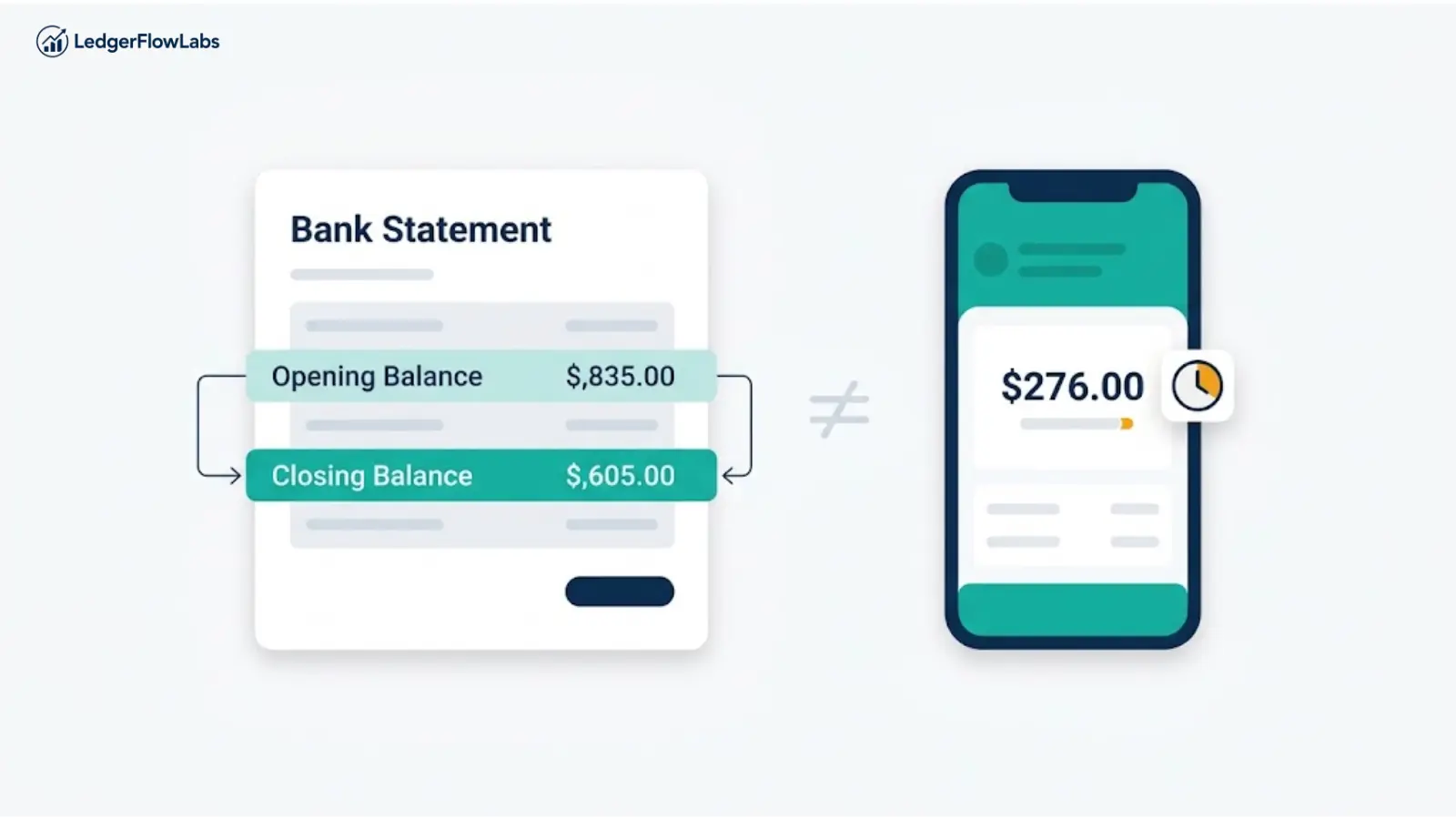
On a bank statement, the opening balance is what the account held on the first day of the statement period, and the closing balance is what it held on the last day, after every transaction that posted between those two dates. That is the short opening vs closing balance statement answer. Your banking app almost never shows either one, because the app reports the balance right now: it includes everything that posted after the statement closed and, in the available balance, pending card purchases and holds as well.
Where this applies: checking and savings accounts at US banks and credit unions. The federal rule quoted below is Regulation E, which covers accounts that can send or receive electronic transfers. Labels and cutoff times vary by bank, so your own statement's wording is the final word on what each line means.
This article explains how statements work. It is general information, not financial advice.
The opening balance: where the statement starts counting
The opening balance goes by several names. Depending on the bank, you may see beginning balance, previous balance or balance forward. All of them mean the same thing: the balance at the start of the period this statement covers.
It is not a fresh number the bank works out each month. It is carried over. The opening balance on this statement should be the same figure as the closing balance on the previous statement for the same account, because both describe the same moment: the instant one period ended and the next one began.
That makes it the first thing worth checking when a new statement arrives. Put last month's statement beside this one. If the old closing balance and the new opening balance match, the chain is unbroken. If they differ, nothing further down the new statement will add up properly, and the gap is a question for the bank rather than something to reason out alone.
The closing balance: a number frozen on the closing date
The closing balance, often labeled ending balance, is the balance at the end of the statement period, after every deposit, withdrawal, fee and interest credit that posted inside the period. Once the period ends, it never changes. A purchase that posts one day later belongs to the next statement, however close it came.
For an account that handles electronic transfers, federal rules require both numbers. The Consumer Financial Protection Bureau's published text of Regulation E, section 1005.9, read on September 24, 2026, says a periodic statement must show "the balance in the account at the beginning and at the close of the statement period." The same section says a bank must send a statement for each monthly cycle in which an electronic transfer occurred, and at least quarterly if none did.
Notice what the rule does not say: that the period has to match the calendar month. The official interpretation shown on the same page allows cycles that are "reasonably equal," meaning they "do not vary by more than four days from the regular cycle." So a statement running from the 18th of one month to the 17th of the next is perfectly normal, and it is one reason the closing balance rarely lines up with what you remember having on the 30th or 31st.
Opening vs closing balance statement math, line by line
The two balances are tied together by one line of arithmetic:
Opening balance, plus money in, minus money out, equals closing balance.
"Money in" is every credit that posted during the period: deposits, transfers in, refunds and interest. "Money out" is every debit that posted: card purchases, checks, bill payments, ATM withdrawals, transfers out and fees. Many statements print these totals in a summary box near the top, so the check can be run without adding up every row.
Here is an illustration with invented round numbers for a checking account whose period runs from March 18 to April 17:
| Line on the statement | Amount |
|---|---|
| Opening balance, March 18 | $1,240.00 |
| Deposits and other credits (two paychecks, one refund) | $2,135.00 |
| Withdrawals and other debits (rent, groceries, bills) | $1,910.40 |
| Fees | $0.00 |
| Closing balance, April 17 | $1,464.60 |
The check: 1,240.00 plus 2,135.00 is 3,375.00. Minus 1,910.40 leaves 1,464.60. It ties.
When a real statement does not tie, three things are worth looking for before assuming an error: a fee or interest line printed in a separate section, a credit counted as a debit (or the reverse) while adding, and a transaction you remember that actually posted outside the dates printed at the top of the statement.
Why your app shows a third number, or a fourth
Open the banking app on April 20 in the example above and you will not see $1,464.60. You will see one or two other numbers, and each has a reason.
Activity that posted after the closing date
Anything that posted on April 18, 19 or 20 is already in the app's balance but belongs to the next statement. A paycheck that landed on the 18th, or a rent payment that cleared on the 19th, can move the app's figure a long way from the closing balance within a day or two.
The current balance versus the available balance
Banking apps often show two balances. The current balance (some banks say ledger balance or actual balance) is the total of everything that has posted so far. The available balance starts from the current balance, then subtracts pending card purchases and holds, and can add deposits the bank has already made available. The split between those two is covered in more detail in available balance vs actual balance, and the life of a single card purchase from swipe to settlement is in pending vs posted transactions.
Why the statement ignores pending activity
A statement records only what posted. A pending transaction has not posted, so it cannot appear on the statement, and a hold is not a transaction at all. That is why the statement can look "richer" than the app: the app is already subtracting a restaurant bill that the statement will not record until it settles.
| Balance | Where you see it | What it includes | When it is fixed |
|---|---|---|---|
| Opening balance | Statement | Everything posted before the period began | Frozen at the start of the period |
| Closing balance | Statement | Opening balance plus everything posted in the period | Frozen at the end of the period |
| Current balance | App or online banking | Everything posted up to now | Changes as items post |
| Available balance | App or online banking | Current balance adjusted for pending items, holds and early-released deposits | Changes throughout the day |
Walking from the closing balance to today's app balance
This is the step most explanations skip, and it is the one that settles the "none of these match" feeling. The app's number can be traced back to the statement in two moves.
Move 1: from the closing balance to the current balance. Start with the closing balance. Add every credit that has posted since the closing date. Subtract every debit that has posted since the closing date. The result should equal the app's current balance. The app's transaction list shows which items posted after the closing date, and the end date on the statement shows where to start counting.
Move 2: from the current balance to the available balance. Start with the current balance. Subtract anything marked pending and any hold. Add any deposit the bank shows as available but not yet posted. The result should come close to the available balance. It may not match to the cent, because each bank sets its own rules for holds and early availability, and those rules live in its account agreement.
Continuing the invented example, on April 20:
| Step | Amount |
|---|---|
| Closing balance, April 17 | $1,464.60 |
| Plus: paycheck posted April 18 | $1,050.00 |
| Minus: rent payment posted April 19 | $1,100.00 |
| Current balance in the app | $1,414.60 |
| Minus: pending gas station purchase | $45.00 |
| Available balance in the app | $1,369.60 |
Three screens, three numbers, and every one of them is right for the moment it describes. When a deposit is part of the gap, how long a direct deposit takes to clear covers the timing side of the same question.
When the statement and the app genuinely disagree
Sometimes the walk-through does not close. The usual causes are ordinary: a transaction made late on the closing day that the bank posted in the next period, a pending item that dropped off or settled for a different amount, or a transfer between two of your own accounts that appears on one statement before the other.
If the gap survives all of that, it may be an error, and timing matters. Regulation E lists several kinds of error a bank must investigate, including "the omission of an electronic fund transfer from a periodic statement" and "a computational or bookkeeping error made by the financial institution relating to an electronic fund transfer." According to the CFPB's text of Regulation E, section 1005.11, read on September 24, 2026, those investigation rules apply when the bank receives notice "no later than 60 days after the institution sends the periodic statement." The date the statement was sent, not the day the problem was noticed, is what starts that clock, which is one practical reason statements are worth reading when they arrive. The bank's account agreement explains how it wants to be contacted.
The same two numbers on a credit card statement
Credit card statements use the same structure with different labels. The opening figure is usually called the previous balance, and the closing figure is the new balance or statement balance. The arithmetic runs the other way, since purchases increase what is owed and payments reduce it, but the idea is identical: one number when the cycle opened, one when it closed, and the app showing a live figure in between. Why a card's cycle rarely lines up with the calendar month is covered in statement cycle vs calendar month.
Frequently asked questions
Is the closing balance the same as the available balance?
Only by coincidence. The closing balance is fixed on the last day of the statement period and includes only posted transactions. The available balance is a live figure that also reflects pending transactions and holds. On the closing date itself, with nothing pending, the two could match, but the next item that posts or goes pending separates them.
Why doesn't this month's opening balance match last month's closing balance?
For the same account, the two figures describe the same moment and should normally be identical. A mismatch is worth raising with the bank, since every total further down the statement depends on that starting point.
Does the closing balance include pending transactions?
No. A statement lists only transactions that posted during the period. A card purchase still pending on the closing date appears on the next statement, dated when it posts.
Why doesn't a bank statement end on the last day of the month?
Banks set their own statement cycles. Under Regulation E, the cycles have to be reasonably equal, within four days of the regular cycle, but nothing in that rule requires them to follow the calendar month. The start and end dates printed at the top of the statement are the ones that count.